After a short Chinese course, the parts that fade fastest are usually the ability to handwrite characters and the accuracy of tones when speaking; listening comprehension and recognising characters last longer. So a plan for keeping up Chinese differs from keeping up English in that it needs a systematic character review schedule, not just listening and speaking.
Vietnamese learners have a particular advantage in the store of Sino-Vietnamese vocabulary, which helps them recognise the meaning of many words, but that advantage does not replace reviewing pronunciation and character forms. This article shows which parts of Chinese to keep up first, how to review characters using spaced repetition, how to keep tones accurate when nobody is correcting them, and how to fit these into your child's study schedule in Vietnam.
Which parts of Chinese fade fast, and which last
Chinese has two layers that learners of English do not face: a writing system that does not record sound, and tones that carry meaning. These two layers respond differently when study stops.
| Area | Tendency with little use | Notes |
|---|---|---|
| Handwriting characters from memory | Fades very fast | Every stroke has to be recalled with no cues; even native speakers used to typing often forget characters when they pick up a pen |
| Recognising characters when reading | Lasts much longer than handwriting | Recognising is easier than producing; characters met many times last longer |
| Tones when speaking | Easily drift | Without correction, tones drift towards easy habits, such as mixing up the second and third tones |
| Listening comprehension | Fairly durable for familiar content, declines for fast speech | As with English: processing speed fades first |
| Vocabulary close to Sino-Vietnamese | Durable, easy to recover | The meaning has an anchor in Vietnamese; only the pronunciation needs reviewing |
| Purely colloquial vocabulary | Fades faster | No anchor in Vietnamese; it has to be remembered entirely from scratch |
The table shows that priorities have to be chosen. For students learning Chinese as a second foreign language after a short course, character recognition and tones deserve to be kept up first; handwriting can be maintained at a moderate level, unless your child studies Chinese at school and has written tests.
Handwriting or typing pinyin: which level to aim for
Character recognition is the foundation. Being able to read is what lets your child keep learning on their own: reading stories, subtitles, messages. Every character they recognise is one they can use even if they cannot write it. If time is short, prioritise reviewing recognition first.
Typing pinyin keeps characters at the level of choosing correctly. When typing pinyin, the device offers several homophone characters and your child has to choose the right one. This choice trains the ability to distinguish characters; it is lighter than handwriting but far from nothing. Messaging in Chinese with friends made on the trip is a natural way to practise, as long as it goes with online safety rules for minors.
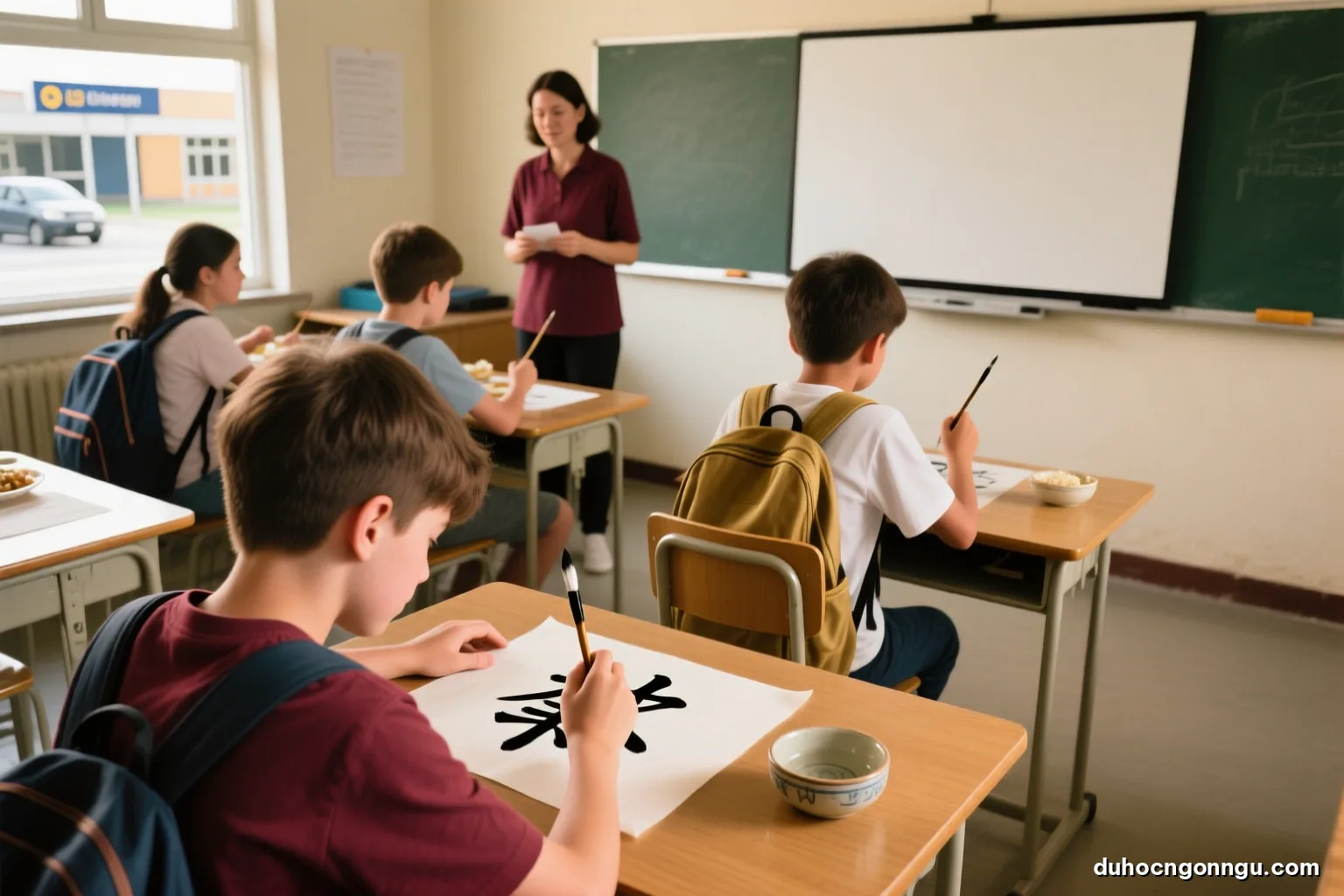
Handwriting still has its own value. Handwriting helps remember how characters are built, their radicals and stroke order, and helps distinguish characters that look alike. For children aged 8–12 who are learning characters, a moderate amount of handwriting each week keeps this foundation. There is no need to copy each character dozens of times; writing it a few times from memory and checking is more useful than copying while looking.
Choose according to your child's plans. Students who study Chinese formally at school or plan to take a qualification with a writing paper need to keep up more handwriting. Students learning to communicate and read can lean towards recognition and typing. Choosing a level and keeping it up steadily matters more than choosing a high level and then giving up.
Reviewing characters with spaced repetition
The spacing effect, reviewing spread out over several sessions at intervals rather than all at once, is one of the most robust findings in the psychology of memory. A 2006 meta-analysis by Nicholas Cepeda and colleagues in Psychological Bulletin, pooling hundreds of experiments, showed that spaced review is retained longer than massed review. Applied to Chinese characters, you can work like this:
- Gather the list of characters your child learned on the course: from the coursebook, notebooks and tests. This is the store to keep; no need to add new characters straight away.
- Make review cards, on paper or in a flashcard app with spaced repetition. The front has the character; the back has pinyin, meaning and an example sentence your child has met.
- Review little but often, ten to fifteen minutes a day. Characters remembered are reviewed again after a longer gap; characters forgotten come back sooner.
- Review actively: look at the character and say its pronunciation and meaning before turning the card. Recalling it yourself works better than looking at the answer, according to findings on the testing effect in memory research.
- Add new characters slowly, only after most of the existing store has been reviewed steadily for a few weeks. Adding too fast makes the daily review load balloon and your child gives up.
Spaced repetition apps are convenient because they calculate the review schedule automatically, but paper cards divided into a few boxes by how well they are remembered do much the same job. What matters is regularity, not the tool.
Keeping tones accurate when nobody is correcting them
At the school abroad, teachers correct tones every day; at home, if nobody corrects them, your child's tones gradually drift without them noticing. Vietnamese speakers have the advantage of already being used to a tonal language, but that very familiarity can pull Chinese tones towards Vietnamese ones, for example the third tone of Mandarin being pronounced like the Vietnamese hỏi tone.
The most effective way to self-correct is shadowing: listen to a short sentence from a native speaker, pause, say it back exactly the same way, record it, then listen to the two versions side by side. Choose short sentences from old lessons or from a film your child likes. Five to ten sentences a day is enough. Reviewing in two-syllable pairs, such as two-character words covering all the tone combinations, helps your child keep how tones change next to each other, for example the tone sandhi when two third tones come together.
If possible, one online speaking session a week with a qualified teacher, asking the teacher to focus on correcting tones, keeps them up better than any self-study. If your child studied in Taiwan and then listens to mainland materials at home, or vice versa, they will notice that some words are read with different tones; that is a difference in standards between the two places, so choose the standard your child learned and stay consistent.
Listening to and reading Chinese at home
Besides reviewing characters and tones, your child needs enough listening and reading to keep the language alive. Some sources and how to use them:
- Graded Chinese readers. There are series written with a limited number of characters, with or without pinyin, for learners. Choose a level at which your child can read most of the characters without looking them up.
- Cartoons and children's programmes for ages 8–12, with Chinese character subtitles. Character subtitles help review character forms while listening.
- Channels about their interests for teenagers: food, sport, games, travel in Chinese. Listening to content your child enjoys lasts longer than listening to lessons.
- Songs help remember words and sentence rhythm, but note that in songs the tones are often masked by the melody, so do not use them for tone practice.
- Keep the writing system consistent. If your child learned traditional characters in Taiwan, choose traditional materials; if they learned simplified characters in mainland China or Singapore, choose simplified. Mixing the two systems while the foundation is still thin easily causes confusion.
Suggested time: fifteen to twenty minutes of listening or reading a day, plus ten minutes of character card review. With Chinese, the character review cannot be skipped, because characters do not maintain themselves through listening.
Using Sino-Vietnamese words properly when reviewing vocabulary
A large part of Vietnamese academic and abstract vocabulary has Chinese roots, so Vietnamese students can often guess the meaning of a Chinese word when they know the Sino-Vietnamese reading of each character: the character read "học" in Sino-Vietnamese appears in học sinh (pupil) and đại học (university); the character "quốc" appears in quốc gia (nation). When reviewing, linking characters with their Sino-Vietnamese readings helps remember meanings faster and longer, and helps guess the meaning of new words.
But this advantage has two traps. First, Sino-Vietnamese readings differ from Mandarin pronunciation; remembering the Sino-Vietnamese reading does not mean being able to say it in Chinese. Review must always include the Chinese pronunciation and tone. Second, some compound words look the same in writing but their meaning in modern Chinese has drifted from the corresponding Sino-Vietnamese word, or they are used in different contexts. When meeting a "familiar" word, still read the example sentence to be sure of the meaning.
For children aged 8–10, their Sino-Vietnamese vocabulary is still small, so the advantage is not yet large. For secondary school students, pointing out Sino-Vietnamese links when reviewing is a way to make Chinese feel less foreign, and it also enriches your child's understanding of Vietnamese.
Measuring how much your child has kept
After about three months, it is worth checking again to see whether the review schedule is working. A simple way is to use the list of characters learned on the course: choose a few dozen at random, have your child read the pronunciation and say the meaning, and count how many they recognise. Comparing with the check done right after returning shows which way things are moving. Do the same with a few short spoken sentences recorded so you can listen to the tones again.
If the family already plans for your child to take a Chinese qualification, the exam result is also a benchmark, but there is no need to sit an exam just to find out how much your child has retained. A home test with a list of familiar characters gives information more closely tied to the review.
Record the results in the same place each time, with the date and the number of characters on the list. After two or three times, the family will see a trend: which characters your child always remembers, and which they forget every time. The characters often forgotten usually have something in common, such as sharing an easily confused radical or being words that rarely appear in what your child reads, and knowing this helps choose a separate way of reviewing that group, for example putting them side by side to compare the differences.
The results are not for grading your child but for adjusting the review schedule: if recognition holds up well but tones have drifted a lot, put more time into shadowing; if many characters are forgotten, check whether your child is reviewing regularly or whether new characters are being added too quickly.
Frequently asked questions
Our child studied Chinese for four weeks. How many characters should they review a day at home?
Rather than setting a fixed number of characters, set a fixed time, ten to fifteen minutes a day, and let the spaced repetition schedule decide which characters to review. In the first few weeks, mainly review characters learned on the course; only add new ones once reviewing the existing store has become a habit.
Our child can only listen and speak and cannot read characters. Do they need to learn characters?
If your child plans to study Chinese long term, they should start learning characters, because without reading it is hard to keep learning independently, and listening and speaking also struggle to reach a high level. For young children learning just for fun, you can start with a few dozen of the most familiar characters, alongside comics with pinyin, so your child gradually gets used to them.
Should we use a lot of pinyin, or will it make our child lazy about remembering characters?
Pinyin is a necessary sound-recording tool for learning pronunciation and typing. The problem only arises when reading material always has pinyin over every character, so the eyes read the pinyin and skip the character. Once your child recognises some characters, choose materials with pinyin only for difficult characters.
After a course in Taiwan, should our child switch to simplified characters at home?
There is no rush. If your child's foundation in traditional characters is still thin, continuing with traditional characters for a while to consolidate before getting used to simplified ones causes less confusion. People who can read traditional characters usually find it not too hard to switch to simplified; the other way round is slightly harder.
Without a teacher, how can we tell whether our child's tones are correct?
Recording your child speaking and comparing it with the native speaker's original is the most effective way to self-check. Some speech recognition apps also help spot clear mistakes. Even so, a session with a qualified teacher every week or two keeps tones better than any self-practice.
Our child studies both English and Chinese. How should they divide their time after returning?
Prioritise the language your child has just studied intensively on the trip, because that is what fades fastest in the first three months, but still keep a small amount for the other one. For Chinese, do not cut the character review; for English, do not cut the listening. The two languages do not get in each other's way if time is clearly divided.