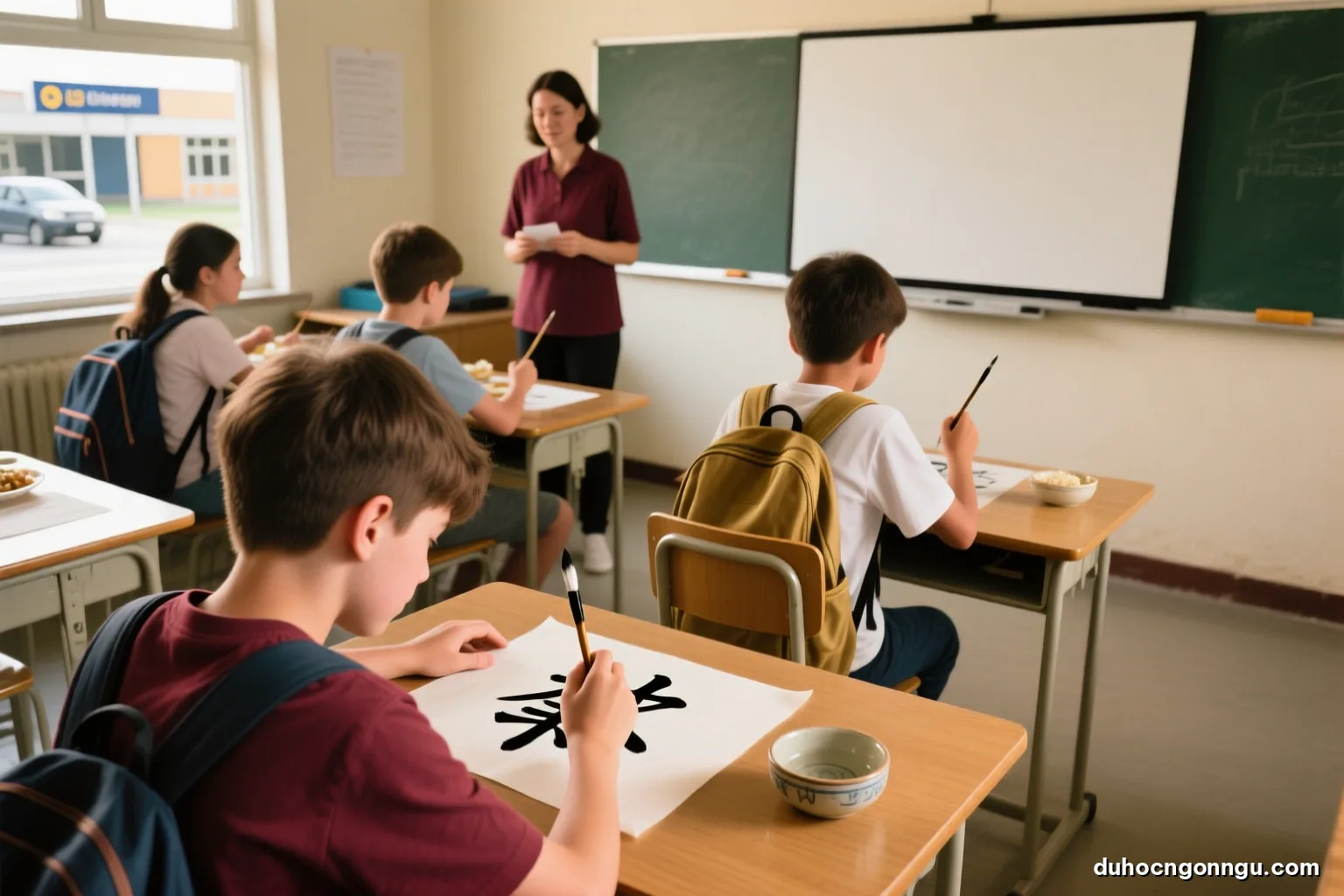
After coming home and using the foreign language less, what fades first is usually speed: the speed of keeping up with fast speakers and the speed of finding words when speaking. Comprehension, the vocabulary recognised when listening and reading, and knowledge of grammar last much longer. Most of what is "forgotten" is actually still in memory but hard to call up, so when the language is used again, learners get it back much faster than when they first learned it.
These conclusions come from a field of research called language attrition. Most of the data come from long-term learners or people who lived abroad for many years, with few studies specifically on courses of a few weeks, so they should be read with moderation when applied to your child's summer course. This article goes through the main studies, pointing out what they show and what remains uncertain.
From the forgetting curve to a field of its own
In 1885, the German psychologist Hermann Ebbinghaus published a book on memory in which he memorised strings of nonsense syllables himself and measured how much he still remembered after different intervals. The result was the famous forgetting curve: much is forgotten immediately after learning, and then forgetting slows down. He also used a subtler measure called the savings method: even when he could not recall a string, relearning it was still faster than learning a new one, showing that traces remained in memory.
Nonsense syllables are very different from real language, which has meaning, structure and is used in daily life. Research specifically on language attrition only took shape around 1980, when a conference at the University of Pennsylvania brought together researchers interested in how people lose languages; the proceedings, edited by Richard Lambert and Barbara Freed, were published in 1982 under the title The Loss of Language Skills.
Since then, the field has studied both directions: migrants gradually losing their mother tongue, and foreign language learners gradually losing the foreign language when they stop using it. The second direction is the one relevant to students coming back from a language course. Researchers such as Kees de Bot in the Netherlands, Monika Schmid and many others have helped show that losing a language is not like deleting data, but closer to the paths to the data becoming blurred.
Bahrick's fifty-year study of Spanish
The most cited study on retaining a foreign language over a long period is Harry Bahrick's 1984 paper in the Journal of Experimental Psychology: General. He tested hundreds of Americans who had learned Spanish at high school or university, from a few months to about fifty years after they had studied it, most of whom had hardly used the language again after leaving school.
The results had a clear shape. Most of the loss happened in the first three to six years after stopping. After that, what remained stayed almost unchanged for many decades, only declining further in old age. Bahrick called this durable portion permastore, roughly a near-permanent memory store. The strongest predictor of how much remained was how far the person had learned in the first place: those who had studied for many years and achieved high grades retained much more than those who had only taken one or two courses.
Two things are worth remembering when applying these findings to students on summer language courses. First, the people in the study learned in classrooms, mainly reading and writing, which differs from learning in a speaking environment. Second, the most useful message is fairly clear: how far one has learned largely decides how much is retained. A short language trip within a long learning process will last much better than a trip that stands alone.
Which skills fade first, and which last
Drawing together the studies on foreign language attrition, the overall picture is fairly consistent, although the degree varies greatly between individuals.
| Area | Tendency when use stops | Why |
|---|---|---|
| Speed of understanding fast speakers | Fades fairly early | Needs continuous practice to process sounds automatically; without listening, processing goes back to slow and conscious |
| Fluency when speaking | Fades early and noticeably | Finding words and building sentences quickly is an automated skill that needs regular use to maintain |
| Vocabulary recognised when listening and reading | Much more durable | Recognising a word is easier than producing it; the memory trace is still enough for recognition |
| Vocabulary actively used in speaking and writing | Fades faster than recognised vocabulary | Has to be retrieved unaided, without external cues |
| Knowledge of grammar | Fairly durable, especially structures learned thoroughly | Learned systematically, linked to many examples |
| Accuracy when speaking fast | Declines as fluency declines | When speaking slowly and with effort, learners easily make mistakes in places that were previously automatic |
There is a long-standing hypothesis that what is learned last is lost first, an idea Roman Jakobson put forward in 1941 when discussing language disorders. Applied to foreign language attrition, the evidence for this hypothesis is mixed; it holds in some areas, such as difficult structures learned last, and not in others. Treat it as a suggestion, not a law.
Really forgotten, or just hard to call up?
The access hypothesis. Many researchers believe that most attrition is because accessing knowledge becomes harder, not because the knowledge is lost. The evidence is that learners often recognise a word correctly when they meet it again, even though they could not recall it themselves, and just a few minutes of renewed immersion brings many words "back".
The savings effect when relearning. Following Ebbinghaus's idea, Kees de Bot's group tested people who had used a foreign language as children while living abroad, then returned home and almost completely forgot it. When relearning words they had once known, they remembered them faster than new words they had never met. In practical terms, this means what your child gained on the trip is not wasted, even when it has faded.
Languages compete with each other. The language used every day, here Vietnamese, is always more readily available. When the foreign language is used less, the threshold for calling it up gradually rises. This is why a child in their first week back still comes out with English naturally, but a few months later has to think in Vietnamese first and then translate.
What it means for families. The goal of keeping up the language is not to prevent all fading, but to keep the access paths in use, so that speed does not drop too far, and so that if it does fade, it can be recovered quickly.
Factors that make a foreign language fade faster or slower
The factors below come up repeatedly in research on foreign language attrition, with varying strength of evidence:
- Level when use stopped. The strongest evidence: those who reached a higher level retain more and for longer. Some argue there is a threshold level beyond which most of it becomes durable, but there is no agreement on where that threshold lies.
- Age. Studies following children who returned home after a period abroad often find that younger children lose the foreign language faster than older children and teenagers, contrary to the idea that "young children learn fast, so they remember long".
- Literacy in the language. Children who can read and write the foreign language usually retain it better than those who only listen and speak, perhaps because writing provides an extra anchor and because they can read on their own when back home.
- Length and intensity of study. Studying for a long time with plenty of exposure builds a firmer foundation; a short course creates speed that fades easily without follow-up study.
- Whether exposure continues. Even a small but regular amount of exposure, such as daily reading and listening, slows attrition considerably compared with stopping completely.
- Attitude and motivation. People who still want to use the language and remain connected to people who speak it usually retain it better. This factor is hard to measure but is mentioned in many studies.
What about courses of a few weeks: what can be inferred, and the limits
Almost all the data above come from people who studied for many years or lived abroad for a long time. Studies specifically following students after a language course of a few weeks are still scarce, so there are no reliable figures on "after so many months, so many per cent is lost". Figures like that appear on some advertising websites without sources, and should not be used to make decisions.
What can be cautiously inferred is this: what a short course changes most, namely fluency and listening speed, belongs to the group that fades earliest when use stops. So without any follow-up, the most visible part of the trip is also the part most likely to fade in the following months. In contrast, new understanding of the language, the vocabulary your child learned and confidence in using the language are likely to last longer.
There is also some comfort: according to the savings effect, what has faded can still be recovered quickly when your child returns to an environment where the language is used, whether another course or another summer. A series of study trips a year apart, with maintenance in between, builds a much more durable foundation than the total time of the individual trips added together.
What research suggests families should prioritise
Putting these findings side by side, an order of priorities emerges for when your child has just come home:
- Keep up speed first. Because listening and speaking speed fade earliest, the most important thing is to keep your child listening to real language regularly and having chances to speak, even a little.
- For young children, add reading. Because young children lose the language more easily and writing helps retention, children aged 8–10 should read English books at a suitable level after the trip, not just listen and watch.
- Raise the level to a more durable point. Because level decides retention, treat the trip as one step in a long process with follow-up study, rather than a stand-alone event.
- Keep the connection. International friends, hobbies that use English and topics your child loves in English keep up motivation, a factor many studies mention.
- Do not panic when it fades. If after a few months your child speaks more slowly, that is the access paths blurring, not effort wasted. A period of intensive use will bring most of it back.
Frequently asked questions
Our 9-year-old studied abroad for three weeks. How long before they forget?
There is no reliable general figure for this case. According to research, young children usually lose a language faster than teenagers if they do not keep using it, and what fades first is fluency in speaking. If your child keeps listening to and reading English regularly, most of it will be kept, and what fades can be recovered fairly quickly.
Do adults retain a foreign language longer than children?
Many studies show that adults and teenagers retain a learned foreign language better than young children when they stop using it, partly because they can read and write and have systematic knowledge of the language. This does not contradict the fact that young children have an advantage in accent when immersed in the language over a long period.
If our child has forgotten a lot, does relearning mean starting from scratch?
Usually not. The savings effect shows that what was once learned leaves traces, so relearning is faster than learning anew. When having your child placed in a class again, give them a few weeks of renewed immersion before the test, because a test straight away will underestimate what they actually still have.
Our child understands when listening but cannot speak any more. Is that laziness?
Usually not. This is exactly the most common form of attrition: comprehension lasts longer than the ability to produce words when speaking. Your child needs regular chances to speak to retrain the retrieval paths, not blame. Short, low-pressure conversations help more than asking your child to speak English in front of a crowd.
Will learning Chinese as well make our child forget English faster?
There is no clear evidence that learning another language makes you lose the first, as long as the first is still used. What really makes English fade is less time spent using English. If Chinese is added while English listening and reading time is kept, the two languages can develop together.
Should our child go on a language trip every year so as not to forget?
A series of intensive study periods at regular intervals, with maintenance in between, is a good way to build a durable foundation, because each trip helps recover what has faded and raises the level. But trips do not replace daily use of the language at home; without that, each year has to start the recovery from the beginning.