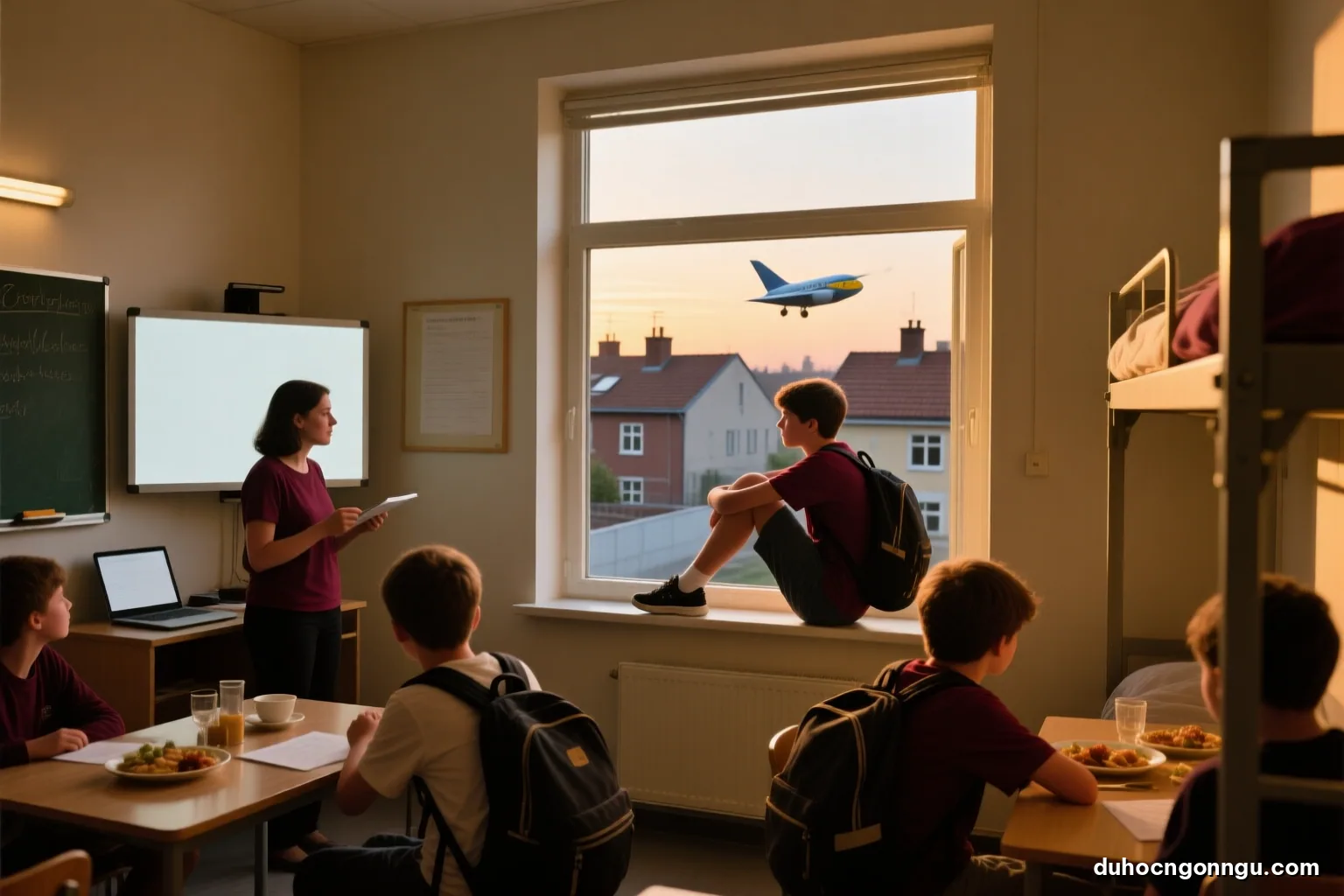
Homesickness is a normal and common reaction when children are away from their families, and is usually strongest in the first few days before easing as your child gets into the rhythm of the new routine. On a language trip abroad, it is easily heavier than at a camp in Vietnam because your child has to cope at the same time with a language they are not yet fluent in, unfamiliar food, jet lag and tiredness after a long flight. Most children get through it; what parents do beforehand and during the first week has a big effect on whether they get through it quickly or slowly.
The most cited document on this subject is the clinical report "Preventing and Treating Homesickness" by Christopher Thurber and Edward Walton, published in the journal Pediatrics in 2007 on behalf of the American Academy of Pediatrics. The article below is based on the report's main recommendations and on experience of organising language trips; it does not replace the advice of a psychologist when your child shows worrying signs.
What homesickness is, and why it is not a sign of weakness
In studies of children at summer camps and boarding schools, homesickness is described as feelings of sadness, worry and preoccupation with home caused by separation from loved ones and familiar surroundings. It is not just "missing mum and dad": many children miss their own bed, familiar meals, familiar voices and the feeling of being understood without having to explain. The intensity ranges from a passing sadness before bed to severe anxiety affecting eating, sleeping and study.
Thurber and Walton's report stresses that mild to moderate homesickness is common, and that the very experience of getting through it has developmental value: children learn how to soothe themselves, find new sources of support and trust in their ability to adapt. Treating homesickness as something shameful, or conversely as a sign they must be brought home immediately, both lose that opportunity.
On a language trip there is an extra layer that researchers of intercultural mobility call culture shock. The anthropologist Kalervo Oberg used this term in a 1960 article to describe the unease felt when familiar cues in social interaction suddenly disappear. The U-curve model, associated with Sverre Lysgaard's 1955 research, suggests that newcomers go through excitement, then disappointment, then adjustment; however, later studies show that not everyone follows that curve, so it should only be seen as a way of picturing things, not a fixed timetable.
What makes homesickness heavier on a language trip
Tiredness and jet lag. Your child is short of sleep after the flight, wakes in the middle of the night by local time, and negative feelings are much stronger when the body is tired. Many tearful episodes on the first two or three nights are largely caused by tiredness.
Not being able to say what they need. At home your child can express themselves; here they have to think about every sentence. The feeling of not being understood makes them withdraw, and talk even less with the adults at the school.
Expectations that are too high. Your child imagines the trip will be all fun and new friends. When the first days are all procedures, level tests and strange meals, the gap between expectation and reality leaves them deflated.
The first long time away from home. Children who have never slept away from home for more than a night or two have little experience of soothing themselves. This is a factor the family can prepare for in advance.
Too much contact. A phone lets your child call home at any time, and each long call can pull them out of the new environment, so that the homesickness is constantly fed again rather than fading.
Not being involved in the decision. Thurber and Walton's report notes that children who feel they took part in choosing the trip usually adapt better than those for whom it was arranged. A child sent away because the parents wanted it, not because they did, has a reason to be sad before they even leave.
Preparing from home: what to do in the months before
Most of the preventive effect lies in the period before departure. Steps that are well founded and doable:
- Let your child help choose the programme. Look at the school's materials with your child and let them choose between two or three options the family has shortlisted. A child who has a part in the decision takes some responsibility for it.
- Practise sleeping away from home first. A few nights at the grandparents', a school trip with an overnight stay, a short summer camp in Vietnam help your child know they can do it, and show the family how they react.
- Talk about homesickness beforehand. Say plainly that almost everyone feels homesick when away, that the feeling will ease, and that being homesick does not mean the trip has failed.
- Make a list of ways to self-soothe with your child. Writing a diary, listening to a familiar song, going for a run, talking with a roommate, reading letters from home. If your child comes up with the ideas, they will use them more easily.
- Let your child take a familiar object. A family photo, a small pillow, a shirt belonging to dad or mum. Such an object gives their feelings something to lean on.
- Agree a contact schedule in advance. Both the family and your child know when they will talk, so your child is not waiting for the phone all day.
These steps do not eliminate homesickness, and that should not be the goal. The goal is for your child to have tools, and for homesickness not to escalate into anxiety.
Common misconceptions and what to do instead
Some of parents' natural reflexes, though born of love, actually make homesickness last longer:
| Common reflex | Why it does not help | What to do instead |
|---|---|---|
| Promising "if you miss us too much, we'll come and get you" | Thurber and Walton advise against this pick-up promise because it signals that the parents do not believe the child can get through it, and turns every sad moment into a question of whether to go home | Say that if there is a serious health or safety problem, the family will decide together with the person in charge |
| Calling several times a day to give encouragement | Each call pulls your child back towards home, cutting into the time they spend connecting with friends and adults at the school | Keep to the agreed schedule, keep calls short, ask about what your child has done |
| Saying the house is so sad without them | Your child feels guilty for being away, adding guilt to homesickness | Say that everything at home is fine and the family looks forward to hearing your child's stories |
| Contacting the school yourself to change your child's timetable or room straight away | Your child has no chance to resolve things themselves, and the school loses the chance to do its job | Encourage your child to talk to the person in charge first; parents only step in when needed |
| Brushing it off: "there's nothing to cry about" | Your child feels misunderstood and will hide it next time | Name the feeling: "you're homesick, that's normal", then find something with your child to do today |
The hardest thing for many parents is bearing the feeling of helplessness when they hear their child crying far away. The parents' own calm on the phone is one of the things that helps the child calm down.
What adults at the destination can do that parents cannot
Parents far away can hear their child's voice but cannot sit beside them. The people who can are the school's staff, the group leader and the homestay hosts. Thurber and Walton's report also stresses the role of adults on the spot: a warm, attentive adult who keeps the child busy with activities and helps them connect with friends usually eases homesickness more effectively than any call from afar.
So when your child is homesick, one of the best things parents can do is quietly tell the adults on the spot, so that they keep a closer eye on your child for a few days: inviting them into a game, seating them next to a compatible friend, checking in on them before bed. At the same time, encourage your child to go to that adult themselves. A sentence like "try telling the supervisor, she has met lots of children like you" gives your child a way out and also helps them learn to ask for help in an unfamiliar place.
A Vietnamese-speaking group leader has a big advantage here with young children, because your child does not have to search for foreign words to talk about feelings. For children travelling alone to an international camp, ask the school in advance whether there are staff or students who speak Vietnamese; if not, teach your child a few simple sentences to say that they are sad and need someone to talk to.
When homesickness needs more intervention
Most cases of homesickness ease clearly after about a week, once your child has friends, is used to the routine and is sleeping normally again. However, some signs show that your child needs more support than encouragement over the phone: not eating for several days, prolonged insomnia, crying almost all day, not taking part in any activities, or saying things that suggest they feel hopeless or intend to hurt themselves.
When you see these signs, the first thing to do is tell the school's person in charge and the group leader if there is one, describing clearly what the family has observed in calls. A good school has student support staff or can connect with professionals locally. If your child has a history of anxiety or depression, also contact the professional following your child in Vietnam.
If your child says or does things that suggest a risk of self-harm, this is no longer homesickness but an urgent safety situation. Ask the school to have someone stay with your child immediately and take them to a medical facility. A decision to bring your child home in this case is reasonable and should be made together with the person in charge, the doctor and the group leader.
The last days and the trip home: homesickness in reverse
Something rarely mentioned is that many children, once used to the destination, become sad as the trip comes to an end. They have just made new friends from many countries and got used to independence, and now have to say goodbye. Back home, some feel deflated for a few weeks: home is the same as ever, friends at school do not understand what they have been through, and English or Chinese is no longer used every day.
Research on people returning after time abroad calls this reverse culture shock. After a course of a few weeks, it is usually mild and short. Parents can help by taking time to listen to their child's stories, letting them keep in touch with international friends within safe limits, and finding an activity at home where they can keep using the language.
How parents welcome their child home also matters. Instead of immediately asking "how was the end-of-course test?", ask what they remember most, who their closest friend was, and what surprised them. Your child's story of the trip, including the homesick days, is part of what they bring back.
Frequently asked questions
Our child calls home crying on the very first night. What should we say?
Listen to your child, name their feeling, and remind them that everyone finds it hard to sleep on the first night somewhere new and that tiredness after the flight makes everything heavier. Ask them to do one small thing right away, such as having a drink of water, telling the supervisor or reading the letter from home. Keep the call short and end it with the time of the next call.
Should we let our child video call every evening?
It depends on age and personality, but for many children a long video call every evening keeps homesickness from fading. A sparser schedule of short calls, with messages and photos in between, usually gives your child time to connect with new friends. If the school has rules on phone times, respect them.
Our child has not called home for several days. Should we worry?
It is usually a good sign: your child is busy and happy. However, if you agreed a schedule and your child has not called, ask the group leader or the person in charge for reassurance. Avoid scolding your child when they do call, or they will see calling home as a heavy obligation.
Are younger children more prone to homesickness than teenagers?
In general, younger children and those away from home for the first time are more prone to homesickness, but teenagers are not immune, especially when something is going on at home or at school. Previous experience of being away, personality, and whether your child wanted to go matter more than age.
Should we send letters or presents to the school for our child?
A handwritten letter or short card can be a good anchor, especially when written cheerfully about ordinary things at home. Ask the school for the address and how long post takes, because on a short course a letter may arrive after your child has left. Another option is to write a few letters in advance and have the group leader hand them to your child on particular days.
If our child insists on coming home, what should the family do?
First talk with the person in charge and the group leader to understand the real situation: is your child eating and sleeping, attending lessons, has anything happened? If it is only homesickness, many children feel better after a few days of support. If there is a serious safety, health or psychological problem, bringing your child home is a reasonable decision.