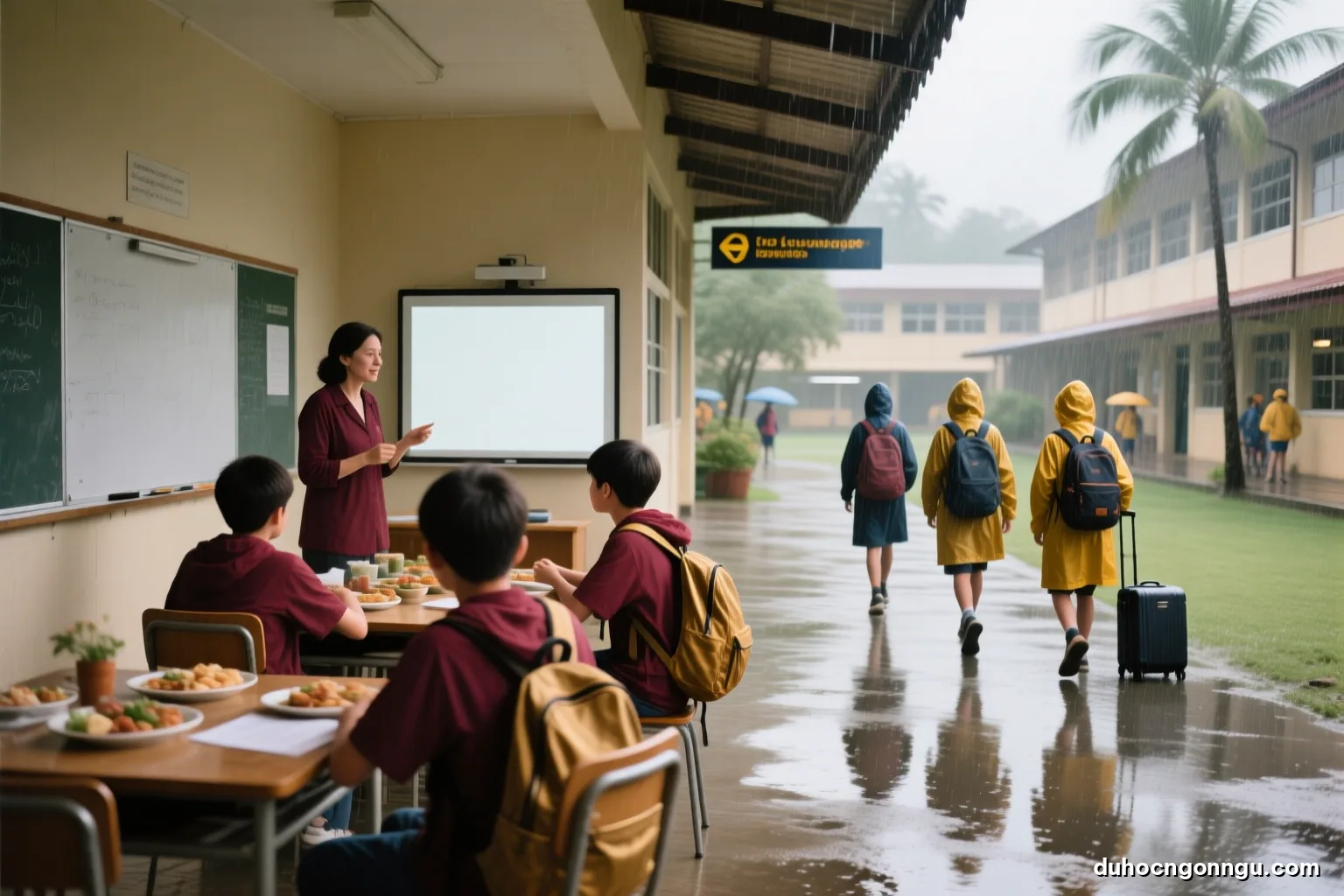
The Philippines has two main seasons: the dry season from about December to May, hottest in its last three months, and the rainy season from about June to November, when tropical storms pass through most often; since the Vietnamese school summer holiday runs from June to August, most Vietnamese children who study English there go right in the rainy season. That does not mean they should not go, but that you need to choose a place and a school experienced in handling the weather, and prepare your child properly.
Beyond the weather, your child's health in a tropical country carries risks familiar to Vietnamese families, such as heat, mosquitoes and unfamiliar food, and one risk few people think of: earthquakes. This article goes through each of them practically: what can happen, what schools usually do, what the family should prepare, and when your child needs to see a doctor.
Official weather information and disaster warnings for the Philippines are published by the weather agency PAGASA and the volcanology and seismology institute PHIVOLCS. Before and during the trip, follow these sources together with announcements from the Vietnamese Embassy in the Philippines.
The two seasons and what they mean for a course
The Philippines lies entirely in the tropics and is hot and humid all year round, so the difference between seasons is mainly rainfall rather than temperature. The dry season is usually pleasant in its first months, then gradually gets hotter, and from around March to May it is sweltering in the lowlands. The rainy season brings heavy downpours, usually in the afternoon, interspersed with sunny days.
On a residential course, the rainy season has little effect on lessons because classrooms and dormitories are on the same campus and your child does not have to travel. The most visible effect is on weekend activities: trips to the beach or islands and outings may be cancelled or postponed, and days of continuous rain can leave your child bored. A good school will have a plan for indoor alternatives.
Each region is different. The western side of Luzon, including Manila, the Clark area and Baguio, has the most marked rainy season around the middle of the year. Some areas in the centre and east of the country have a different rainfall pattern. Baguio, in the mountains, gets a great deal of rain in the rainy season, sometimes for days on end. When choosing where to study in summer, ask the school about the typical weather for the exact weeks your child will be there, rather than just hearing "the Philippines is warm and sunny".
Typhoons: how schools handle them and what the family needs to know
Typhoons are a familiar part of life in the Philippines. The Philippines lies in the path of many storms that form in the western Pacific each year, most often from about July to October. Most typhoons bring a few days of wind and rain and then pass; a few cause serious damage in the areas where they make landfall directly.
A tiered warning system. PAGASA issues wind signal warnings in rising levels for each area. At the higher levels, local authorities usually close schools and residents are advised to stay indoors. Language schools usually follow these announcements to cancel outdoor activities or suspend classes.
Questions to ask the school. During a typhoon, does the school have a generator, does it keep stocks of water and food, where do students go if the dormitory is affected, and through which channel does the school inform parents? Long-established schools usually have clear procedures because they have been through many typhoon seasons.
Effects on flights. Typhoons can cancel or delay the flight home. Choose a ticket that allows date changes and travel insurance that covers weather-related delays and cancellations. Tell your child that if the flight is cancelled they should stay put and wait for the school and the family to make arrangements, rather than trying to sort things out alone.
Choosing when to go: the factors to weigh
The table below summarises the factors linked to timing, to help the family decide when your child's schedule allows a choice.
| Period | General weather | Students at the school | Notes |
|---|---|---|---|
| June to August (Vietnamese summer) | Rainy season, typhoons | Many Vietnamese pupils; in July and August, also pupils from other countries on summer holiday | Book early, ask about the nationality mix |
| September to November | End of the rainy season, still typhoons | Few school pupils, many adults | Suits university students and working adults |
| December to February | Start of the dry season, pleasant | Many students from countries with a winter holiday | Clashes with the school year in Vietnam |
| March to May | End of the dry season, hottest | Varies from school to school | Watch out for heatstroke; an air-conditioned room is needed |
For school pupils, the holiday calendar in Vietnam usually decides instead of the weather. When you cannot choose the month, choose the place and the school to compensate: Baguio is cool but very rainy, while the lowlands are hot but less prone to the transport disruption of mountain roads.
One point few people notice is Philippine public holidays. National holidays that fall during the course may mean the school cancels classes or changes the schedule, and the big end-of-year holidays make airports and roads busier. Ask the school for the holiday calendar during your child's exact study period, so you can count the real number of study days and book tickets that avoid peak dates.
Heat and dehydration: an often underestimated risk
Vietnamese children are used to heat, so parents rarely worry about this. But at school, your child studies in an air-conditioned room and then steps out into a sunny courtyard, plays sport at midday, goes on outdoor excursions all day, and often drinks less water than at home because nobody reminds them. That combination easily leads to dehydration, tiredness, headaches and, with vigorous activity in strong sun, heatstroke.
Prevention is simple: bring a personal water bottle and build the habit of drinking regularly, wear a hat, put on sunscreen when going out and avoid strenuous activity at midday. The school is responsible for scheduling outdoor activities at cooler times and giving breaks in the shade; ask the school about this, especially for teenage camps in the hot season.
Signs to watch for in children: unusual exhaustion, headache, dizziness, nausea, hot skin and passing little urine. When these signs appear, take the child to a cool place, give them water and tell the guardian or medical staff. If the child is drowsy, confused, stops sweating while hot, or has a seizure, it is an emergency and they need to go to hospital immediately.
Mosquitoes, food and drinking water
Dengue fever is endemic in the Philippines as in Vietnam, and the rainy season is when mosquitoes multiply. There is no foolproof prevention, but reducing mosquito bites reduces the risk: apply repellent when going out in the early morning and late afternoon, wear long sleeves on outings, and sleep under a net or in a room with screens. For vaccinations, ask a doctor or vaccination centre in Vietnam a few weeks before the trip.
Stomach upsets are common for newcomers to an unfamiliar place; most are mild and clear up on their own within a few days. Tell your child to drink bottled water or the school's filtered water, limit undercooked street food and wash their hands before eating. If diarrhoea goes on for a long time, contains blood, comes with a high fever, or your child cannot keep water down, they need to see a doctor rather than treating it themselves.
If your child has an underlying condition such as asthma, allergies, heart disease or diabetes, ask the treating doctor before booking the course whether the trip is suitable, what medicines to bring and what the backup doses are, and give the school a summary in English. Do not leave the guardian to guess when something happens.
Children in an unfamiliar place sometimes hide being ill because they are afraid of worrying their parents or of being sent home. Tell your child clearly before departure that reporting illness early is the right thing to do, and agree with the guardian that the family will be informed every time your child sees a doctor.
Earthquakes and volcanoes: understanding them so as not to panic
The Philippines lies on the Pacific Ring of Fire, where tectonic plates meet, so it has frequent earthquakes and a number of active volcanoes. Most earthquakes are small, and people indoors sometimes do not feel them. Large ones are rarer but do happen, and people and schools in the Philippines are trained to respond.
Parents do not need to worry excessively, but should ask whether the school holds earthquake drills and whether new students are briefed. The basic principles your child should know in advance: when the shaking starts, drop, cover your head and hold on to something solid such as a table, and stay away from glass windows; do not run outside while it is shaking; only after the shaking stops, follow the evacuation route to the assembly area.
Information on earthquakes and volcanic activity is published by PHIVOLCS. If the school area is near a volcano under monitoring, the school and local authorities will have specific instructions. For families in Vietnam, on hearing news of an earthquake in the Philippines, the best first step is to contact the school's guardian, because early news is often unclear about which areas are affected.
A step-by-step health plan for the trip
Bringing the sections above together into a sequence for the family to follow:
- Six to eight weeks before: a general health check if needed, and ask the doctor about vaccinations and medicines to bring.
- Four weeks before: buy travel insurance with medical cover, repatriation and weather-related cancellation; read the exclusions carefully.
- Two weeks before: write a health summary in English, prepare a medicine bag with original labels, sunscreen and mosquito repellent.
- First day at the school: your child knows where the clinic is, who the guardian is and the school's emergency phone number.
- During the course: a regular schedule for calling home, and remind your child to report illness straight away rather than hiding it for fear of worrying their parents.
- In a typhoon or earthquake: contact the guardian, follow the school's instructions, and do not arrange travel on your own.
These steps do not make the trip completely safe, but they turn most unexpected situations into ones with a ready response. That is what lets both your child and you feel at ease for the whole course.
Frequently asked questions
Should we avoid the rainy season entirely when sending our child to study in the Philippines?
Not necessarily. Residential study is little affected by rain, and every year a great many pupils still study in summer. What matters is choosing a school with a typhoon procedure, a changeable ticket and suitable insurance, and accepting that some outdoor activities may be cancelled.
If a typhoon closes the school for a few days, will my child get make-up lessons?
Each school has a different policy. Some make up the lessons on other days or move classes into the dormitory if there is still power; some treat it as force majeure. Ask before registering and get the policy in writing.
Does my child need any vaccinations before going to the Philippines?
The Philippines does not usually require any special vaccine for visitors from Vietnam, but rules can change. Additional vaccinations, such as flu, hepatitis or others, should be decided by a doctor based on your child's vaccination history. Ask a vaccination centre a few weeks before the trip.
Is the food at the school safe?
The canteen at a residential school serves hundreds of students every day, so it usually has basic hygiene procedures. The risk usually comes from food bought outside on outings. Tell your child to eat cooked food, drink bottled water and tell the guardian about any unusual symptoms.
Should we pack fever and stomach medicine?
Pack a small bag of common medicines on the advice of a doctor or pharmacist, kept in boxes with the original labels. For children, the guardian should know what medicines your child has brought. Do not keep self-medicating when symptoms do not improve; at that point your child needs to see a doctor.
On hearing news of a typhoon or earthquake in the Philippines, what should the family do first?
Contact the guardian or the school office through the channel agreed in advance, then follow announcements from PAGASA, PHIVOLCS and the Vietnamese Embassy in the Philippines. Avoid calling your child repeatedly when the network may be overloaded; a short message asking whether they are safe is enough.