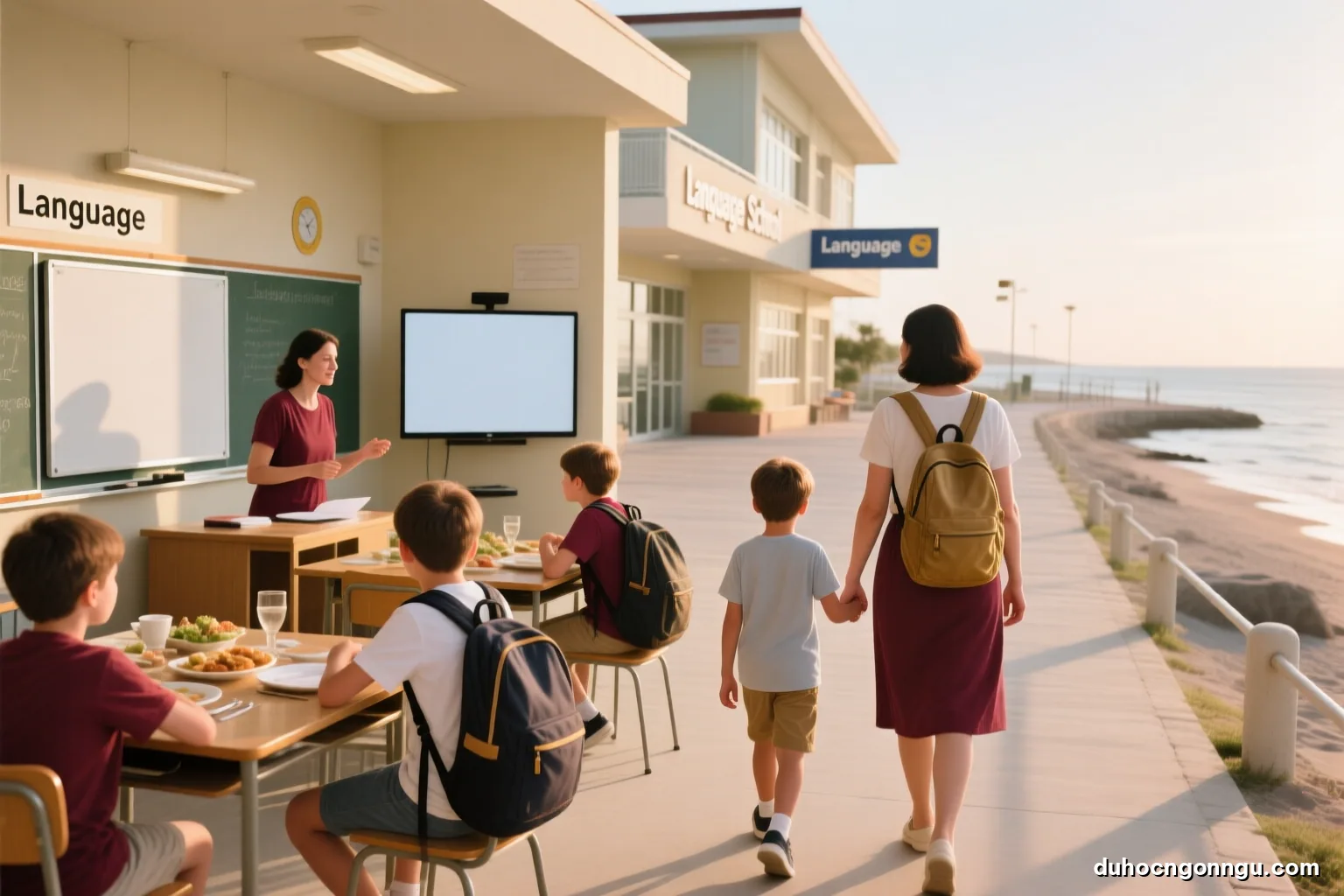
A summer language programme is a short language course, usually 2 to 8 weeks long, held abroad during the school summer holidays. In the morning your child has language classes grouped by level, in the afternoon and evening there are activities, and at weekends there are excursions; for the rest of the time your child lives somewhere they have to use the foreign language to eat, sleep, ask the way and make friends. There are three main types: residential camps (living in a dormitory with students from many countries), day classes with a stay in a local family's home (homestay), and courses for the whole family when parents come along.
What sets it apart from a language course at a centre at home is not the textbook but the number of hours your child is forced to use the language outside the classroom. A pupil who takes three extra classes a week at home gets a few hours of contact with English; a pupil at a summer camp listens and speaks almost all day, including when they are tired and when they would rather not. The sections below explain each format, the ages camps usually accept, what a course is made of, and the questions parents should answer for themselves before they start looking for a programme.
How a summer language programme differs from learning at home
In Vietnam, a secondary school pupil's English lessons stay neatly inside the classroom: the teacher asks, the pupils answer, the bell rings and everyone goes back to Vietnamese. The language becomes a school subject, with tests and marks, but it is rarely a tool for getting something real done. A summer course abroad turns that ratio around: class time is only part of the day, and for most of the rest your child has to use the language to get by.
Language acquisition researchers describe this as the difference between learning about a language and using it in meaningful interaction. Michael Long's interaction hypothesis (put forward in the early 1980s and revised in 1996) holds that the moments when learners do not understand, have to ask again and have to rephrase so the other person understands are the moments when language is processed most deeply. At a summer camp, moments like these happen dozens of times a day: asking the dining hall staff what is in a dish, explaining to an Italian roommate that you want to turn the light off, negotiating a football schedule with a group of Spanish friends.
So the right question when comparing programmes is not "where are the teachers better" but "how many hours a day will my child actually have to listen and speak, with whom, and about what". A good summer camp is one that answers that question with concrete numbers in its timetable, not just with advertising about a "native-speaking environment".
The three common formats of summer language programmes
Almost every summer language programme for ages 8–17 falls into one of the formats below, or combines two of them. The table compares them on the points parents ask about most; each type is covered in more depth in other articles in this topic.
| Format | Where your child stays | Who supervises outside class | Suits |
|---|---|---|---|
| Residential camp | A dormitory on a school campus or a boarding school closed for the summer | Camp staff living in the same building, with evening room checks | Children already used to sleeping away from home who enjoy group life and need a full daily schedule |
| Day classes, staying in a homestay | A local family's home, travelling to school by public transport or a school shuttle | The host family in the evening; the school during classes and activities | Older, independent students who want to hear everyday English around the dinner table |
| Course for the whole family | An apartment, hotel or homestay where the whole family stays together | Parents | Young children travelling far for the first time, or families who want the parents to study too |
| Day course for children staying with relatives abroad | The relatives' home | The relatives | Families with relatives in an English-speaking country who only need classes and daytime activities |
Some camps combine two types: the first week in a dormitory to settle in, the following weeks in a homestay, or the other way round. Many camps also put residential and homestay students in the same classes, so the real difference lies in the evenings and weekends.
What a summer language course usually includes
A placement test. On the first day, or before departure as an online test, your child takes a grammar and vocabulary test, often with a short speaking part as well. The result is used to place them in a class at the right level; many schools map it to the levels of the Common European Framework of Reference (CEFR), from A1 to C1. The purpose is to put children in classes that suit them, not to mark or rank your child.
Morning lessons. The core is the English lessons, usually counted in "lessons" of 45 or 60 minutes. A standard summer camp programme typically has 15 to 20 lessons a week; intensive courses have more. Classes are usually small groups of students of many nationalities, and teachers work through projects or weekly themes.
Afternoon activities. Sport, art, drama, short film-making, hands-on science or a visit to a place in the city. This is when the language is really used, so good camps have activity staff who speak English with the students rather than just standing by and watching.
Evenings and weekends. Group games, talent shows, quiz nights; at weekends there is a full-day or half-day trip. For homestay students, the evening is dinner with the family.
End-of-course assessment. Most camps give a certificate of completion showing the number of hours and the level your child was placed at, together with the teacher's comments. This certificate confirms that your child took part; it is not equivalent to an international certificate such as Cambridge's.
The ages summer language camps usually accept
Most "junior" programmes in English-speaking countries take students aged roughly 8 to 17; some camps accept children from 7, others only from 12 or 13. Within a camp, students are usually divided into groups of similar ages, so that a 9-year-old does not end up in the same class as a 16-year-old just because they share a level. From 16 or 18 upwards, learners move on to adult courses, which are freer and have no evening supervision.
The minimum age is usually tied to the type of accommodation. Residential camps for young children need more staff per student, so not every camp takes children under 10. Homestays for students travelling alone are usually only open from 12–14 upwards, because the child has to get around by themselves. Family courses take very young children because the parents are there.
The figure printed in the enrolment brochure is only the threshold the camp accepts. Whether your child is ready also depends on whether they have slept away from home before, whether they can take care of their personal needs, and whether they want to go. How to choose for each age group is discussed in detail in the topic on choosing by age and goal.
What a summer language programme can and cannot give your child
Wrong expectations are the biggest source of disappointment after a summer. The points below are what a 2–8 week course usually can and cannot do, based on the general experience of the industry and on research into short study periods abroad:
- Usually achieves: your child gets used to hearing native speakers and friends from many countries; they respond faster when speaking and are less afraid of making mistakes; their everyday vocabulary grows (food, getting around, asking permission, inviting others); and most importantly, they see the foreign language as something that works in real life, not just something for tests.
- Usually achieves: a guided experience of independence, as your child has to manage their own belongings, timetable and pocket money under adult supervision.
- Do not expect: a jump of several levels in one short course. Accurate grammar and academic writing skills take much longer.
- Do not expect: the progress to last if your child stops using the language after coming home. Keeping the language after the trip is a job for the whole following school year.
- It is not: an exam preparation course. Some camps run separate exam classes for older students, but a standard summer camp leans towards communication.
In short: a good summer opens a door and changes your child's attitude to the language. Walking through that door is a longer road than one summer.
Four questions parents should answer before looking for a programme
Before comparing schools and countries, sit down with your child and answer these four questions. The answers will rule out most of the unsuitable programmes and help any advice session get straight to the point.
- What is the goal of this summer? To give your child a first taste, to build confidence in speaking, to prepare for longer study abroad later on, or simply a holiday with some learning? Each goal leads to a different format and length.
- Has your child ever slept away from home? If not, a family course or a camp with a group travelling together from Vietnam is a safer first step than an international residential camp where they travel alone.
- What is your child's current level? No certificate is needed, but you should know whether your child can understand simple questions and introduce themselves. Complete beginners can still go, but they need a camp with a class for beginners.
- How many weeks does the family have during the holidays? The summer holiday calendar in Vietnam, extra classes and school transition exams will decide how long the course can be and which month your child can go.
Once these four questions are answered, choosing a country, choosing a school and setting a budget have something to rest on. Each of those steps has its own articles in the topics on choosing a school, preparing for the trip, and safety and guardianship.
Summer language programmes and long-term study abroad: where the line is
Many parents ask whether a summer course is a stepping stone to secondary school or university abroad later. It can be, but the two are different in nature. A summer course is a short language course; depending on the country, your child travels on a tourist visa or a visa for short courses, earns no credits and does not enter the formal school system. Long-term study abroad means enrolling in a school, following an academic-year programme, and needing a student visa and an academic application.
The value of a summer for long-term plans lies elsewhere: the family gets to see how the child adapts to living away from home, the child gets to try life in a country before committing several years to it, and both sides have real information to base a decision on instead of guessing. Some students go for one summer and come back very keen to study abroad long term; others realise they prefer to study at home and go on an exchange later. Both outcomes are useful.
If the family already has a long-term study plan, say so clearly when getting advice about a summer course, so that the country, city and type of school chosen are close to that plan. The team at duhocnganhan.com, the summer programme site run by Global Gate Pass, can send the timetable and rules of each course so the family can check them against the questions above.
Frequently asked questions
Does a summer language programme need a visa?
It depends on the destination and the nationality. Vietnamese students travelling to most English-speaking countries need a visa, usually a tourist visa or one for short courses. The exact type and documents change from country to country and from year to year, so check the website of that country's immigration authority as soon as you have chosen a programme.
Can my child go to a summer camp without knowing any English?
Yes, if the camp has a class for beginners and staff used to working with children who have little of the language. It helps to have your child study for a few months beforehand to learn the bare minimum, such as greetings, asking permission and saying they feel unwell, so the first week is less stressful and they dare to ask when they need to.
Does a summer course give a certificate?
Usually only a certificate of completion issued by the school, showing the number of hours and the level your child was placed at. This is not an international certificate. If your child needs a certificate such as Cambridge or TOEFL Junior, they have to register separately for the exam at a recognised exam centre.
Are there many Vietnamese students at summer language camps?
It depends on the camp and the week. Some camps publish their nationality mix or limit the number of students of the same nationality in a class. Ask for this figure for the exact weeks your child will attend, because the mix in July can be very different from August.
When should we start looking for a programme?
Summer camps in the Northern Hemisphere usually open enrolment from the end of the previous year, and residential and homestay places run out early in the peak weeks. Add the time needed for a visa, and families should start looking about six to nine months before the planned departure.
Should my child travel alone or with someone?
Young children usually travel in a group with a group leader, or with their parents on a family course. Older students can fly alone if the camp offers an airport pick-up and the airline offers an unaccompanied minor service. The document requirements for minors leaving the country should be checked with the immigration authority.