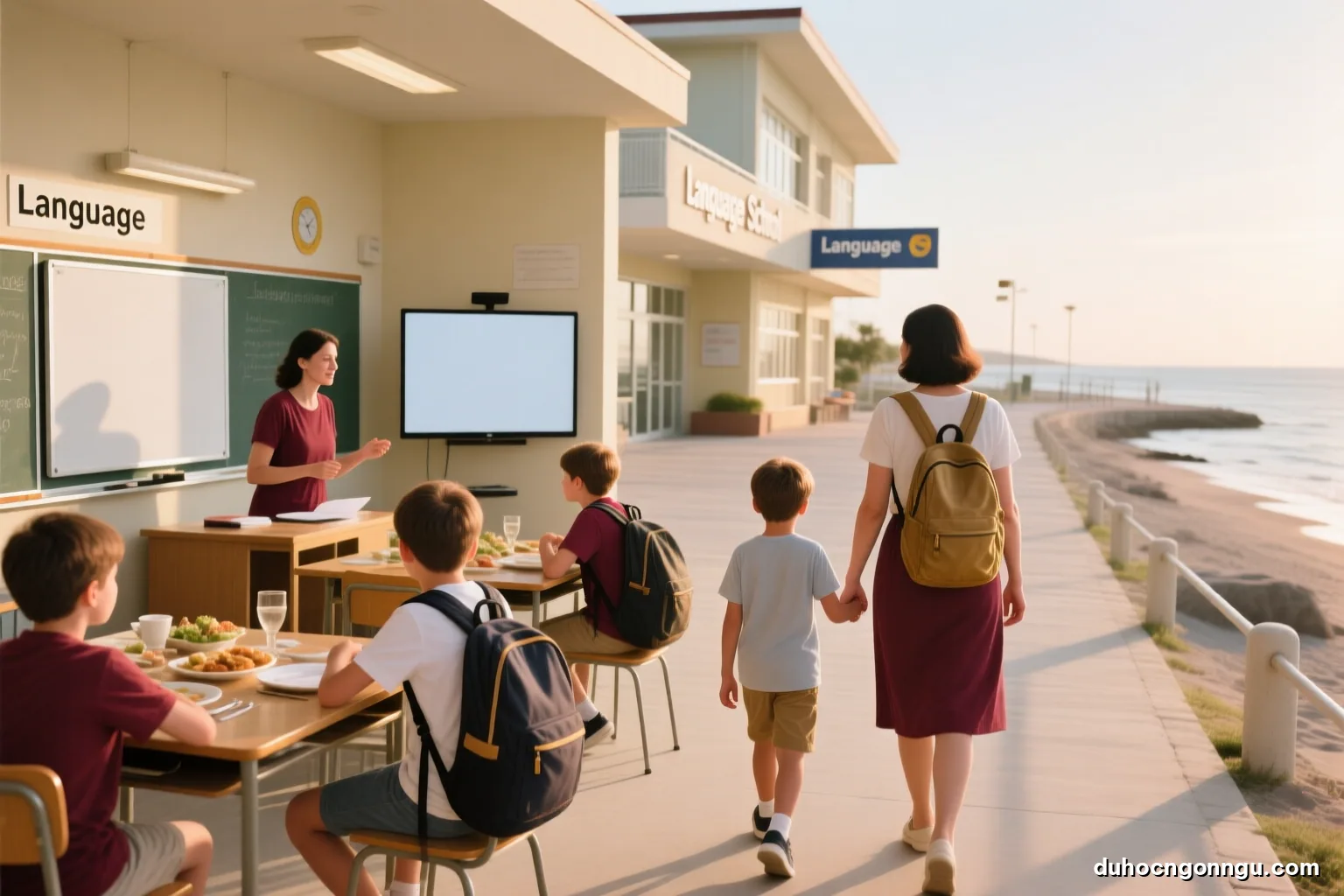
Yes. Most summer language camps accept students at every level, including complete beginners, and place them using a test on the first day. What your child needs is not to be "good at English", but to have a few minimum phrases to manage basic things and ask for help when needed: greeting people, introducing themselves, asking again when they do not understand, saying they are tired or where it hurts.
The real difficulty for children with little English is not in class, because the class has been matched to their level, but in the hours outside class, when everyone talks fast and your child cannot keep up. This article explains how camps usually place students, which level is enough to go alone and which level calls for someone to go with them, how to read levels on the CEFR framework, and what to do at home in the months before departure.
How summer camps place students
Most camps have students take a placement test, either online before departure or on the first morning. The test usually has a multiple-choice grammar and vocabulary section, sometimes a short reading passage, and a conversation of a few minutes with a teacher. The aim is to put students into classes of similar level within the same age group. It is not an exam, there is no pass or fail, and the results are not used to compare children with each other.
Many schools map the results onto the levels of the Common European Framework of Reference for Languages (CEFR), published by the Council of Europe in 2001 and updated by the Companion Volume in 2020. The framework divides ability into six levels from A1 to C2 and describes what a learner can do with the language rather than counting grammar points. Some schools use their own scale, such as "Beginner, Elementary, Pre-intermediate…", which broadly corresponds to the first CEFR levels.
During the first week, teachers observe further and may move your child to another class if the placement was not right. If after a few days your child finds the class too hard or too easy, encourage them to tell the teacher or the member of staff in charge. Changing class in the first week is normal at camps.
What the first CEFR levels say about a student
The table below gives a short interpretation of levels A1 to B1 in the spirit of the CEFR descriptors, applied to a summer camp setting. It is an interpretation, not the wording of the framework:
| Level | What your child can usually do | At a summer camp, your child will |
|---|---|---|
| Below A1 | Knows a few separate words, cannot yet put them into sentences | Need a lot of support; a family course or a group with a Vietnamese speaker is better |
| A1 | Introduces themselves, asks and answers very simple questions about familiar things if the other person speaks slowly | Keep up with a beginner class and manage basic things, but find group social time tiring |
| A2 | Talks about family, hobbies and daily routines; understands short, clear sentences | Take part in most activities and make friends, but still miss things when a group talks fast |
| B1 | Handles most situations while travelling, tells stories, gives short opinions | Fit into the camp quite naturally and make good use of theme sessions that need discussion |
If you do not know your child's level, you can ask their English teacher at school, or have your child take one of the placement tests many language schools offer free online. The result is only for reference; no certificate is needed.
The minimum to have before going alone
Introducing themselves and asking other people's names. These are the phrases your child will use most in the first week. Being able to say them fluently makes your child far more confident when meeting new friends.
Saying when they do not understand. Knowing how to ask someone to speak more slowly, repeat something or explain a word. This is the most important phrase for children with little English, because it turns every awkward moment into a chance to learn.
Saying what they basically need. Hungry, thirsty, needing the toilet, needing to call home, unable to find their room. Young children especially need to practise these phrases.
Saying when they feel unwell. Saying they have a headache or stomach ache, are allergic to a food, or are taking a medicine. Write the allergy and medication information in English on a card for your child to carry.
Understanding familiar instructions. Line up, stay with the group, meet at what time and where. Camp staff usually use short, repeated instructions, but your child needs to recognise them.
If your child is not there yet. They can still go, but choose a family course, a group with a group leader, or a camp experienced with beginners and with staff who keep an eye on each child.
Why the hours outside class are the hard part
In class, the teacher speaks slowly, uses familiar words and repeats when needed, because the class has been matched to your child's level. Outside class it is different. At the dining table, a Spanish and an Italian tablemate talk fast to each other in English and make jokes your child does not understand. During games, the rules are explained once and the game starts straight away. In the evening the group tells stories and laughs, and your child sits silently.
This is where children with little English easily withdraw, seek out students from their own country or sit with their phone. Not because they are lazy, but because constantly not understanding is exhausting. Fatigue from processing a foreign language all day is quite common among people who have just started living in a new language environment, adults included.
The way to help is to prepare your child with a few concrete strategies: sit next to a member of camp staff at the first meal, ask a friend to explain the rules of a game again, say straight out "I've just started learning English, please speak slowly for me". Children who have these phrases ready usually get through the first week better than children who are good at grammar but do not dare to speak.
Preparing at home three to six months before departure
There is no need for exam classes or a heavy study schedule. The things below, done regularly, help your child arrive at the camp in a better frame of mind:
- Listen every day. Twenty to thirty minutes of English your child enjoys: cartoons, videos about their hobbies, children's audiobooks. The aim is to get the ear used to real speed and real voices.
- Practise survival phrases. Together with your child, make a list of the fifteen to twenty phrases they will need most at camp, role-play them at home and swap roles for fun.
- Talk to strangers in English. One online speaking lesson a week with a teacher your child does not know helps them become less afraid of speaking to strangers.
- Learn camp vocabulary. Rooms, the dining hall, personal belongings, the activities your child has signed up for. Vocabulary on the right topics is more useful than general vocabulary.
- Practise looking after themselves. Organising belongings, getting up on their own, washing a few small items. With one less thing to worry about, your child has more energy for the language.
- Look at the camp information with your child. Photos of the campus, the weekly schedule, the names of the activities. Children who know what is coming are less overwhelmed.
Preparation is not about pushing your child up a level before departure, but about giving them enough tools to use in the first week. The real progress will come while they are at camp.
What if your child does well at grammar tests but cannot yet speak?
This is very common among Vietnamese students: high English marks at school, quick at multiple-choice tests, but flustered when they have to speak and unable to keep up with native speakers. A placement test weighted towards multiple choice can put your child in a class above their real listening and speaking ability, and in the first week they find the class talks too fast and classmates answer fluently while they are still translating in their head.
If your child is in this group, tell the camp when booking, or remind your child to tell the teacher during the placement conversation. Many teachers who are used to Asian students with a "strong at reading and writing, weak at listening and speaking" profile will take this into account when placing them or watch more closely in the first few days.
The good news is that this group usually progresses fast at camp. Your child already has the vocabulary and grammar and only lacks the chance to use them. After one or two weeks of constant listening and speaking, the knowledge already in their head starts to come out faster. Preparation at home for this group should focus entirely on listening and speaking and skip grammar exercises.
Which camps suit beginners
Not every camp does well with students at the earliest levels. When your child still has little English, prioritise camps with the following features:
- A separate class for complete beginners, rather than putting your child into a general elementary class with students who are already fairly good.
- Experience with young students who have little English, and the ability to describe specifically what they do in the first week for this group.
- Activity staff who are briefed to use simple language, give instructions with actions as well as words, and check that students have understood.
- A fixed group leader so your child knows whom to turn to when stuck.
- A varied nationality mix, but not so few Asian students that your child feels completely out of place.
- Afternoon activities based on movement or working with the hands, where your child can join in even before they can say much.
By contrast, academic courses, exam preparation courses, or themes that require a lot of discussion are usually not suitable for a beginner's first summer.
Children with little English sometimes gain the most
Something parents often do not expect: students at a low level when they go are frequently the ones who change most visibly after the summer, especially in listening comprehension and confidence in speaking. Some studies of short periods abroad, including work by Àngels Llanes and Carmen Muñoz (2009) on stays of three to four weeks, found that learners with a lower starting level often made more progress in some skills. These results come from small samples, so they should be read only as a trend.
The reason is easy to see. For a child already at B1, four weeks add to a fairly solid base. For a child at A1, four weeks are the first time English has become a real tool, the first time they have ordered food, asked the way or made a friend by themselves. Those first times change their attitude to the language completely.
So weak English is not a reason to wait. It is a reason to choose a sensible format, prepare more carefully and set the right expectations. Families who want to look at a programme with classes for beginners can see the short summer courses at duhocnganhan.com.
Frequently asked questions
My child has lost the basics of English. Should they catch up before going?
Some study is worthwhile, but there is no need to catch up on all the grammar. Focus on listening, basic conversational phrases and the vocabulary of daily life at a summer camp. Three to six months of a little every day is more useful than a crash course crammed into the last month.
Is an English certificate needed to book a summer camp?
Most summer camps for school students do not require a certificate. The camp does its own placement test. Some special themed or academic courses for older students may require a minimum level, in which case the camp will state it clearly in the booking conditions.
If my child is placed in a low class, should we ask for a change?
A class at the right level helps your child understand the lessons and dare to speak. If your child finds the class too easy after a few days, they should tell the teacher so a move can be considered. Do not push the camp to place your child higher just because you feel they have been underestimated, because a class that is too hard can easily leave your child silent for the whole course.
Are there older students in the beginner class at summer camp?
Camps usually divide classes by both level and age group, so students in a class are of similar ages. If a camp has few students at the earliest level, it may combine a wider age range. Ask the camp how they handle this for the week your child is going.
Should an introverted child with little English go alone?
They can, if the camp has staff who look out for new children and your child has prepared a few strategies for starting conversations. For a first trip, a group or a family course is usually gentler. What matters is that your child wants to go and understands that the first week will have difficult moments.
Does the placement test have any effect after the course?
The result is only used to form classes, and is sometimes shown on the end-of-course certificate of completion together with the level reached at the end. It is not an exam mark and is not used to rank students. How to read the school's results and comments is covered in a separate article in the section on measuring progress after the trip.