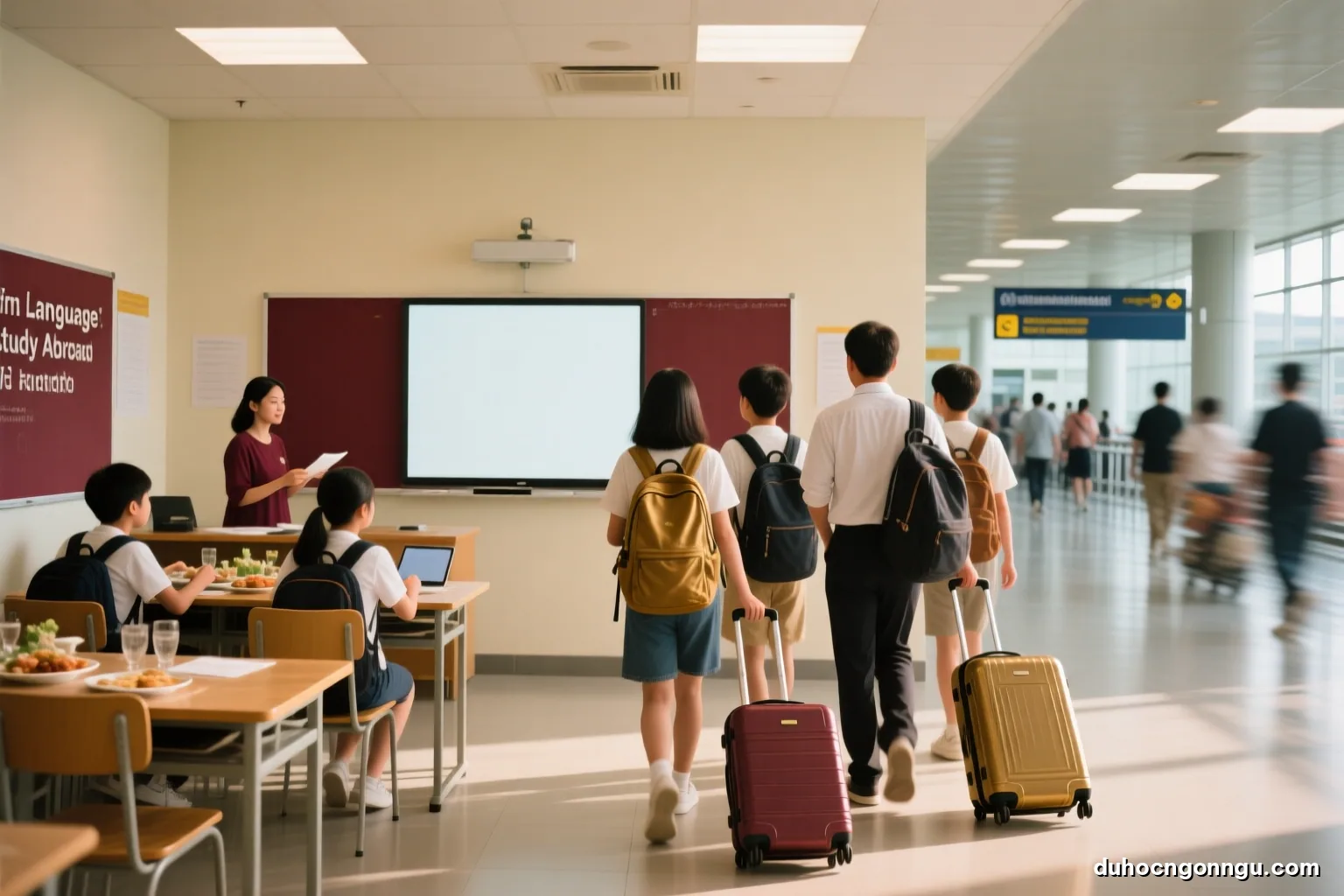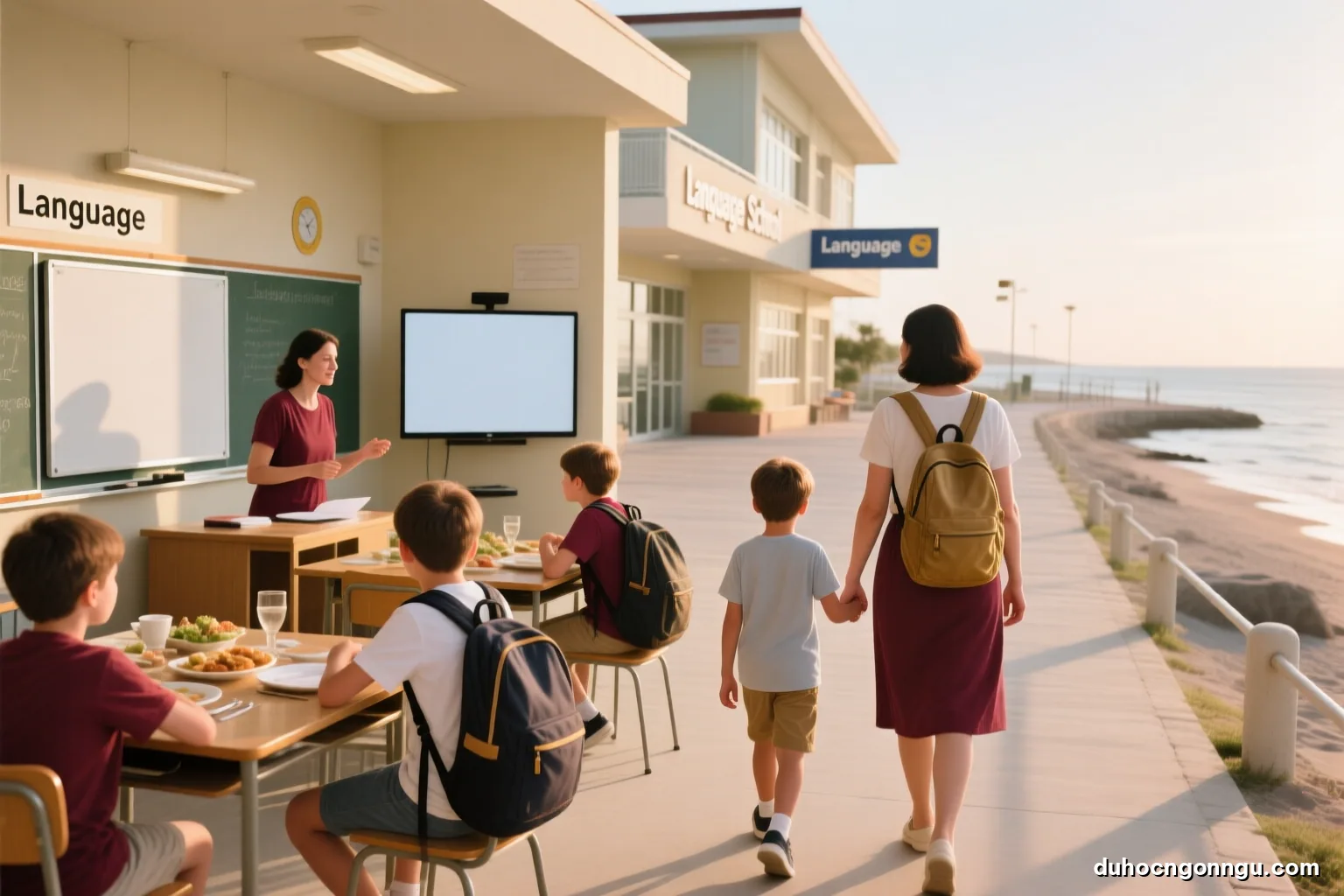
A family summer language course is a programme in which your child attends a junior language class at a language school, while a parent comes along, shares the accommodation, and either takes an adult class at the same school at the same time or simply does the school run and has the day free. This format suits young children who are not yet old enough for a residential camp, children who have never been away from home, and families who want to combine a holiday with learning without handing their child over to strangers.
Not every school offers family courses. Schools that do are usually in tourist towns, near the sea or close to the centre, with separate junior classes from about age 5–6 and adult classes running in parallel. This article explains how family courses work, when to choose one, when to move on to a camp your child attends alone, and the parental habits that quietly reduce how much your child learns without anyone noticing.
How a family summer course works
The usual pattern is this: in the morning, the whole family goes to school together. Your child joins a junior class grouped by age and level; parents go to an adult class on another floor, or leave the school to do their own thing. At lunchtime you collect your child; in the afternoon they can join activities the school runs for younger students, or the family goes out on its own. In the evening everyone returns to the shared accommodation, which may be a rented apartment, a hotel or a homestay that takes whole families.
Some schools also organise joint activities for parents and children, such as weekend trips, baking sessions or sports afternoons, where families from many countries meet. These are a good chance for your child to see that their parents are also using English, also getting stuck and also asking again.
One point to be clear about: on a family course, looking after your child outside class time is the parents' responsibility, not the school's. The school takes care of lessons and the activities you have signed up for; the rest of the day is the family's own trip. This is quite different from a residential camp, where the camp is responsible almost around the clock.
Which families should choose a summer course with their child
Children under 10. Most residential camps for children travelling alone take students from around 8–10 upwards. For younger children who want to study abroad, the options are almost limited to family courses or day courses while staying with relatives.
Children who have never slept away from home. Jumping from not a single night away from home to four weeks at a residential camp in a foreign country is too big a step for many children. A summer with their parents lets your child get used to an international classroom, local teachers' accents and the rhythm of a language-learning day, while still having someone to lean on in the evenings.
Parents who also want to study. Many working parents need English but have no time for a long course. Two to four weeks in an adult class at the same school as your child is an efficient use of a holiday, and your child sees that learning a language is something the whole family does.
Children with particular health needs. Children with severe allergies, a condition that needs monitoring or other special support can study abroad more safely with a parent close by, instead of depending on camp staff.
Families who want to try it before sending their child alone. A summer together lets parents see how the school teaches and how their child reacts, and judge for themselves whether their child will be ready for a camp on their own the following year.
Family courses compared with camps your child attends alone
The table below compares them on the points that affect language learning and the rhythm of the trip:
| Point of comparison | Family course | Camp your child attends alone |
|---|---|---|
| Age accepted | From about 5–6, depending on the school | Usually from about 8–10 |
| Who looks after your child outside class | Parents | Camp staff or the homestay family |
| Time spent using English each day | Mainly in class and school activities | Almost all day, including meals and evenings |
| Independence your child needs | Low; parents handle most things | Higher; your child manages their own belongings and schedule |
| Risk of homesickness | Low | Yes, especially in the first week |
| Who arranges accommodation and meals | The family, on its own or booked through the school | The camp, all included |
| The parents' experience | A holiday with some learning | At home, keeping track through regular contact |
The third row is the crucial one. A family course gives your child more security and less stress, but in exchange the hours your child has to use the language outside class are significantly fewer, because the family speaks Vietnamese in the evenings.
Parental habits that make your child learn less
Whether a family course succeeds depends a great deal on the parents during the hours outside class. The habits below are very natural, very easy to fall into, and quietly cut down your child's share of English:
- Answering for your child. The shop assistant asks your child which ice cream flavour they want, and the parent answers straight away. Each time this happens, your child loses a chance to use a phrase they have just learned.
- Translating everything at once. Your child does not understand a sign or the guide's instructions, and the parent immediately translates into Vietnamese. Try letting your child guess and ask first, and help only when they are really stuck.
- Filling the schedule with sightseeing. Lessons in the morning, three sights in the afternoon, shopping in the evening. Your child is tired and has no energy left for the school's afternoon activities, which is where they meet international friends.
- Only spending time with other Vietnamese families. Meeting compatriots at school is nice, but if the two families go out together every afternoon, your child ends up speaking Vietnamese with their new friend.
- Letting your child watch Vietnamese content on a device in the evening. If they do watch something, try switching to cartoons or films in English whose story they already know.
If the parents also take an adult class, there is an advantage: the family can agree on a time of day when only English is spoken, for example lunch or the walk home. A small agreement kept consistently works better than general reminders.
A sample week on a family summer course
The schedule below is a hypothetical example to give a sense of the rhythm of a week, not the timetable of a particular school:
- Monday: placement tests for both child and parents, class allocation, a tour of the school. In the afternoon, back to the accommodation to rest and a trip to the local supermarket.
- Tuesday and Wednesday: morning lessons. On Tuesday afternoon your child joins the school's craft activity; on Wednesday afternoon the family goes to a park and lets your child order the food.
- Thursday: morning lessons; in the afternoon there is a joint school activity for families, for example a museum visit with an English-speaking guide.
- Friday: morning lessons, and your child gives a short presentation of the week's project to the class. A free afternoon to rest.
- Weekend: one full-day trip, organised by the school or by the family; the other day for your child to catch up on sleep and rest.
This slow pace is deliberate. Young children learn languages well when they are not exhausted, and a family course should have at least one free afternoon a week so your child can play freely with new friends.
Parents in an adult class: choosing the right course for yourself
If parents are studying too, choose a course based on your own needs and not only on your child's timetable. Most schools have morning general English courses that coincide with the junior classes, which makes the school run very convenient. Some schools also offer business English, speaking courses, or a few one-to-one sessions a week for people who need to focus on one skill.
Working adults usually benefit most from small group classes with learners from many countries: classmates are working people from Italy, Brazil, Japan and Korea, each with their own accent, much like a real international workplace. If the goal is to pass a certificate exam, a family summer course is usually not the best place, because the schedule is shaped by your child and by the holiday.
One small but useful point: when parents study at the same time as their child, the child sees learning as something perfectly normal for adults. At lunchtime, everyone shares one new thing they learned that day, in English if possible. Young children usually love "teaching" their parents a new word, and that is the most natural way to revise.
Choosing a city for a family course
Because the whole family is travelling, the city matters more than when your child goes to a residential camp. Give priority to places that are easy to get around, with public transport to the school, parks, beaches or green spaces where children can run around in the afternoon, and easily accessible medical services. A very large city can mean hours on buses or trains every day; a very small town may offer the family little to do after class.
The summer climate is also worth checking in advance. Some places are fiercely hot at midday, and young children get uncomfortable if they have to walk long distances; others are cool with unpredictable rain, so a jacket is needed. For young children, a mild coastal town with a slow pace of life is usually more pleasant than a crowded capital.
Finally, there is the flight. Children under 8 flying for more than ten hours across a six- or seven-hour time difference will need a few days to settle. For a course of only two weeks, choosing somewhere closer or with a smaller time difference gives the family more real days of learning.
When to move from a family course to a camp on their own
There is no fixed age. Common signs of readiness are: your child can manage their personal hygiene, organise their belongings and get up on their own with an alarm; they have spent a few nights away from home, at their grandparents' or on a school trip, without too much distress; they can tell a stranger their basic needs in English; and most importantly, they want to go.
Many families follow a progression: the first summer studying alongside their parents; the second summer at a day camp while the parents stay in the same city; the third summer at a residential camp with a group. Each step gradually increases independence, and each summer your child gains more language so the next step is easier.
When talking to an advisory service, describe your child's history of time away from home and how they reacted. That is better information than the age on their birth certificate. If the family would like to look at a specific summer programme for your child to join with a group after a family course, duhocnganhan.com has information on the short courses organised by Global Gate Pass.
Frequently asked questions
Can parents whose English is not good join a family course?
Yes. Adult classes are also grouped by level, including classes for beginners. If you are only coming along, you need enough English for the basics, such as shopping, asking the way and contacting the school; schools usually have staff who support international students.
Does a child on a family course share a class with children travelling alone?
At some schools, junior classes take both children with their families and children in homestays or residences. At other schools, family classes are separate. Ask beforehand, because mixed classes usually have more nationalities.
Can the whole family stay in a homestay?
Some schools have homestays that take whole families, but there are few of them and they fill up early in the peak season. An apartment or hotel near the school is the more common choice, and gives the family freedom over timings and meals.
Can two children of different ages study at the same school?
Yes, if the school has junior classes for both age groups. For example, a 6-year-old and a 12-year-old can attend two different classes at the same time. Check the minimum and maximum ages for junior classes at the school you are considering.
Does a family course give my child a certificate?
Most schools give a certificate of completion to both children and adults, showing the number of hours and the level they were placed at. For young children, the main value of the course is the experience and their attitude to the language, not the certificate.
Can parents work remotely while their child is in class?
Many parents do, using the mornings while their child is in class to work. Choose accommodation with a reliable connection close to the school, and remember that in the afternoon your child needs an adult with them, so meetings are best scheduled in the morning.