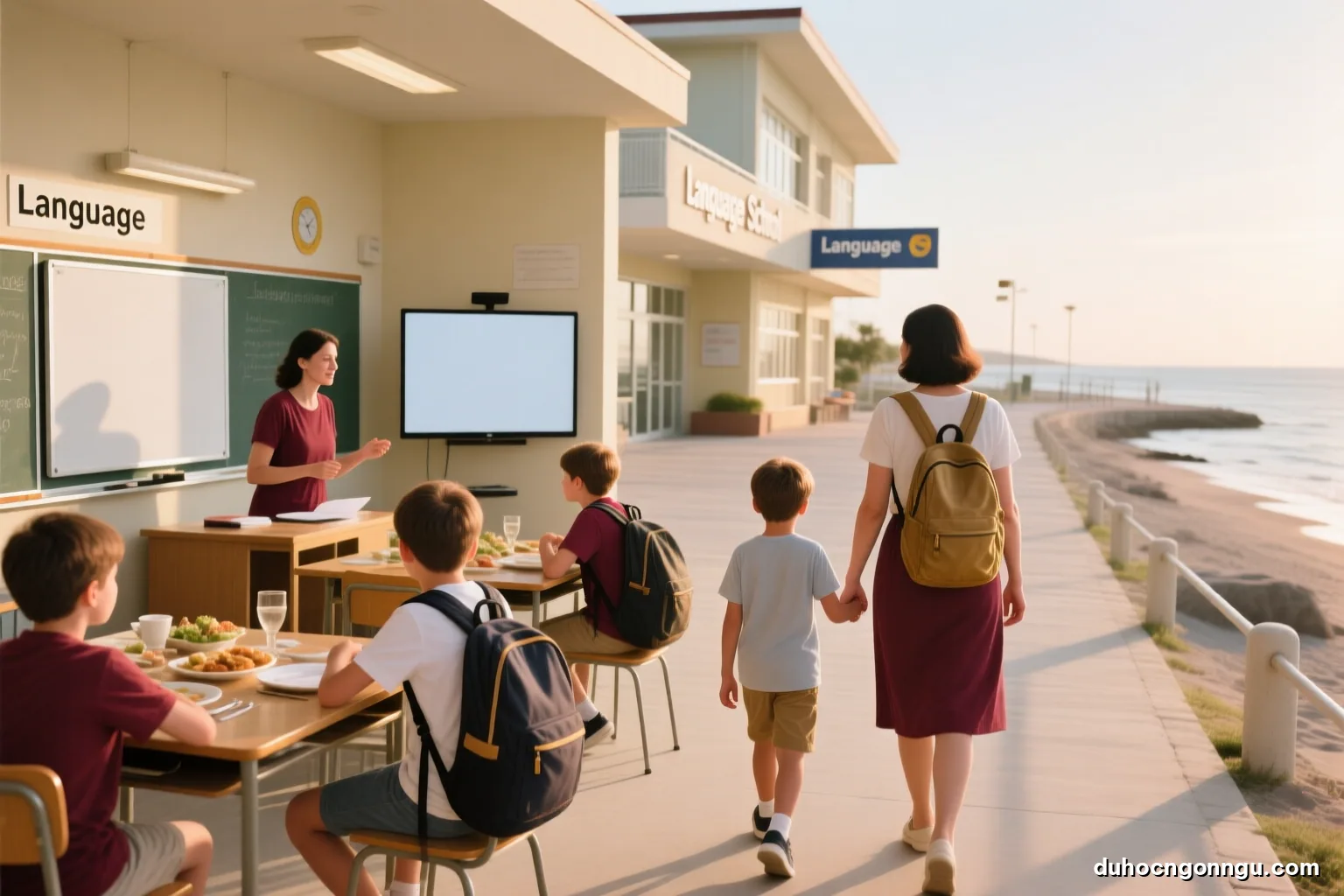
For most students aged 10–17 going for the first time, a 3–4 week course is the most balanced length: long enough for your child to get through the disorientation of the first week and have at least two weeks of using the language comfortably. A 2-week course suits a first taste or a tight summer schedule; a 6–8 week course suits older students who have been before and want clearer progress in listening and speaking.
The reason lies in the adjustment rhythm almost everyone goes through when living in a new language environment: a few days of excitement, then fatigue from having to listen and speak non-stop, and only after that a phase of settling in and starting to use the language naturally. The shorter the course, the smaller the "settling in" part. This article goes through each length, what usually happens at each one, and how to work it out against your child's school calendar in Vietnam.
Why the first week is almost always the hardest
The first day at camp is usually great fun: a new room, new friends, new teachers. From the third or fourth day, many students start to feel tired. Their brain has to process English almost constantly, even for things they never had to think about before, such as asking when meals are or finding the bathroom. Jet lag, different food and sharing a room with strangers all add up. This is when your child calls home saying "I want to come home".
This phase usually passes after about a week, once your child has a group of friends, knows the timetable and knows where to go and whom to ask. From the second week, the energy that went into settling in is freed up for learning and having fun. Your child starts to talk more because they are less anxious, starts joking in English and starts to notice the phrases their friends use.
The consequence for choosing a length is quite clear: a 2-week course spends nearly half its time on the hardest part. A 4-week course spends a quarter. That is not a reason to rule out short courses, but it is a reason not to expect much in language terms from two weeks, and to prepare your child mentally for the first week.
2-week courses: getting a feel for it, trying it out
Two weeks is the shortest length most camps accept. It suits situations where:
- Your child is young or away from home for the first time, and the family wants to see how they react before committing to a longer course.
- The summer schedule is squeezed by compulsory summer classes, school transition exams or family plans.
- The goal is cultural experience and getting used to an international classroom, not measurable language progress.
- Your child is combining it with another course, for example two weeks of language before a specialist activity.
For a 2-week course, choose a camp whose first week is carefully organised, with ice-breaker activities and staff who keep an eye on new arrivals. Also take the flight and the time difference into account: if the first two days go on recovering, a 2-week course leaves only about ten effective days. A realistic expectation is that your child comes back with a more positive attitude to English, a few foreign friends to keep in touch with, and a wish to go again. That is already a worthwhile result.
3–4 week courses: the most common length
This is the length most families choose, and with good reason. After the first week of adjustment, your child has two to three weeks in a familiar state, using the language more comfortably and taking part in activities more fully. Most camps design their programme around weekly themes, so four weeks usually means four different themes, varied enough that your child does not get bored.
Four weeks is also long enough for teachers to get to know your child, move them to another class if they were placed at the wrong level on the first day, and write comments with real substance instead of a few generic lines. If the camp has an end-of-course test, the result after four weeks means more than after two, although you still should not expect a jump in level.
For the family, four weeks fits most summer holidays in Vietnam while still leaving time for your child to rest, take extra classes or visit their home town before the new school year. Many families choose a four-week course around the middle of the holidays, leaving the first few weeks of summer for preparation and the last few for your child to get their sleep pattern back. If your child has a close friend or a sibling who wants to go too, four weeks is also the easiest length to coordinate, because many camps use the same arrival day for 2, 3 and 4-week courses.
6–8 week courses: for older students with clear goals
Long courses suit students aged about 14 and over who have already been away for one summer, are quite independent and have a specific language goal, for example preparing for long-term study abroad or wanting a real step up in listening and speaking. After a month, many students enter a different phase: they are no longer visitors but start living like locals, getting around on their own, organising their own weekends and making deeper friendships.
Long courses also have their own risks. Some students stall in the fifth or sixth week, losing motivation because the friends they made in the first week have gone home and the class keeps changing. Some camps deal with this by giving long-stay students a change of theme, a bigger project or a new activity group. Ask the camp specifically what they do with students staying more than four weeks.
A 6–8 week course takes up almost the whole summer holiday. Work out beforehand whether your child will have time to review their school work before term starts, and whether the start-of-year tests fall right after the return date. For students in grade 9 and grade 12 preparing for transition or graduation exams, a long course in the summer before the exam year is usually more sensible than the summer right before the exams.
Counting the weeks your child really has in the summer holiday
In Vietnam, the Ministry of Education and Training issues a framework for the school-year calendar every year, and each province sets the exact dates based on it. The school year usually ends around the end of May and pupils return at the end of August or the beginning of September, but the exact dates change from year to year and from place to place, so check that year's official notice.
On paper, the holiday is about three months. In practice it is much shorter. Take away the weeks of transition exams for grade 9 and grade 12 students, school summer classes or revision, local summer activities, and family trips home or holidays, and many students are left with only four to six consecutive free weeks. From that, take away a few more days before departure for preparation and at least a week after coming back for your child to rest and get their sleep pattern back.
A simple method: take a paper calendar, mark every day that is already taken, find the longest gap, and only then choose the length of the course. Doing it the other way round, choosing the course first and then squeezing it into the calendar, often ends with your child flying home the morning before the first day of school.
Short courses can still deliver a lot with the right preparation
When there are only two or three weeks, preparation at home decides how many of those days your child can really use. The steps below shorten the disorientation phase:
- For a few weeks before leaving, let your child listen to plenty of natural English: cartoons, children's programmes, videos about the city they are going to.
- Practise the phrases your child will need on the very first day: introducing themselves, asking the way to their room, saying they feel ill, asking permission to call home.
- Show your child the photos of the campus and rooms and the campus map the school sends, so the first day feels less strange.
- Adjust bedtime gradually over a few days before the flight if the time difference is large.
- Agree on a schedule for calling home, not too frequent in the first week, so your child has time to blend into the group.
Each of these small steps can help your child settle into the rhythm a day or two sooner. On a two-week course, a day or two is a significant share of the total learning time.
Choosing the length by goal
The suggestions below should be read together with your child's age and experience of being away from home. They are a starting point for discussion, not a formula.
| Main goal | Suggested length | Notes |
|---|---|---|
| See whether it suits your child | 2 weeks | Choose a camp that organises the first week carefully |
| Confidence in communicating, getting used to an international environment | 3–4 weeks | The balanced choice for a first trip |
| Clear progress in listening and speaking | 4–6 weeks | Suits students from 12–13 who are used to being away from home |
| Preparing for long-term study abroad | 6–8 weeks | Choose a country and city close to the long-term plan |
| Combining language and a specialist theme | 2 weeks of language + 1–2 weeks of a specialist theme | Check whether the camp allows combinations |
If you are torn between two lengths, choose the shorter one for a first trip and keep the option of extending. Many camps allow extra weeks if places are available, but almost no camp refunds fees when a child goes home early because it did not suit them.
Length-related points parents often forget
Arrival and departure days. Many camps have fixed arrival and departure days, usually at weekends. A "2-week" course may be fourteen nights, but the first and last days are mostly travel. Count the actual teaching days on the calendar.
Public holidays in the host country. Some public holidays fall in summer; the school may cancel lessons but still run activities. A short course that includes a public holiday loses a significant number of lessons.
Visa duration. Each type of visa allows a stay of a certain length and has conditions about studying. For a long course, check from the start that the visa type is suitable.
Health and sleep after coming back. For a long course at the end of the summer, your child needs at least a week after returning to get their sleep pattern back before the first day of school.
Costs do not rise in a straight line. The flight is a fixed cost, so a long course has a lower cost per week than a short course on the same flight. How to build your own budget is covered in a separate article in the trip preparation topic.
Frequently asked questions
Is one week enough for a summer course abroad?
Some camps offer one-week courses, but for students flying from Vietnam to Europe or North America, jet lag and travel fatigue take up almost all of the time. One week makes more sense for nearby destinations, for example within Asia, and is better seen as an experience trip than as language study.
Are two 2-week courses in two countries better than one 4-week course?
Two countries let your child see more places, but they have to go through the adjustment phase twice. In language terms, one 4-week course in one place usually gives better results. Two 2-week courses suit families whose main goal is cultural experience.
If my child is very homesick, should they come home early?
Homesickness in the first week is very common and usually fades. Talk to the staff in charge to understand how your child is doing at camp, because children tend to call home at their lowest moments. A decision to come home early should be based on an overall assessment, not on a single phone call.
Will a long course make my child forget what they learned at school?
Two months away from books can leave your child a little behind in subjects that need regular practice, such as maths. Many families send their child with some light revision work to do a few times a week, or review in the two weeks before term starts.
How many weeks should an 8–10-year-old go for?
For young children going for the first time, two to three weeks is usually enough, or a family course with their parents. Young children tire more quickly and need more rest, so a short course with a not-too-busy schedule suits them better than a long one.
Should we extend the course while our child is at camp?
If your child has settled in well, wants to stay longer and the camp has places, extending is a sensible option. Before leaving, ask about the conditions and the deadline for extensions, check whether the flight can be changed, and make sure the visa allows enough time.