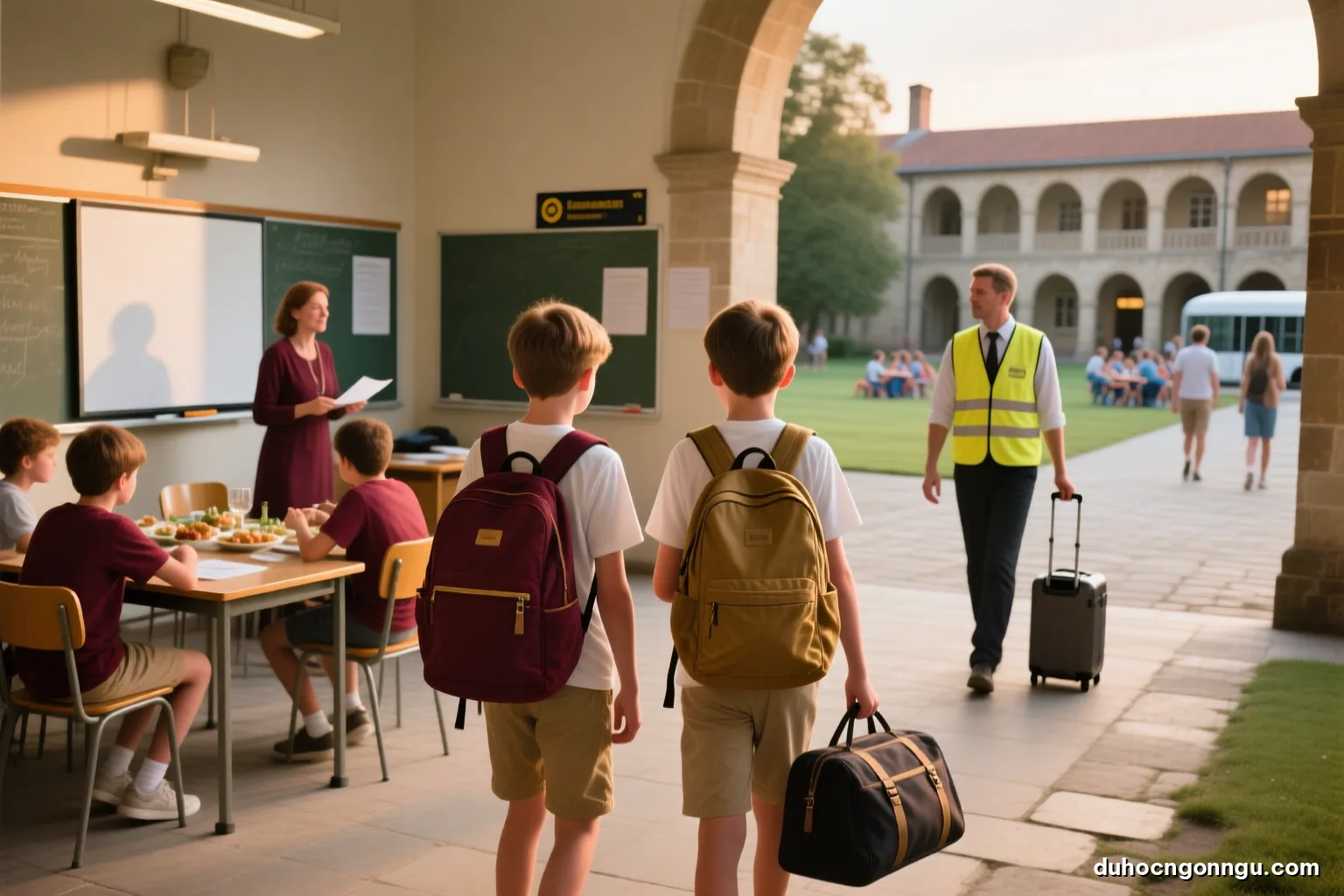
Two children of different ages travelling together on a language trip works best when you choose a place with programmes for both age groups, but let the two children study in separate classes by level, take part in activities with their own age groups, and do not give the older child the responsibility of looking after the younger one. If the age gap is large, for example an 8-year-old and a 15-year-old, a family course with the parents travelling along is often the only way to combine the two.
Many families want to send two children at the same time because it is easier to arrange the schedule, because they want the children to have shared memories, or because the parents can only travel with them once a year. That wish is reasonable, but two children at two different ages have very different needs. This article explains how to choose the place and the courses, arrange classes and accommodation, keep a balance between the two children, and the questions to ask the school.
Why two children on one trip is different from two children travelling separately
Two children in different age groups need two different kinds of course. A 9-year-old needs a class with lots of activities, an early bedtime and close supervision; a 14-year-old needs a class with grammar explanations, group projects and more freedom outside lessons. Putting both children into one course designed for one age group usually leaves one of them a poor fit: either the younger one is overstretched, or the older one is bored.
Travelling together also creates something that does not exist when travelling separately: the two children have each other. The good side is that the younger one has a familiar face nearby and is less homesick; the other side is that the two easily speak Vietnamese together, and the younger one may cling to the older sibling and not make new friends. Many families say the shared trip brought their children closer, but some found the two argued more than at home because they had no space of their own.
So the question is not whether travelling together or separately is better, but if they travel together, how to arrange things so that each child still has their own experience. The answer depends on the age gap, the two children's personalities, their relationship, and whether the parents can go with them.
Timing also needs considering. The two children's school calendars may differ, especially when one is in a transition exam year. A three-week course that suits the younger child may be too short for an older child with academic goals, or vice versa. Some families solve this by sending the older child a week or two earlier and the younger one later with the parents; others accept a common length and choose goals that fit it.
Choosing the format by age gap
The age gap is the first factor that decides which formats can combine the two children. The table below gives suggestions for common situations.
| Situation | Format that usually suits | How to arrange it | What to watch for |
|---|---|---|---|
| Same age group, for example 11 and 13 | The same junior residential camp | Different classes by level, different rooms if different genders or by age group | The two easily cluster together speaking Vietnamese |
| Different age groups, one school with both programmes, for example 9 and 14 | A school with programmes for children and teenagers | Two timetables, two activity groups, accommodation by age group | Bedtimes and freedom differ, which needs explaining to both children |
| A very large gap, for example 8 and 16 | A family course with the parents along | The younger one in a children's class, the older one in a teenage class or an adult class if old enough | Parents have to handle transport to two places if the two classes are at two locations |
| One child not ready to travel alone | A family course or a day camp | The whole family stays in one place, the two children follow two programmes | Avoid leaving the older child at home minding the younger one in the evenings |
For the second situation, ask the school whether the two programmes share a campus and whether there are any shared meals or activities. Some families want the two children to meet at dinner or at weekends; others want them fully separated so each becomes more independent.
Classes and activities: a separate timetable for each child
The first principle is to let the school place each child by the entry test, rather than asking for the two to share a class for convenience. Children of different ages usually have different levels, and even when their levels are close, sharing a class gives them someone to speak Vietnamese with during lessons, invites comparison and causes friction. If the school only has one class at that level, ask whether the two can be put in different groups for activities.
Afternoon and weekend activities should also follow each child's age group. A long excursion or an evening activity that runs late suits the older child but tires the younger one. Many schools have separate activities for the younger group; if not, ask whether the younger child can take part in lighter activities.
There is a subtle point: younger children often want to follow their older sibling, and the older child sometimes wants space with friends of their own age. Tell both children in advance that each has their own timetable and group of friends, and that they will meet at fixed times. That way the younger child knows when they will see their sibling, and the older one does not feel pulled away from their new friends. If either child is sad or having difficulties, the school's supervisor is the first to help, not the sibling.
Do not turn the older child into a minder
This is the most important point and also the one most often forgotten. When two children travel together without their parents, it is natural for parents to tell the older one to "keep an eye on your brother or sister". That instruction is well meant, but it puts on a 13–15-year-old a responsibility that is not theirs, and takes away part of their own experience. The older child may feel they have to leave activities with friends to check on the younger one, worry every time the younger one cries, and feel guilty if anything happens.
The school or the group leader is the party responsible for supervising both children. Make this clear to both: the younger child knows to find the supervisor when they need help; the older child knows they are not responsible for the younger one and only need to tell a supervisor if they see something wrong. You can agree on something small and enjoyable instead of minding duty, such as the two having breakfast together a few times a week.
Tell the school in advance that the two are siblings, so that each group's supervisor knows and can coordinate when needed, for example when the younger child is homesick and wants to see their sibling. Ask the school how it usually handles this. A school used to taking siblings will have a specific way of doing it.
Accommodation: same room, same house or fully separate
At residential camps, schools usually allocate rooms by gender and age group, so two children of different genders or very different ages will almost certainly be in two rooms, sometimes in two buildings. Some families ask for two children of the same gender to share a room; this reassures the younger one but reduces the chance of speaking English with roommates. If you choose for them to share, ask for an international student to be added to the room.
With a homestay, the two children can stay with the same family. That is comfortable for the younger child, but the two will speak Vietnamese to each other at home. Some schools place siblings with two families close to each other. Ask the school about its policy for siblings, and weigh reassurance against the language environment.
On a family course, the whole family stays in one place, so what needs arranging is individual time. In the evenings there should be moments when each child tells the parents about their own day, rather than the family always being together. Also let the older child go out to activities with friends of their age in the evening if the programme has them, rather than making them stay in with the younger one.
Questions to ask the school when enrolling two children
Send the questions below together when you get in touch, with each child's date of birth and expected level, so the school answers for the family's actual situation.
- Which programme and age group will each child be in, based on their age on the course start date?
- Are the two programmes at the same location and do they start on the same day? If at different locations, who provides transport?
- How do the timetables, bedtimes and curfews differ between the two groups?
- Are there any activities or meals where the two children can meet, if the family wants?
- What is the room allocation policy for siblings? Can they share, be close by, or must they be separated?
- Do the supervisors of the two groups coordinate when one child needs to see their sibling?
- If one child has to go home early because of illness or another reason, how is the other child's situation handled?
- Does the school have any particular policy for siblings enrolling together?
Few families think of the seventh question, but it is very practical. If the younger child has to go home early, parents need to know whether the older one can stay alone, who travels home with the younger one, and whether both tickets have to be changed. The school's answer should be in hand before booking flights.
Keeping a balance between the two children
A shared trip can easily make one child the main character and the other a companion. A few ways to keep a balance:
- A separate goal for each child. For the younger one it may be getting used to the language and having fun; for the older one it may be academic skills or confidence in presenting. Do not compare the two children's progress.
- Each child has a say in choosing the course. The older one reads the materials and chooses electives; the younger one chooses activities they like from the list.
- Do not use one child as the yardstick for the other. Avoid sentences like "look, your sister can already speak". Each child is at a different age and level.
- Call each child separately. If the parents are not travelling with them, call each child separately rather than together, so each can tell their own story.
- Next time they can go separately. A good shared trip does not mean every trip has to be shared. As the children get older, a separate trip lets each have an experience entirely their own.
After the trip, read the school's report on each child with that child alone, not together for comparison. Parents should also ask each child: next time, do you want to go with your sibling or on your own? The children's own answers are the best data for the next trip.
Frequently asked questions
Should the two children share a class so they are easier to look after?
Usually not. Children of different ages usually have different levels, and sharing a class makes them speak Vietnamese together during lessons and invites comparison and friction. Let the school place each child by the entry test, and let them meet at fixed times outside class.
Can a 16-year-old act as guardian for their younger sibling?
No. The school and the group leader are responsible for supervision, and someone under 18 cannot be the legal guardian of their sibling abroad. Handing them the job of minding their sibling also takes away the older child's experience. The older child should get to be a brother or sister, not a minder.
Can two children of the same gender but four years apart share a room?
It depends on the school's policy; many camps allocate rooms by age group, so the two may be separated. If the school allows sharing, the younger one feels more secure but the two easily speak Vietnamese. A way to balance this is to ask the school to add an international student to the room.
What if the younger child is homesick and keeps asking to be with the older sibling?
Tell the younger child's group supervisor so they pay more attention and create opportunities for the child to join in with friends of their own age. You can agree on fixed times when the siblings meet, such as breakfast. Remind the older child that they do not need to give up their own activities to look after the younger one.
Are there schools that take an 8-year-old and a 15-year-old at the same time?
Some language schools have programmes for children, teenagers and adults in the same city, sometimes on different campuses. Family courses also often take children of many ages. Ask the school whether the two programmes are at the same location with the same start dates, and who provides transport if they are at different locations.
Does travelling together mean the two children speak less English?
There is a risk, because each has someone ready to speak Vietnamese with. Reduce it by separating classes and activities, asking for an international roommate, and agreeing with both children on times when only English is used, such as meals with international friends or group activities.