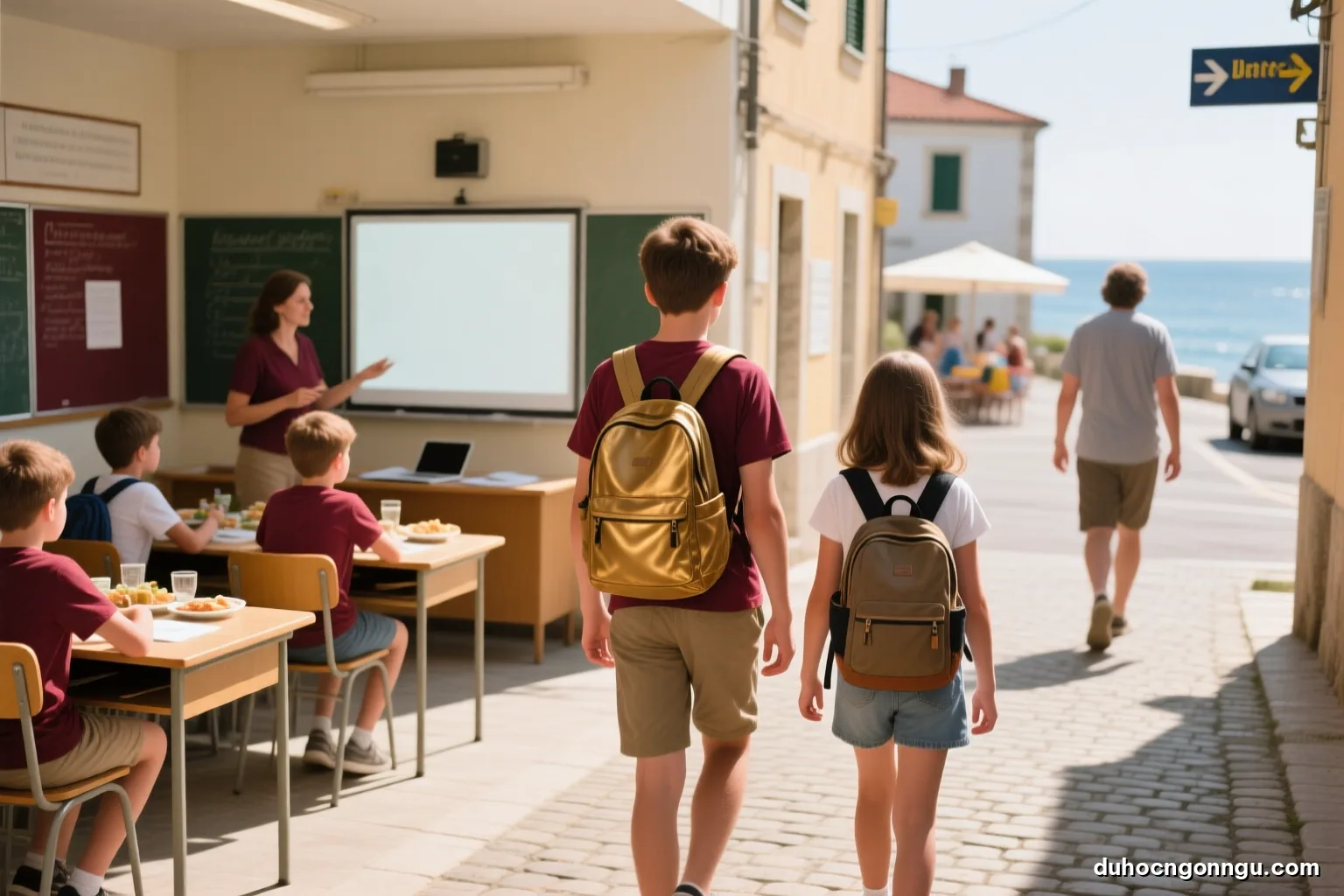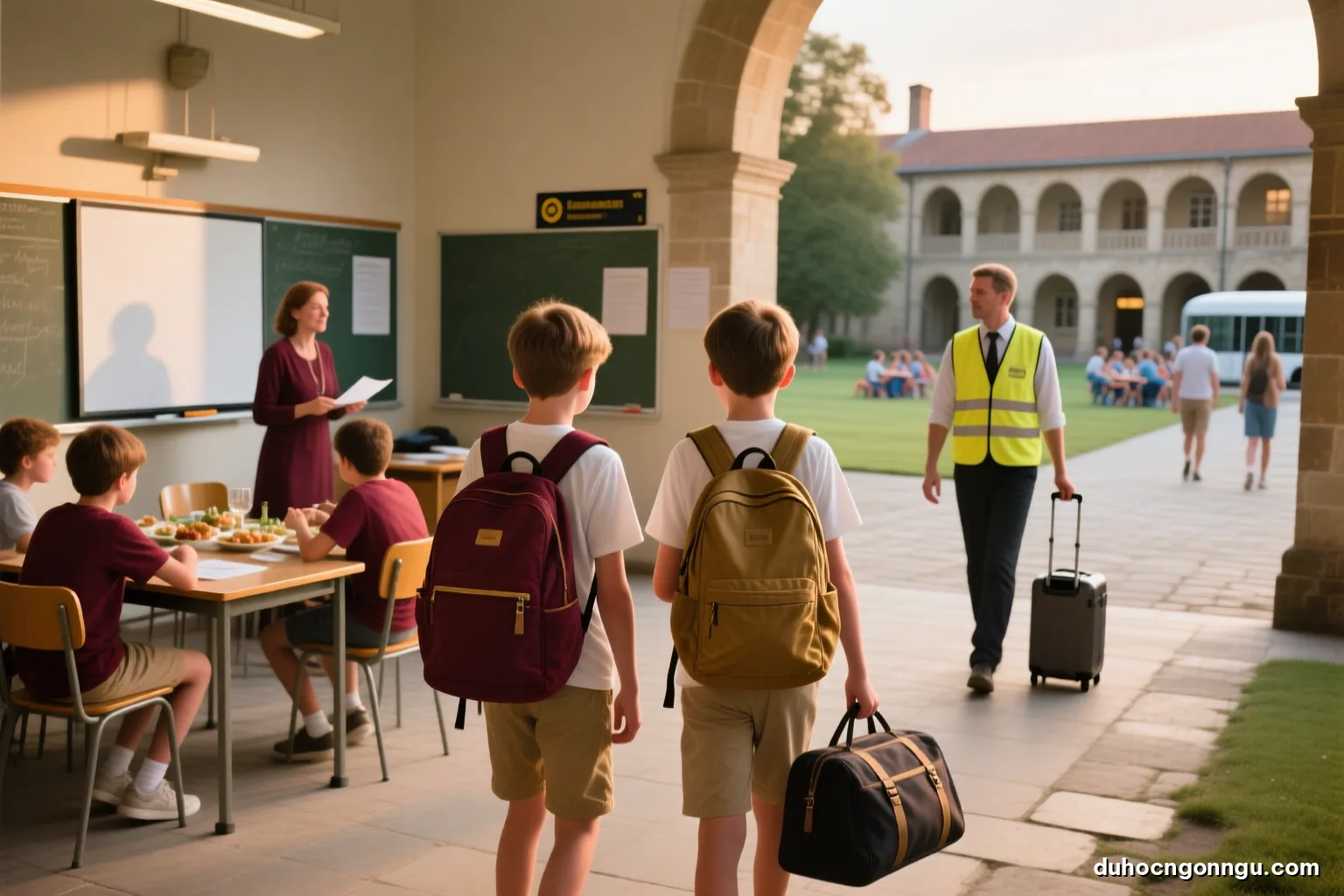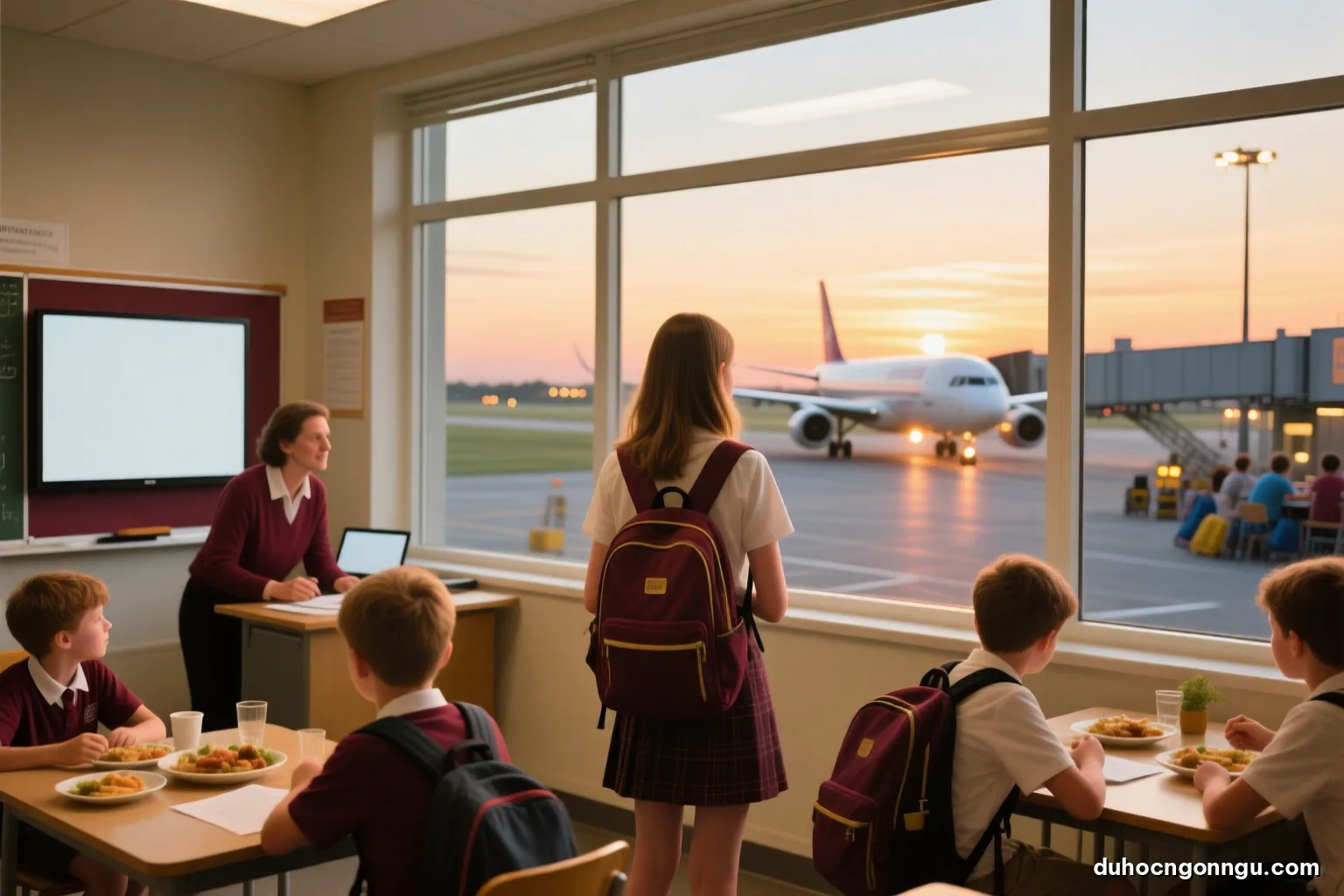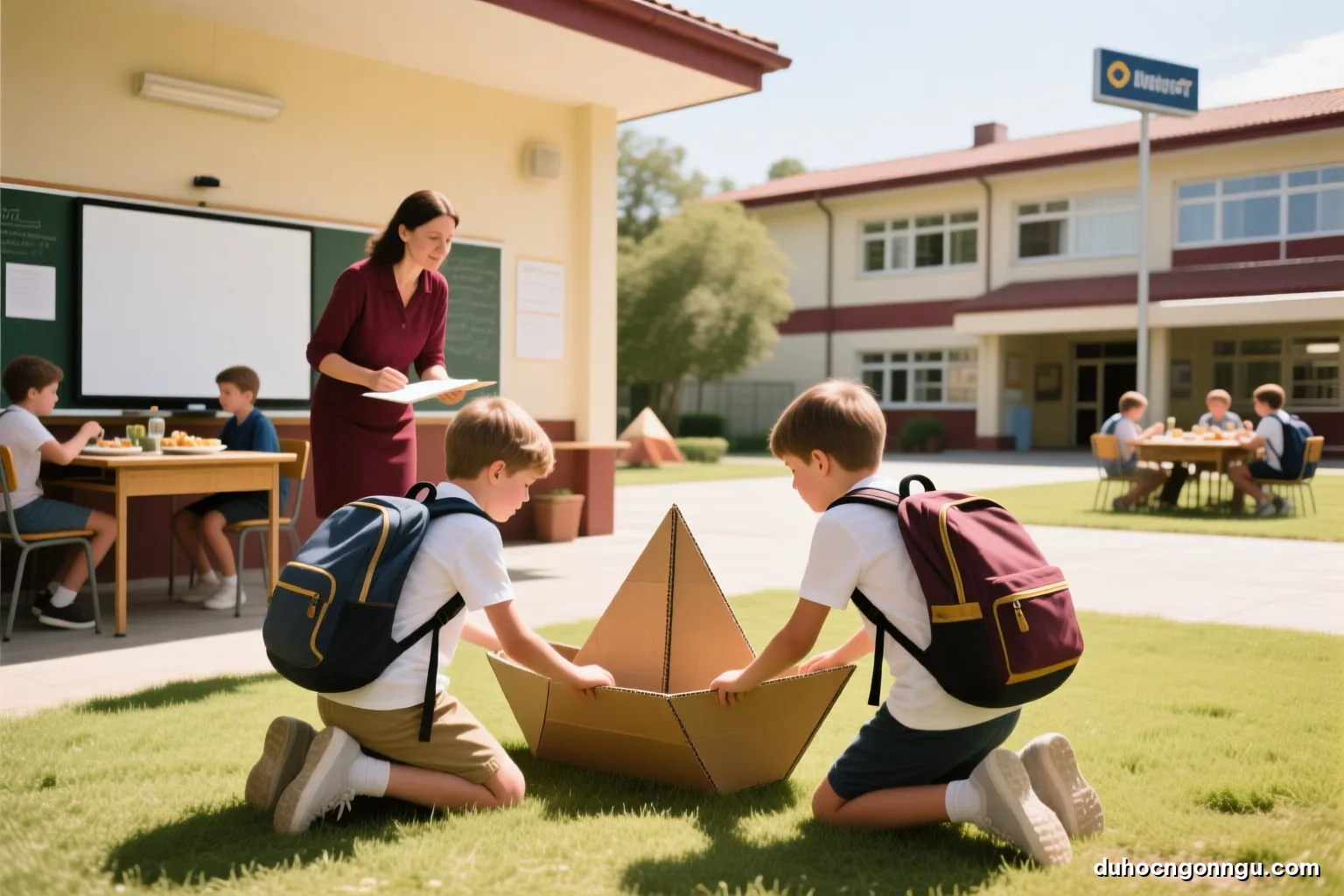
For children aged 8–10, the format that suits a first language course abroad best is usually one with parents or relatives nearby: a family course, or a day camp while the family stays in the same city. Residential camps that take children from age 8 do exist, but there are not many, and they only suit children who are used to sleeping away from home, can handle their daily routines and have enough of the language to speak up when they need help.
At this age, the most valuable thing the trip brings back is not the number of new words or a level gained, but the feeling that a foreign language is something you can use to play and make friends. This article explains how primary-age children learn languages, compares three formats, discusses homesickness and sleep, and then gives a list of questions to put to the school before enrolling.
How children aged 8–10 learn a foreign language
Primary-age children understand and remember best through concrete activity: holding, modelling, running, role-playing, singing. The Total Physical Response method, developed by James Asher from the 1960s, is based on this observation: learners hear an instruction and act it out physically before they have to speak. Many classes for young learners abroad use activities in the same spirit, mixed with games, crafts and small group projects.
Children's attention spans are also shorter than adults'. A good lesson for this age breaks activities into small chunks, changes pace often and lets children move around. When looking at a course timetable, if you see three hours sitting at desks with a textbook, that is a sign the course was not designed for this age group, even if on paper it accepts children from age 8.
Young children's strength is that they imitate sounds very naturally and are less afraid of making mistakes. An 8-year-old will often repeat a native-speaking friend's sentence without worrying about sounding funny, something many 13–14-year-olds have started to feel shy about. Their weakness is that they rarely systematise on their own: they learn "Can I have some water?" at a meal but do not work out by themselves how to ask for other things. So an adult at home needs to follow up after the trip, otherwise the language can fade within a few months.
Starting levels at this age are often low, and that is fine. Cambridge's young learners qualifications have three levels, Pre A1 Starters, A1 Movers and A2 Flyers; a child at Starters or Movers level can still take part in activity-based classes, as long as the class is at the right level and the teacher is used to teaching young children.
Three formats that suit primary-age children
The table compares three common ways of going for children aged 8–10. No format is better in absolute terms; what decides it is how used to being away from home your child is and whether someone in the family can go along.
| Format | How your child studies | Where your child sleeps | Suits which children | What to weigh |
|---|---|---|---|---|
| Family course | Your child joins a children's class, parents join an adult class or are free during your child's lessons | With the parents, in a flat, hotel or private home | First time away, never slept away from home for many nights | Your child may cling to the parents and speak a lot of Vietnamese outside lessons |
| Day camp | Lessons in the morning, activities with international friends in the afternoon, back to the family in the evening | With the family or relatives in that city | Used to full school days, needs to be with familiar people in the evening | The family has to arrange accommodation and transport itself |
| Residential camp taking children from 8 | Studying, activities, eating and sleeping on campus with supervisors | A residence, usually arranged by age group and gender | Has been to a camp away from home before, independent, has basic language | Few schools take this age; ask carefully who looks after children at night |
With a family course, agree in advance that outside lessons the family will try to use English in a few fixed situations, such as ordering food or asking for directions, to give your child more time using the language. With a day camp, ask whether the school provides transport and what the latest pick-up time is. With a residential camp, read the section below on homesickness carefully before deciding.
Homesickness at a young age: understanding it to prepare properly
Homesickness is a normal reaction, felt to some degree by most children at camps away from home, including those who are cheerful throughout. A clinical report by Christopher Thurber and Edward Walton, published in the journal Pediatrics in 2007, reviewed research on homesickness in children and made some recommendations for parents that are useful in practice.
First, let your child practise being away from home beforehand, for example sleeping a few nights at the grandparents' or a relative's without the parents. Second, prepare for the trip together with your child: look at photos of the accommodation, read the activity schedule, let your child choose what to pack. Third, avoid promises like "if you get homesick, call us and we'll come and get you", because such a promise makes children believe they cannot get through it themselves and leads them to give up at the first bout of sadness. Instead, tell your child that homesickness is normal and show them things they can do when sad: write a letter, talk to the supervisor, ask a friend to play.
At 8–10, homesickness tends to come in the evenings and in the first few days. That is why a family course or day camp suits a first trip: in the evening your child goes back to familiar people, and the feeling has no chance to build up. If you choose a residential camp, ask the school how it deals with homesick children, whether there is a supervisor who speaks Vietnamese or at least a procedure for calling home at fixed times, and in which cases it informs the family straight away.
The daily schedule, sleep and jet lag
Children aged 6–12 are recommended to sleep 9–12 hours a night, according to the 2016 consensus recommendation of the American Academy of Sleep Medicine. The schedules of many junior camps are written for the whole 8–17 age group, with evening activities running until about nine or ten o'clock. A good programme for young children must have a separate bedtime for the younger group and lighter, shorter evening activities.
Jet lag makes the problem worse. Flying to Europe, children are about five to six hours out of sync; to the east coast of North America, about eleven hours. In the first few days, children may be sleepy at midday and wide awake at midnight, irritable and tearful, and this feeling is often mistaken for homesickness. For young children, choosing a destination with little time difference, such as countries in the Asian region, for the first trip is one way to reduce the strain. If going further, arrive a day or two before the course starts if the family can go along.
Meals are something often forgotten. Young children are fussier eaters, and a week of eating only bread because they are not used to the food will wear your child out. Ask the school for a sample menu, whether there is a rice or Asian option, and how it handles food allergies. Packing a little familiar food, within the limits the destination's customs allow, also makes the first few days easier.
Questions to ask the school when your child is under 10
Most of the information below is in the school's materials, but a direct answer from the person in charge shows whether they are used to working with young children.
- How old are the other children in my child's class usually? Is there a separate class for the 8–10 group, or are they combined with 13–14-year-olds?
- How many children is each supervisor responsible for during activities, and who is near my child's room at night?
- Do the teachers of the younger group have experience or qualifications in teaching children, for example an English teaching qualification with a component on young learners?
- What time is bedtime for the younger group? When do evening activities finish?
- When my child is ill, has toothache or cries for several nights in a row, what does the school do, who takes them to the doctor, and when is the family told?
- When can my child call home, and on what device? Are personal phones held by staff?
- If my child is teased or bullied by other children, what is the school's procedure?
- Is there a Vietnamese speaker in the group, or does the school have a way for my child to express themselves when their language is not enough?
A school used to working with young children will answer these questions specifically, with procedures. A general answer like "your child will be fine" is a signal to ask more or consider somewhere else.
Eight weeks at home before a primary-age child's trip
Preparing documents and luggage has its own articles in the trip preparation section. The part below is only about what to do with your child so they walk into their first lesson with as little bewilderment as possible, divided into approximate milestones.
- About eight weeks before: look at photos and videos of the city, the school, the residence or where the family will stay with your child. Let your child ask anything they wonder about, and note down the questions that worry them most.
- About six weeks before: practise survival sentences in English through role-play at home: asking to go to the toilet, saying they are hungry, thirsty, hurt or lost; asking a friend's name and introducing themselves. Ten minutes a day is enough.
- About four weeks before: if your child has never slept away from home, arrange a night or two at a relative's without the parents. Watch how your child copes and talk with them about how it felt.
- About three weeks before: let your child pack some of their own things, learn to recognise their own belongings, and practise keeping things in a small bag carried with them.
- About two weeks before: gradually shift your child's bedtime towards the destination's time zone, fifteen to thirty minutes a day, if there is a large time difference.
- The last week: agree with your child on a schedule for calling home and say clearly that homesickness is normal, and that when they feel sad they should tell the supervisor.
None of this takes much time, but it makes the first day abroad feel less like a shock. A child who has practised saying "I don't feel well" at home will find it much easier to say it to a stranger than a child who has never heard the sentence.
Measuring success at this age: attitude before scores
At 8–10, parents are tempted to want a figure: how many levels has my child gone up, how many more words do they know? A course of two or three weeks rarely produces a jump that can be measured with a standard test, and pushing a child into score pressure on their first trip can make them afraid of the language itself. The yardstick that suits this age lies in behaviour.
Encouraging signs after the trip: your child says a few sentences in English to strangers without being prompted; talks about a foreign friend and wants to keep in touch; watches English cartoons for longer without asking for subtitles; asks when they can go again. If the school sends an end-of-course report, read the description of what your child can do rather than just looking at the grade.
Most important is having a plan to follow up at home over the following months: an hour of reading English stories each week, letters with a friend from camp if the school and the friend's family agree, an activity class in English. Without follow-up, most of what your child learned in a few weeks will fade. With follow-up, the trip becomes the starting point of a long-term habit of using the foreign language, and that is what is truly valuable at this age.
Frequently asked questions
Can an 8-year-old who cannot speak English yet go to camp?
Yes, if you choose a format with a relative nearby, such as a family course or a day camp, and the school has a class for beginners. For a residential camp, it is best to wait until your child can say basic sentences such as asking to go to the toilet, saying they are hurt or hungry, and asking a friend's name.
Will travelling with the parents make our child cling to them and speak little English?
There is that risk, especially in the evenings and at weekends. To reduce it, choose a course with afternoon activities just for children, so your child plays with international friends, and agree as a family to use English in a few situations each day, such as ordering food, shopping and asking for directions.
Should a 9-year-old go with a group led by a Vietnamese group leader?
Going with a group leader gives your child a familiar person who speaks Vietnamese when needed, which helps at this age. Ask carefully about the ratio of group leaders to children, whether the group leader stays in the same building as the children, and how many children in the group are the same age as yours.
Is a two-week course too short for young children?
For a first trip, two to three weeks usually suits children aged 8–10: long enough for your child to get used to the routine, make friends and start using short English sentences, but not so long that homesickness builds up. The goal of a short course is attitude and habits, not a level.
Does our child need their own phone?
It depends on the school's rules. Many junior camps hold young children's phones and only allow them at fixed times. The family should ask in advance, agree a call schedule with their child, and avoid calling too often, because constant calls make homesickness last longer.
How can we tell whether teachers have experience teaching young children?
Ask the school whether the teachers of the children's class hold English teaching qualifications such as CELTA or TESOL, or qualifications specific to teaching children, how long they have taught this age group, and ask to see a sample timetable. A timetable with many short activities and frequent changes of pace is a good sign.