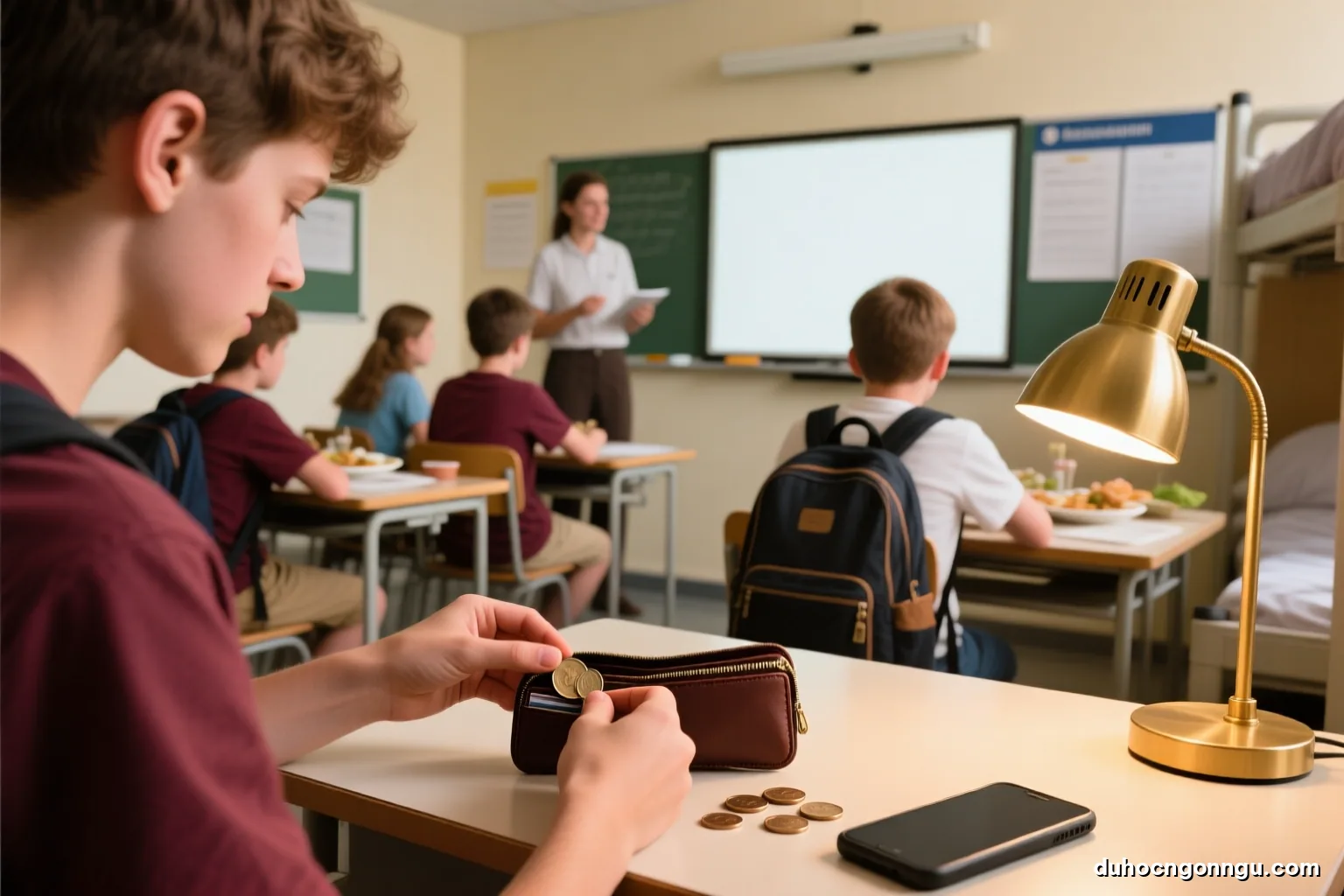
Pocket money for your child on a language course abroad should be worked out from the bottom up: list what the programme does not include that your child may need to spend on each week, multiply by the number of weeks, add a small reserve, then compare with the school's suggested amount if it has one. The money is best split into two forms: a little cash for the first few days and the rest on a card the parents can monitor.
For school students, pocket money is not just about having enough. This is often the first time your child manages a sum of money over several weeks, in a place where they do not know the prices, with a different currency. How parents prepare and hand over the money affects both safety and the lesson about money your child brings home.
What pocket money is used for
Before calculating the amount, you need to know what the programme already includes. An all-inclusive residential summer camp usually includes three meals a day, afternoon activities, scheduled excursions and entrance tickets for them. In that case pocket money is mainly for snacks, drinks, souvenirs and a few personal items. In contrast, a homestay course may only include breakfast and dinner; lunch on school days, the bus or train fare to school, and weekend outings are paid for by your child.
There are also extras that are rarely thought of: extra mobile data, using the coin-operated machines in the residence laundry, replacing something forgotten such as a charger or warm top, optional excursion fees, a birthday present for a classmate, or simply a meal out with a group of new friends.
So the first step is to get the list of what the programme includes, mark the items your child will have to pay for, and ask the school what amount of pocket money it usually recommends to parents. Many junior summer camps have a suggested weekly figure based on the actual experience of students in previous years.
How to estimate by week
The table below is a framework to fill in with the destination's currency. No specific figures are given because prices vary from place to place; the price of lunch in the centre of a big city may be several times that in a small town.
| Item | Questions for estimating | Frequency |
|---|---|---|
| Lunch, snacks, drinks | Which meals does the programme include? How much does your child snack at home? | Daily |
| Transport | Does your child travel to school alone or is there a transfer? Is there a weekly travel pass? | Weekly |
| Optional activities | Which excursions on the schedule are charged separately? Does your child want to do them all? | By schedule |
| Communication | Local SIM or roaming package? Will top-ups be needed? | Weekly or for the whole trip |
| Personal items, laundry | Is laundry free at the accommodation? Toiletries that run out need replacing | Weekly |
| Souvenirs | Whom does your child plan to buy presents for, and how much per person? | Once, usually at the end of the course |
| Reserve | Replacing lost items, small unexpected costs | One amount for the whole trip |
A hypothetical example: if the daily items are estimated at A and the weekly items at B, for a four-week course the regular part is four times (seven times A plus B), then add the activities, presents and reserve. Once calculated, compare it with the school's suggestion. If there is a big gap, go back over each line.
Cash, card, or deposited with the school
No form is perfect; it is usually best to combine two. A comparison of the common options:
| Form | Advantages | Limitations | Suits |
|---|---|---|---|
| Foreign cash | Usable immediately on arrival, not dependent on a network or machine | Lost means gone for good; hard to track | A small amount for the first few days |
| Your child's international debit card or a parent's supplementary card | Parents can top up remotely and see the spending history | Foreign transaction fees, fees for withdrawing at machines abroad | Older students used to cards |
| Prepaid card loaded with foreign currency | The amount can be capped; losing the card does not expose the main account | Need to understand the fee schedule and the loading rate | Families who want to cap spending |
| Deposited with the school | Safe for young students; the school hands it out weekly | Your child has less say, and depends on the school's opening times | Young students at residential camps |
Many junior summer camps offer a banking service: students deposit money on arrival and withdraw as needed or at a fixed weekly amount. Ask the school whether it offers this and whether it keeps a record of each withdrawal. For cards, ask the bank about cards for minors or supplementary cards, the fees for use abroad, and how to block the card quickly in the app.
Pocket money differs by age and type of programme
Ages 8 to 10, all-inclusive residential camp. Almost everything is taken care of; spending is mainly on souvenirs and snacks on excursions. The money is usually held and handed out by the school. The amount needed is low, and letting your child practise paying for a small item in a shop themselves is a lesson worth more than the money.
Ages 11 to 13. Your child starts wanting to buy things themselves and to go out with a group of friends during supervised free time. Spending rises on snacks, presents and personal items. Part can be given to your child to keep, with the rest deposited with the school.
Ages 14 to 17, homestay or a course in a city. Your child may travel to school by public transport, eat lunch out and go out at weekends with friends. This is the group that spends most and most variously. A card with transaction notifications helps parents keep track without asking about every purchase.
University students and working adults travelling on their own. The learner pays for almost everything outside class, including meals if the accommodation does not provide them. The living budget is then close to the real cost of living at the destination, so draw it up using the weekly table above but with all three meals and daily travel.
Children of the same age differ. Some children spend very little, others are easily swept along by their friends. Parents' knowledge of their child's spending habits at home is a better basis than any general figure.
Rules on carrying foreign currency when leaving Vietnam
Under Circular 15/2011/TT-NHNN of the State Bank of Vietnam, individuals leaving the country carrying more than 5,000 US dollars in foreign cash or the equivalent in another currency, or more than 15,000,000 dong in cash, must declare it to customs at the border. A student's pocket money in cash is usually far below this threshold, but parents should know it so as not to exceed it accidentally when combining cash for other expenses, and should check the current rules again before departure.
Destination countries also have their own cash declaration thresholds. The European Union requires a declaration when carrying 10,000 euros or more in cash when entering or leaving the bloc; the United States requires a declaration when carrying more than 10,000 dollars. Other countries have similar rules with different thresholds. Failing to declare when over the threshold can lead to the money being held and a fine.
Beyond the rules, there is a practical reason not to let your child carry a lot of cash: a student carrying a lot of cash is an easy target, and lost cash cannot be recovered. Most spending in the popular language-learning countries can be paid by card.
Teaching your child to manage money during the trip
The trip is a good opportunity for your child to learn to manage money on a small scale. A few simple steps before and during the trip:
- Before leaving, draw up a weekly budget with your child using the table above. A child who understands how the money is divided will find it easier to keep control.
- Teach your child to convert in their head between the destination currency and dong at a rounded rate, so they have a feel for prices.
- Agree which purchases your child can decide on alone and which they must ask about first, for example anything above a certain amount.
- Let your child record their spending each day in a phone note or small notebook, and go over it together during the weekend call.
- If using a card, turn on transaction notifications in the banking app for both your child and the parents.
- Agree how to handle running out of money partway through: your child tells the parents, and the parents top up after both sides have looked at where it went, rather than topping up immediately without asking.
- Tell your child not to lend their card, not to tell anyone their PIN, and not to lend or borrow large sums among friends.
The aim is not to control every penny, but for your child to get used to money having limits and to spending choices being their own choices.
Keeping money safe, and talking about money with your child
Split money between several places. A little cash in the wallet, a little in the suitcase, the card kept somewhere else. Losing the wallet does not mean losing everything.
Withdraw cash from machines inside banks or in busy places, in daylight. Cover the keypad when entering the PIN. If the machine asks whether you want to convert into dong, choose to withdraw in the local currency.
Know how to block the card. Practise with your child beforehand how to block the card in the app or via the bank's emergency number. If the card is lost, block it immediately and then tell the parents.
Talk beforehand about differences between friends. At an international camp, your child will meet friends who spend much more or much less than they do. Tell your child beforehand that everyone has their own budget, there is no need to keep up with anyone, and that turning down an expensive outing is normal.
Do not use money as a substitute for attention. Sending extra money every time your child is sad or homesick easily becomes a habit. A call or a few caring words usually help your child more than a top-up. If homesickness lasts several days, tell the school's person in charge so they can keep an eye on your child too, rather than solving it with money from afar.
Frequently asked questions
Should a 10-year-old carry money?
At this age, most summer camps advise depositing money with the school and having it handed out weekly. Your child should still be allowed to keep a little to practise buying small items. Ask about the camp's rules, as many camps have their own system for holding young students' money.
Should we change all the pocket money into cash in Vietnam?
No. Only change a little for the first few days, for things like transport and drinks, in case the card does not work yet. Keep most of it on a card, which is safer and can be monitored. Change money at banks or organisations licensed to deal in foreign currency.
Are there fees for withdrawing cash from ATMs abroad?
Usually yes: a fee from the card-issuing bank in Vietnam, sometimes an extra fee from the ATM owner, plus the currency conversion fee. Withdrawing less often, a moderate amount each time, helps reduce total fees. Read the card's fee schedule before travelling.
What if our child spends all the money before the course ends?
Look with your child at where it went before topping up. If the estimate was too low, top up just enough and adjust the budget. If it was overspending, top up the minimum for essential needs. The aim is for your child to learn from it.
Does pocket money need to be included in the proof of funds?
Visa applications usually need to show that the sponsor can pay for the whole trip, including living costs at the destination. Pocket money is part of living costs, so the overall budget should include it when estimating the amount that needs proving.
Should we give our child a supplementary credit card?
A supplementary credit card is convenient, but its limit is usually higher than your child needs. If you use one, set a separate limit for the supplementary card and turn on transaction notifications. For many families, a debit or prepaid card is easier to control.