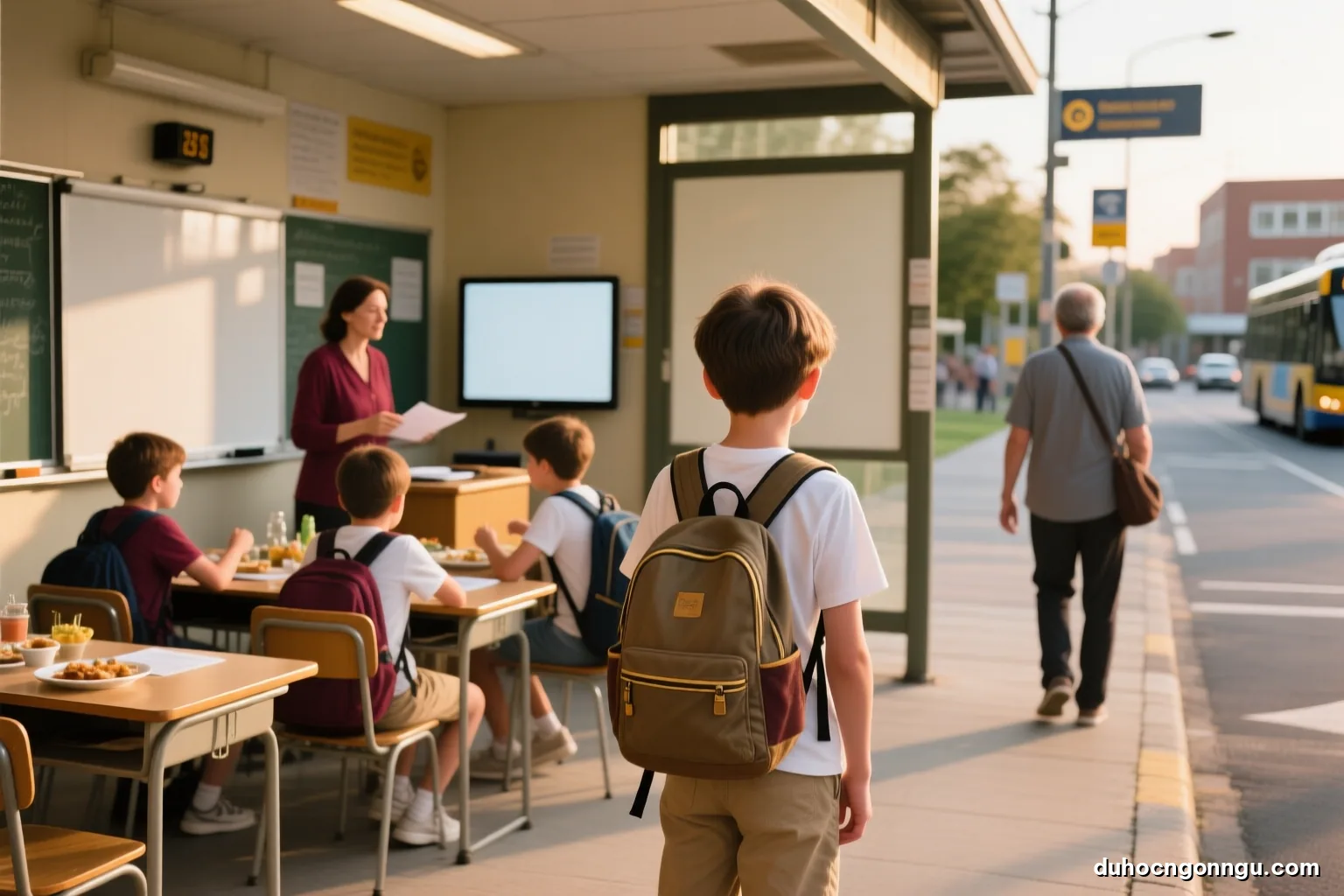
Before a language course away from home, your child should practise five groups of skills right at home: looking after their belongings and daily routine, getting around on their own, speaking survival English in specific situations, knowing what to do when small things go wrong, and living with strangers. Eight weeks is enough to practise gradually, one group a week, on the principle that parents step back bit by bit rather than doing things for them.
The reason for practising beforehand is very practical: the course is short, usually only a few weeks, and the first week decides whether your child gets into the rhythm. A student who spends the whole first week learning how to do laundry, take the bus and order food has less time left for learning the language itself. In contrast, a student already used to looking after themselves can put their energy into lessons and making friends.
This article is for parents of children aged about 8 to 17, but most of it also applies to university students living away from home for the first time. Each part can be practised separately; if time is short, prioritise survival English and handling incidents.
Daily-living skills: looking after belongings and time
Most Vietnamese students aged 10 to 15 do not yet do many household tasks themselves. At a residential camp or homestay, your child has to do the following on their own:
- Get up with an alarm they set themselves, without anyone calling them.
- Prepare their things for the next day: school bag, sports kit, jacket, water bottle.
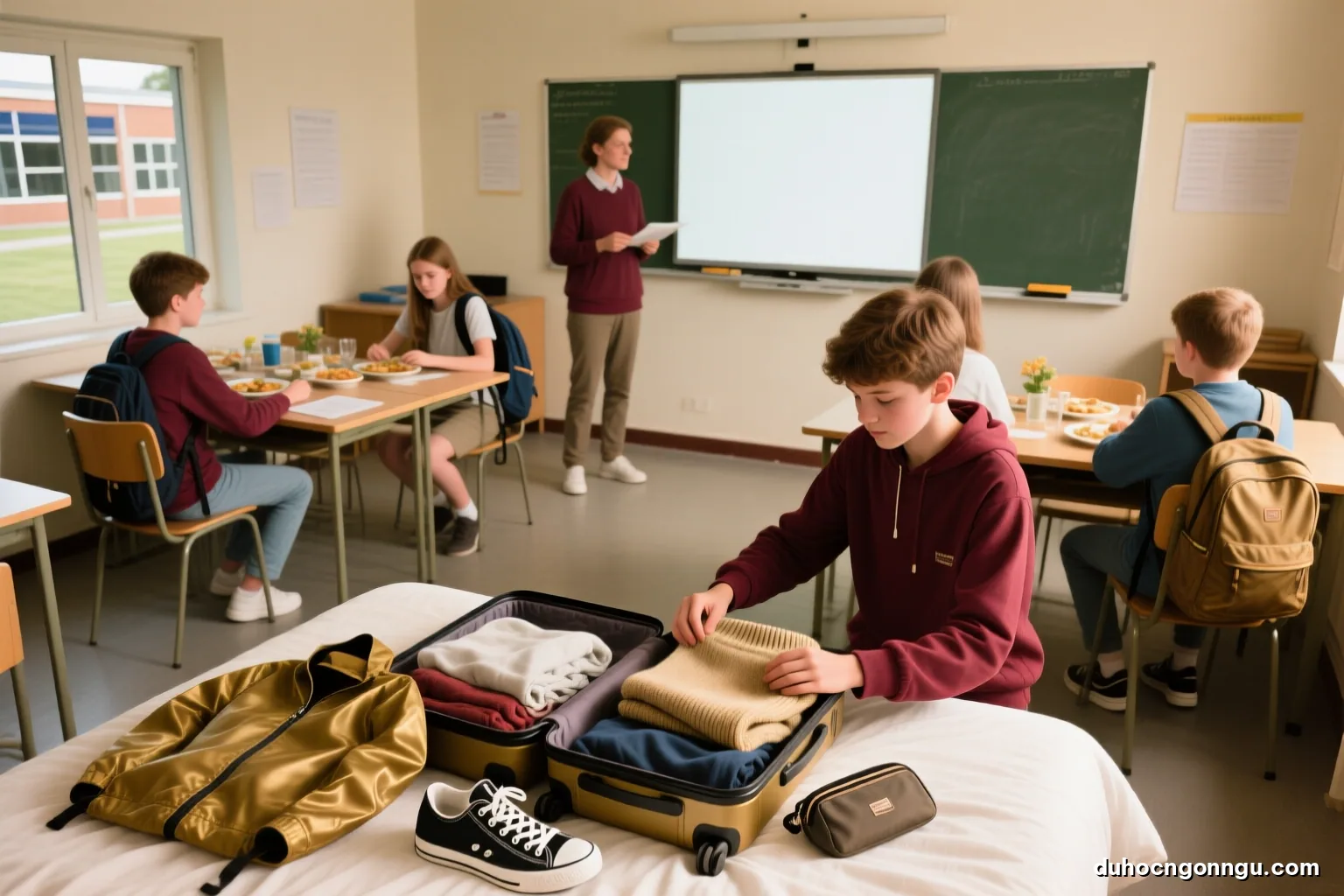
- Wash clothes in a machine, hang them up or tumble-dry them, fold them and put them away. Know how to read the care symbols on clothing labels.
- Keep their room tidy enough not to lose things, especially when sharing.
- Look after their personal items: phone, charger, wallet, keys, access card.
- Shower and wash their hair quickly within a time limit when the bathroom is shared.
- Clear their dishes after meals and help with a small task in the house when in a homestay.
An effective way to practise is to hand over one task completely to your child for the week, without reminders, and let them face a small consequence if they forget, such as having no clean shirt for the next day. Small consequences at home are much cheaper than abroad. When your child does something clumsily, give feedback once and let them do it again rather than doing it for them; your child needs the sense that the task is theirs.
Skills for learning in an international class
Language classes abroad are often different from the classes Vietnamese students are used to in a few ways. Classes are small, desks are arranged in a horseshoe or in groups, and the teacher talks little and lets students talk a lot. Students are expected to put their hands up and ask when they do not understand, to give their own opinions, and to work in pairs or groups with classmates from many countries. A student who is good at grammar but used to sitting quietly listening may find the first few days very hard, not for lack of knowledge but because they are not used to that way of learning.
You can practise at home in a few ways. Encourage your child to ask again when they do not understand, including with adults at home, instead of nodding along. Let your child give a short presentation on a topic they like, first in Vietnamese and then in English, in front of family members. If your child has English lessons at a centre, ask the teacher to let them speak more in the sessions before the trip.
Tell your child to take notes in their own way: a small notebook for new words met during the day and useful phrases heard from friends or the hosts. This notebook helps them review in the evening, and is also something the whole family can look at together when your child comes home. And tell your child in advance that making mistakes when speaking is part of learning, and that teachers and international friends do not laugh at it.
Getting around: practise right in your own city
On many language courses, especially homestay courses for older students, your child has to take the bus or train from the house to school on their own. Even at residential camps, excursions include free time in groups, which requires reading directions and meeting times. These skills can be practised right here in Vietnam.
Start by having your child use a map app on the phone to find their way to a familiar place, then to a place they have never been. Next, practise taking a city bus: looking up the route, waiting at the stop, getting on and off at the right stop, paying or tapping a card. The first time, a parent goes along but lets your child lead; the next time, the parent takes a different bus or stands at a distance; the time after that, your child travels alone on a short route and sends a message on arrival.
Also practise downloading offline maps, because there is not always a signal at the destination. Teach your child one principle: when lost, stop in a busy, safe place, do not wander around, and call the person in charge or ask staff in a shop or station. If there is a chance to take a domestic flight before the trip, let your child check in and find the gate themselves; that is the best airport practice there is.
Survival English: sentences your child must be able to say
Your child does not need to be good at English to go on a language course, but they should be able to say some sentences in important situations. Practise through role-play, with a parent or older sibling playing the other person.
| Situation | Your child needs to be able to say | Why it matters |
|---|---|---|
| Not understanding | Sorry, could you say that again more slowly? | The most used sentence in the first week, it stops your child going silent |
| Asking for directions | Excuse me, how do I get to…? | When lost during free time |
| Allergies, food | I am allergic to… Does this have… in it? | Directly related to safety |
| Illness, pain | I do not feel well. My stomach hurts. | So the person in charge knows early |
| Needing help | Can you help me, please? I am a student at… | When something goes wrong in a public place |
| Saying no | No, thank you. I do not want to. | Your child needs to be able to say "no" clearly and politely |
| In a homestay | Is it okay if I…? What time is dinner? | Helps your child ask rather than guess the household routine |
Write these sentences on a small piece of paper to keep in your child's wallet. When nervous, looking at the paper is easier than remembering. When practising, swap roles so your child plays the person asking and the parent plays someone who answers quickly or uses unfamiliar words, so your child gets used to asking for repetition and does not panic when they cannot keep up.
Handling incidents: practise with "what if…" questions
How to practise. At dinner, a parent describes a situation and lets your child say how they would handle it, then you discuss it together. There is no right or wrong mark, just a search for a better way. A few situations a week is enough.
What if you lose your phone? Your child knows who to tell first, whose phone to use to call home, and which numbers they know by heart or have written down in their wallet.
What if you get separated from the group on an excursion? Your child knows the group's agreed meeting point, knows to stay still in a safe place, and knows who to ask for help.
What if your roommate makes you uncomfortable? Your child knows to talk openly and politely first, and then tell the person in charge if it is not resolved, rather than putting up with it silently for the whole course.
What if someone invites you to break the rules? Your child knows how to say no, knows that rules abroad have real consequences, and knows they are entitled to tell the person in charge without being seen as a "tell-tale".
What if you feel sad and homesick? Your child knows this is a normal feeling, knows whom at school to talk to, and knows the agreed time for calling home.
Living with strangers: homestays and roommates
Living with a local family or a roommate from another country is the part of the experience many students remember most, but it is also where small frictions easily arise. Every household has its own routine: dinner time, shower time, using the washing machine, going into the kitchen, the time to be home. Your child should understand beforehand that in someone else's home you ask before doing things, and that the habits of your own home are not universal.
You can practise this in Vietnam with a holiday at a relative's or a family friend's home, where your child has to follow someone else's routine for a few days. Afterwards, talk it through with your child: what was different from home, what did you find hard, how did you deal with it?
For roommates, teach your child a few basics: agree early on lights-out time, where to keep things and using each other's belongings; keep personal things tidy in their own space; respect a roommate's differences in culture, religion and eating habits without making comments. Many students form lasting friendships with their roommates, but that usually starts with small agreements on the first day.
An 8-week plan at home
The plan below is a suggestion; adjust it to your child's age and current level of independence. The general principle: each week add one group of tasks, and the parents step back one more step.
- Weeks 1 and 2: your child gets up on their own, prepares their things and washes their own clothes once a week.
- Week 3: your child takes a short bus route alone with a parent following on another bus, and uses the map app on their own.
- Week 4: practise survival English through role-play for a few minutes every evening; add the sentences about allergies and health.
- Week 5: your child stays with relatives or acquaintances for a few days, following another household's routine.
- Week 6: start the "what if…" sessions at dinner; your child keeps their own record of spending from a weekly pocket money allowance.
- Week 7: your child makes their own packing list from the school's suggestions and packs a trial suitcase, weighing it and pulling it.
- Week 8: the family reviews everything together; your child explains the flight-day plan, who will meet them, when to call home and what to do if something happens.
If at the end of the eight weeks your child is still very anxious, crying a lot or losing sleep when thinking about the trip, talk it through carefully with them and consider a shorter course, a group trip, or postponing to a later session. The goal is a trip your child wants, not one they have to endure.
Frequently asked questions
Does an 8- or 9-year-old need to practise all these skills?
At this age, children usually go to camps with close adult supervision and rarely have to get around alone. Focus on looking after personal belongings, saying a few survival English sentences, and knowing to speak up when ill or sad. Taking the bus alone is not yet needed.
Our child is older, 16 or 17. Do they still need to practise?
Yes, especially if they will stay in a homestay and travel to school alone. At this age children often feel more confident than their actual abilities justify, so the "what if…" sessions about rules, safety and managing money are worth more than the daily-living skills.
Should our child try sleeping away from home first?
Yes, if your child has never been away from home. A few nights at the grandparents', a relative's or a short camp in Vietnam helps both your child and the parents know in advance how they react to being apart, and gives your child the sense of having done it once.
How can we get our child to practise without feeling forced?
Link the practice to the trip your child is looking forward to, explain the reason for each task, and let your child choose the order. Praise what your child manages on their own, even when it is not perfect. Avoid turning practice sessions into tests.
Is a shy, quiet child suited to a language course away from home?
Many shy students still have good trips, especially when they are well prepared. Practising the necessary English sentences and situations where they have to speak up in advance helps your child worry less. Choosing a course with small classes and close pastoral care also helps your child fit in.
What can parents do to avoid worrying too much?
Thorough preparation is the best way to reduce worry. Agree on times for calling home, know the school's emergency number, and trust what you have practised with your child. Avoid calling constantly in the first few days, because that makes it harder for your child to settle into the new rhythm.