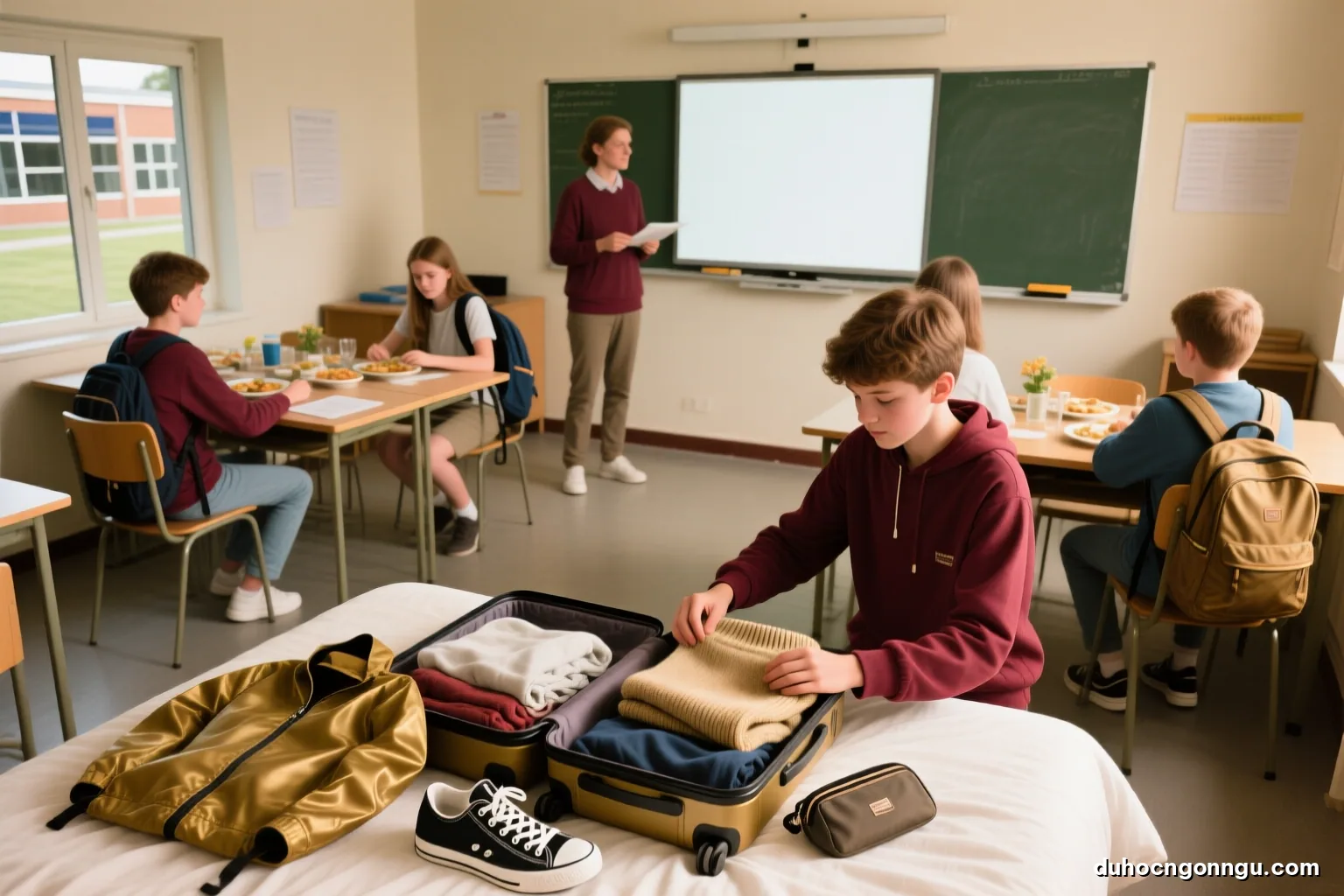
Luggage for a language course of a few weeks should be planned around the laundry cycle rather than the number of days: enough clothes for about a week, plus items for the course's particular activities, documents and medicine in hand luggage, and the right plug adaptor for the destination. What not to bring is fresh food or anything containing meat, eggs or milk, medicine with unknown active ingredients, and more cash than needed.
Parents often pack more than necessary, worried that their child will run short. The result is an overweight suitcase that the child cannot pull themselves, does not know where things are in, and has no room left in for the return. A manageable suitcase, packed by your child themselves from a list, lets them look after their own things at the accommodation, and that is part of learning independence.
Ask the school before making the list
Every course has different needs. A residential summer camp in the countryside may have outdoor activities every afternoon and long walks at weekends; a language course in a big city may only need clothes for class and going out. Before making the list, ask the school for its suggested packing list. Many summer camps have one ready, along with what the school provides and what is not allowed.
Three more questions are worth asking. First, does the accommodation do laundry for students, how often, or does your child have to wash their own clothes in a shared machine? Second, does the school provide bedding and towels? Homestays usually do, but some residences ask students to bring their own towels. Third, are there activities that need special clothing: swimwear, indoor sports shoes, smart clothes for a farewell evening, a uniform top?
At the same time, look up the climate at the destination for the exact weeks of the stay. Summer in many parts of the northern hemisphere has hot days and cool evenings with sudden rain; if going to Australia or New Zealand from June to August, it is winter there. Many Vietnamese students pack only light clothes and then have to buy warm ones in the first week.
A list by category
The table below is a general framework for a course of a few weeks. Adjust it to the school's list and the destination's climate.
| Category | What to bring | Notes |
|---|---|---|
| Documents | Passport, visa, printed document folder, photos saved on the phone | Always in hand luggage |
| Clothes | Enough for about a week, a light rain jacket, a warm top, nightwear | Based on the accommodation's laundry cycle |
| Shoes | One pair for school, one pair of trainers, one pair of indoor slippers | New shoes should be worn in at home for a few weeks first |
| Activity items | Swimwear, hat, sunglasses, personal water bottle, small day backpack | According to the course activity schedule |
| Toiletries | Toothbrush and personal items for the first few days | Most can be bought at the destination |
| Medicine and health | Current medicine for the whole trip plus a few days, prescription in English, face masks | In original packaging, in hand luggage |
| Electronics | Phone, charger, plug adaptor, headphones | Power bank in hand luggage |
| Study | Notebooks, pens, a small dictionary if your child is used to paper ones | The school usually provides course materials |
| Comfort items | Family photos, a familiar object, small gifts for hosts or new friends | Light, and not perishable food |
For young students at residential camps, many camps advise labelling clothes and belongings because shared laundry easily gets mixed up. Use fabric labels or a fabric marker and write the name on the inside.
Clothes by climate and laundry cycle
The simplest way to work out how many clothes to pack is to ask how often the accommodation does laundry, then pack enough for that period plus two or three days spare. If the homestay does laundry once a week, pack about ten sets of underwear, eight or nine tops and a few pairs of trousers. If the residence has shared washing machines and your child does their own laundry, practise using the washing machine at home first, sorting whites from colours and reading the care symbols on clothing labels.
For climate, the principle is several thin layers rather than one thick one. A T-shirt, a sweatshirt or thin jumper, and a wind- and rain-proof jacket can be combined for both sunny days and cold evenings. Many places in Europe and North America have significant differences between day and night temperatures even in midsummer, and rain can come suddenly; a hooded jacket is often more useful than an umbrella.
If going to the Philippines, the hot and humid tropical climate is close to that of southern Vietnam, but classrooms and residences often have the air conditioning turned up cold, so a light jacket is still needed. If going to Australia or New Zealand during the Vietnamese summer holidays, it is winter there, and real warm clothes are needed. Choose clothes that are easy to wash, dry quickly and need little ironing. Wash new clothes once at home to see whether the colours run or they shrink.
Hand luggage: what must stay with your child
Documents and money. Passport, visa, printed document folder, bank card and cash for the first few days. Losing a checked suitcase is a nuisance; losing these brings the trip to a halt.
Medicine. Current medicine, with a prescription or doctor's letter, in the original box with the manufacturer's label. If the checked suitcase goes missing for a few days, your child still has their medicine.
Power banks and loose lithium batteries. Under common aviation safety rules, power banks and loose lithium batteries may not go in checked luggage and must be carried in the cabin, with limits on capacity. Many airlines also restrict using or charging power banks on board. Read the airline's rules before the day of travel.
Liquids. Liquids, gels and sprays in hand luggage are usually limited by the volume of each container and must be in a clear bag. Large tubes of toothpaste and bottles of shampoo should go in the checked suitcase.
A change of clothes and overnight items. In case the suitcase arrives late or a connection is missed. Add a light jacket, as planes are often cold.
Not in hand luggage. Scissors, penknives, anything with a sharp blade, even a nail-clipper set with a small knife, are easily confiscated at security.
What not to bring: food, medicine, gifts
Food is the thing that causes the most trouble at the border. Many countries tightly control bringing in meat, eggs, milk, fresh fruit, seeds and animal-based foods, to protect crops and livestock from disease. Australia and New Zealand are well known for strict biosecurity: passengers must declare all food they carry, and failing to declare it can lead to a fine, even for a packet of dried food. Other countries have their own rules too. The safe approach is not to bring food, or only bring sealed manufacturer-packed items and declare them fully when asked.
Medicine also needs care. Some active ingredients found in medicines commonly sold in Vietnam, for example in some cold remedies or strong painkillers, are controlled in other countries and need documents to bring in. Before departure, look up the destination's rules on medicine for personal use, bring just enough, keep it in its original packaging and carry the prescription.
Gifts for homestay hosts or new friends are a nice gesture. Choose light gifts that are not perishable food: a small handicraft, a scarf, a souvenir with a Vietnamese touch. If you want to give sweets or snacks, choose sealed ones and still declare them on entry.
Sockets, voltage and electronics
Different sockets in different countries are a common reason why a child cannot charge their phone on the first night. A few things to know before buying an adaptor:
- The UK, Ireland and Malta use a three-pin plug with flat pins, usually called type G.
- Australia and New Zealand use a plug with two or three flat pins set at an angle, type I.
- The US and Canada use type A or B, with a common voltage of about 120 volts, lower than in Vietnam.
- The Philippines uses several types of socket, most commonly A, B and C.
- An adaptor only changes the shape of the plug, not the voltage. Most phone and laptop chargers state a wide input voltage range and so work in many places; read the specifications printed on the charger to be sure.
- Heating appliances such as hair dryers and straighteners may not cope with a different voltage; ask whether the accommodation has one before bringing your own.
- A small multi-socket strip lets your child charge several things from one adaptor; ask whether the accommodation allows it, because some residences have their own rules.
Stick a piece of coloured tape on your child's charger and adaptor. Chargers are the things most often left behind or mixed up with a roommate's.
Let your child pack the suitcase and prepare for the return
Parents can prepare the list and go shopping with their child, but should let the child pack the suitcase. When they pack it themselves, they know where everything is, and at the accommodation they will not have to call home to ask where their jacket is. After your child has packed, check it together against the list, then let your child carry the suitcase up and down the stairs once. If they cannot manage it, the suitcase is too heavy for them, and at the airport, the station or the homestay stairs there will be nobody to help.
Weigh the suitcase before going to the airport. Leave a margin below the luggage allowance, because the return is almost always heavier. A foldable bag packed in the suitcase gives your child somewhere to put presents and extra purchases on the way home.
Photograph the outside of the suitcase and its contents, and send a copy to the parents. If the suitcase goes missing, the photos help report it to the airline faster and more accurately. A copy of the packing list inside the suitcase also helps your child check when leaving the accommodation, so nothing is left in the wardrobe or under the bed.
Finally, remind your child: the suitcase is their responsibility throughout the trip. The sense of being able to look after their own things is one of the first changes parents usually notice when their child comes home.
Frequently asked questions
How many sets of clothes are enough for a four-week trip?
Usually only enough for about a week, because the accommodation does laundry regularly. Ask the school about the laundry cycle; if laundry is done once a week, pack a few spare sets. Whether the trip is four weeks or six, the suitcase is almost the same.
Should we pack instant noodles or Vietnamese food for our child?
A little sealed dried food can help with homesickness, but many countries tightly control food containing meat or milk, and some noodle seasoning sachets contain meat. If you pack any, choose manufacturer-packed items, read the ingredients and always declare them on entry.
Does our child need to bring a laptop?
Language courses usually do not require one. If the school has online assignments or your child needs to do work for their school at home, a small laptop is useful, but it adds the risk of loss or breakage. Ask the school and consider how careful your child is.
Where can we buy a plug adaptor?
You can buy one at an electronics shop in Vietnam or at the airport. Choose an adaptor for the right socket type of the destination country, or a multi-pin universal type. Pack a spare, as this is something easily lost.
Should the suitcase be locked?
A lock helps prevent the suitcase being opened casually, but airport security in some countries may need to open it for inspection. A lock that security services can open with a special key avoids it being broken. Valuables should always go in hand luggage.
What should our child do if the suitcase goes missing?
Go to the airline's lost luggage desk at the arrival airport straight away, before leaving the baggage reclaim area, report it using the baggage tag and photos of the suitcase, and get a receipt. Tell the school and the family. The change of clothes in hand luggage will get your child through the first few days.