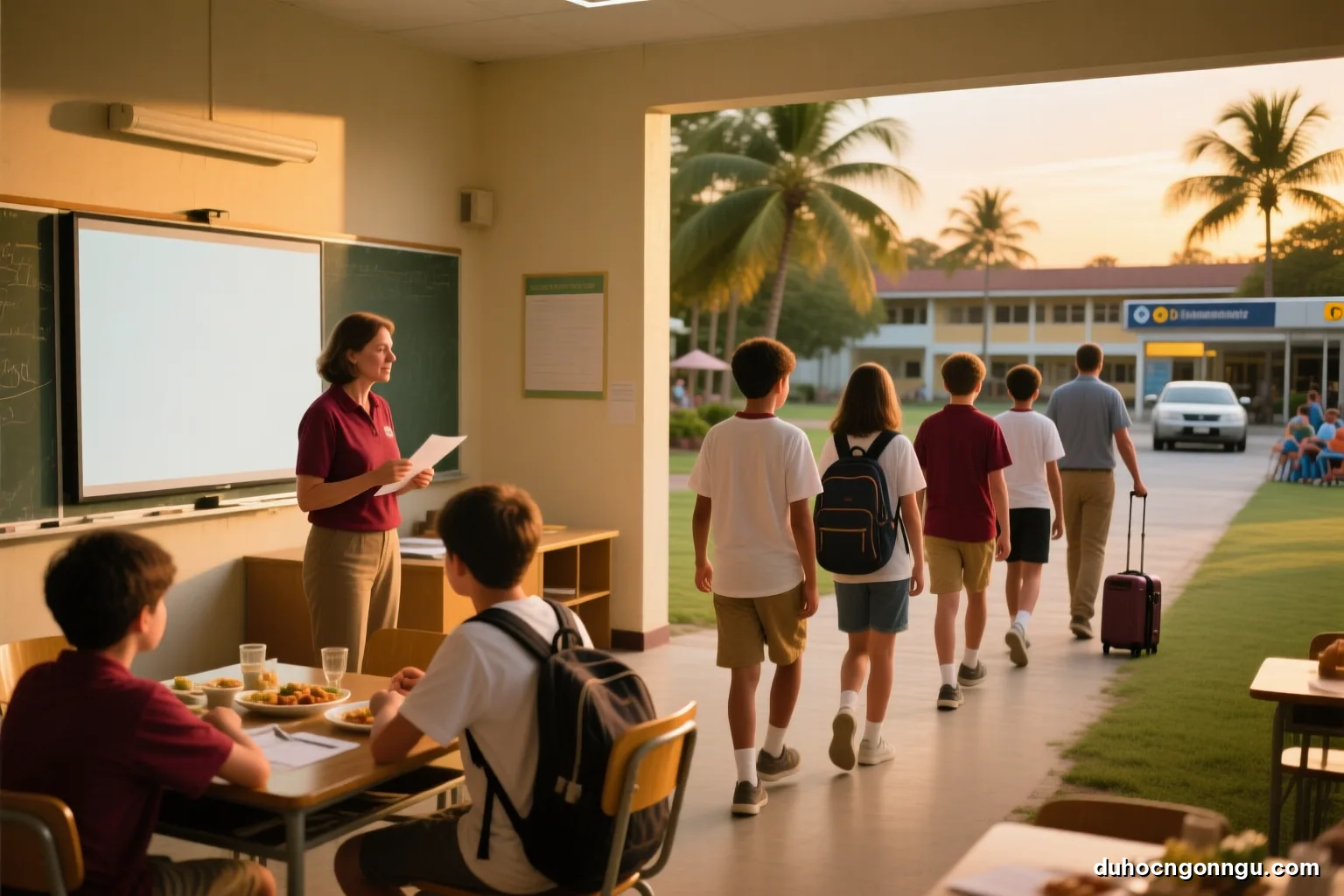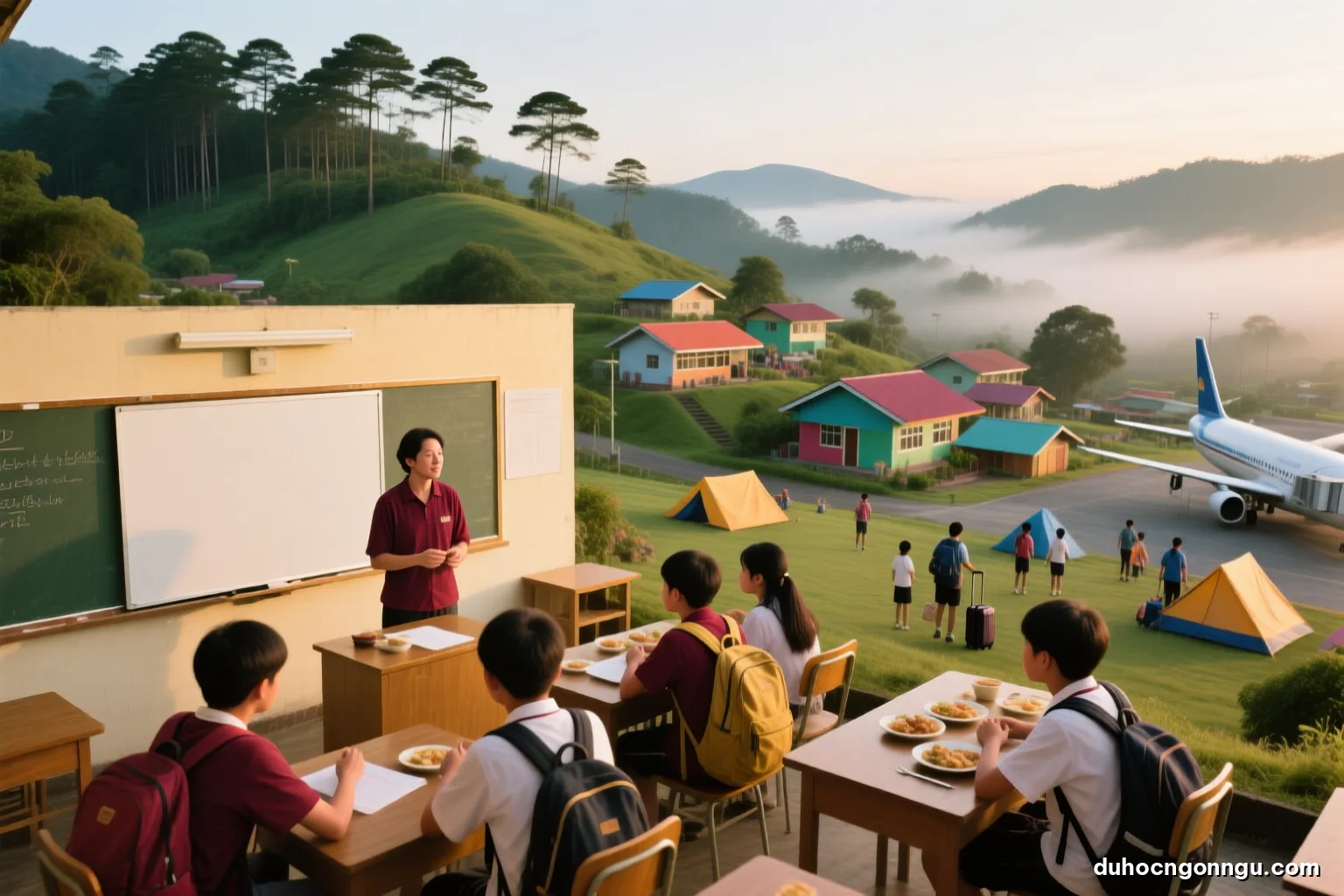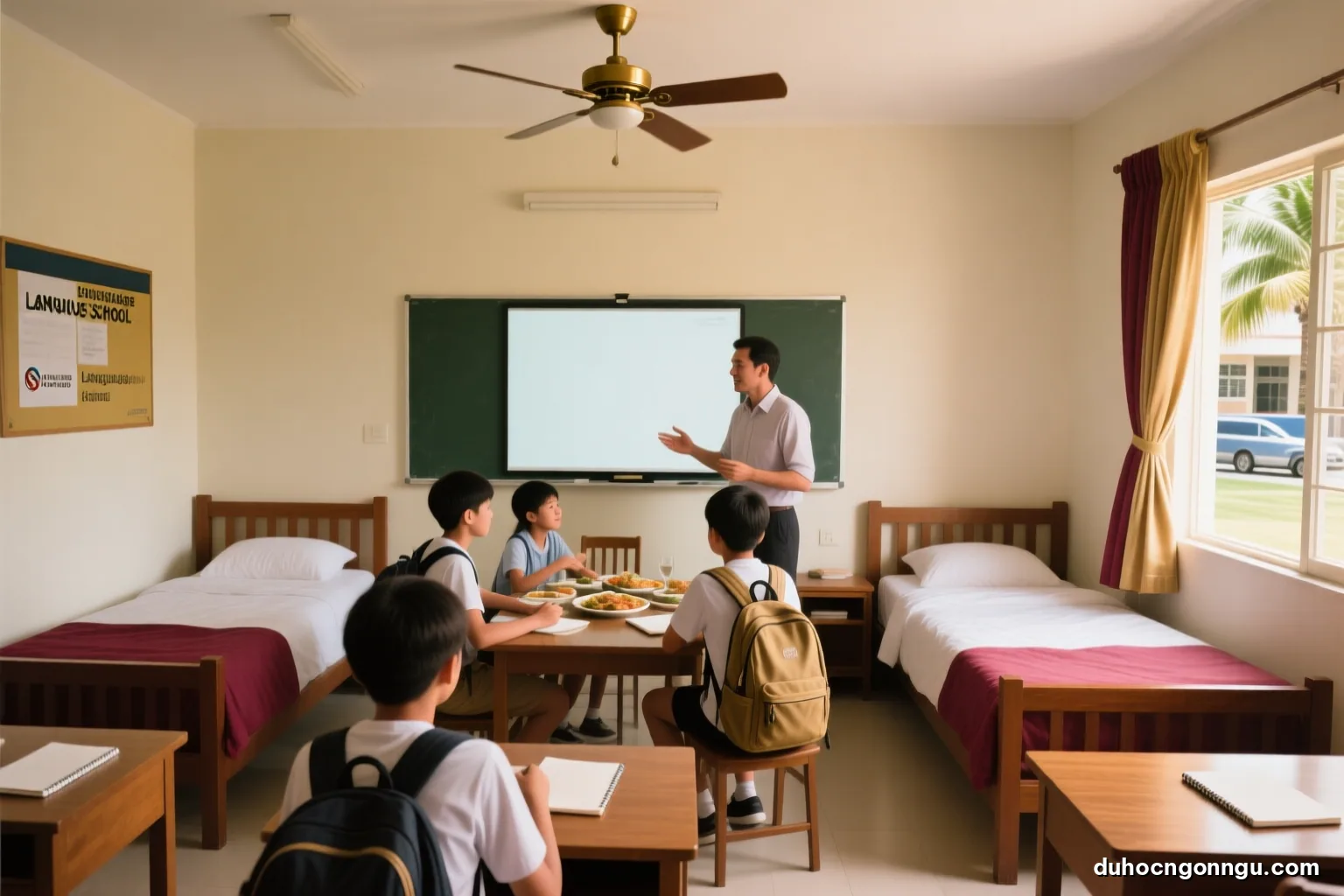
Most students on English courses in the Philippines live in a dormitory on the school campus, choosing a room for one to six people, with three meals a day provided by the school, and laundry and room cleaning several times a week. This all-inclusive way of living is part of the reason the Philippine model is easy to manage for teenagers: your child does not have to cook, go shopping for food or take a bus to class, and everything happens inside a guarded compound.
But the dormitory is also where your child spends most of their time outside class, and where most problems arise: not getting on with a roommate, unfamiliar food, lost belongings, noise, a broken air conditioner. Which room type to choose, who to share with, what to pack and how to read the dormitory rules are things to sort out before departure, not when your child calls home to complain.
This article describes the arrangements common at language schools. Details differ from school to school, so parents should always ask for real photos of the rooms, the dormitory rules and a sample menu from the specific school their child plans to attend.
Room types and what to consider
Schools usually have several room types at different prices. The table below does not give prices; it only sets out the pros and cons for the family to weigh up.
| Room type | Pros | Cons | Suits |
|---|---|---|---|
| Single room | Quiet, good sleep, easy to keep belongings safe | Few chances to speak English with a roommate, easy to feel lonely | Adults, working people |
| Twin room | Company while keeping some privacy | Whether it works depends on a single person | Older teenagers, university students |
| Room for three or four | Easy to make friends, plenty of chances to speak English if nationalities are mixed | Noisier, more clashes over schedules | Lower and upper secondary pupils |
| Room for five or six | A summer-camp atmosphere, less homesickness | Little privacy, hard to sleep if someone stays up late | Teenage camps travelling as a group |
For children, a shared room is not necessarily a worse choice. Having roommates helps a child feel less lonely on the first night, and if the roommate is from another country, that is a free English lesson every evening. What to ask is how the school assigns rooms: by age, sex, nationality, or simply in order of registration.
Mixing nationalities in rooms: the benefits and how to ask for it
Many schools have a policy of putting students of different nationalities in the same room, because it is the most effective way of making English the language of everyday life. Two children, one Vietnamese and one Japanese, have to speak English to each other to agree on lights-out, borrow things and invite each other to eat. Those small, scrappy conversations are exactly the comprehensible input that the classroom cannot supply enough of.
However, the policy depends on the mix of students at any given time. In the peak months for Vietnamese students, the school may not have enough students from other countries to mix rooms. Parents can request in writing at registration that they would like their child to share with a student of another nationality if possible; the school cannot promise, but will give it priority when allocating rooms.
On the other hand, some families want two siblings or two close friends to share for peace of mind. This is a reasonable choice for young children away from home for the first time, as long as you accept there will be less English outside class. One compromise is to let them share for the first week and then change rooms once they have settled in, if the school allows it.
Conflicts between roommates usually revolve around small things: bedtimes, desk lamps, phone noise, sharing the bathroom. It is worth teaching your child how to speak directly but politely in English, for example suggesting lights-out at eleven or asking to change shower times. When they cannot sort it out themselves, your child should tell the dormitory supervisor early rather than putting up with it until the end of the course.
Meals: what, where, and special diets
Three meals a day are usually served in the school canteen, buffet-style or as set meals, from Monday to Sunday or with a few weekend meals excluded. At many schools the menu leans towards Korean and Filipino dishes because of the history of the student body; some add simple Western dishes. Rice is the familiar staple, so most Vietnamese children have no great difficulty, though spicy or sweet flavours may be unfamiliar.
Picky eating is a common worry for parents. Ask for a sample week's menu, show it to your child in advance, and ask whether the school has backup options such as eggs, noodles and fruit when your child cannot eat the main dish. A few familiar dry snacks from home help your child through the first days, but do not pack too many, since dormitories often ban opened food in rooms because of ants and insects.
For children with food allergies or special diets, inform the school in writing in English before departure, with a specific list of foods to avoid, and ask whether the kitchen can keep them separate. Serious allergies such as peanut or seafood allergies must be known to both the guardian and the kitchen, and your child should carry medication as prescribed by the doctor.
Laundry, cleaning and other services
Laundry. Many schools offer a laundry service several times a week: students put their clothes in a named bag, staff wash them and return them. Clothes can get mixed up or fade, so write your child's name on the labels, avoid packing expensive clothes, and show your child how to hand-wash underwear. Young children should pack enough clothes for at least a week.
Room cleaning. Cleaning staff usually work to a schedule, mopping floors, emptying bins and changing bed sheets periodically. Your child still has to organise their own belongings and keep their desk tidy. Remind your child to put money, phone and passport in a locked cupboard or hand them to the guardian before cleaning time.
Electricity and air conditioning. The Philippines uses 220 volts like Vietnam but at 60 Hz, and the common sockets take flat pins. Pack one or two plug adapters. Some schools charge separately for the electricity used by in-room air conditioning, so ask in advance to avoid a surprise at the end of the course.
Internet. Most dormitories have wifi, but it can be slow in the evenings when the whole school is online. For students who need frequent video calls, a local SIM card with a data package is a good backup.
Shared facilities. Some schools have a gym, swimming pool, sports ground, convenience store or clinic on campus. Ask about opening hours and the rules for teenage students, especially for the pool.
Security and dormitory rules
On-campus dormitories usually have guards at the gate and cameras in shared areas, and students enter with a card or must sign in. Boys' and girls' areas are usually separate, and at schools that accept both minors and adults, the under-18 area is separated from the adult one. These are points parents should ask about directly, not assume.
Dormitory rules typically ban alcohol, smoking, opened food in rooms, cooking with electrical appliances and non-student visitors in rooms, and schools with strict discipline set a lights-out time. Repeated violations can lead to a room change, a fine or expulsion. Reading the rules together with your child beforehand helps them understand that these are general rules for everyone, not strictness aimed at them.
Things can go missing in a dormitory, as in any crowded place. Tell your child not to keep much cash in the room, not to lend their phone and to lock the door when going out. The passport should be handed to the office or the guardian to keep in a safe, with your child carrying a copy. If something goes missing, report it to the dormitory office straight away so they can record it and help.
A question worth asking the school is who is on duty in the dormitory at night, who to call in an emergency such as illness, a power cut or a fire, and whether the school has held evacuation drills. A specific answer shows that security is actually done, not just a line in the brochure.
Living off campus: an option for older students
Some schools, especially in Manila and at schools with a free-style schedule, let adult students live off campus: in a partner hotel, a serviced apartment or a rented room near the school. This gives more freedom, with the chance to cook and come and go as you like, but in return costs travel time, means looking after your own security and offers less of an English environment outside class.
Homestays with Filipino families are not as common in the language-school model as they are in English-speaking countries, but some schools or organisers do arrange them. If you choose this, ask carefully who checks the host families, how far the home is from the school, how your child will get there, and which adult is responsible if something goes wrong.
For students under eighteen, living off campus is almost never a recommended option, unless a parent is living with them. The biggest advantage of the residential model is that there is a guardian and a clear framework for daily life, and that is exactly what a family needs most while their child is young.
What to pack for a four- to eight-week course
The list below is based on typical living conditions in language-school dormitories. Adjust it for the city and the season your child is going in:
- Light, breathable clothes for the hot, humid climate; a light jacket for air-conditioned rooms and for Baguio.
- A raincoat or folding umbrella, shower slippers, a small spare towel.
- Plug adapters, a spare charging cable, a small reading light if the school turns lights off early.
- Sunscreen, mosquito repellent, regular medicines in their original packaging.
- A small padlock for the locker, a laundry bag with your child's name on it.
- A few familiar dry snacks in sealed packs, enough for the first few days.
- A notebook, pens, a pencil case; earphones for listening practice in the evening.
There is no need to pack too much: most personal items can be bought at a supermarket near the school. A compact suitcase makes it easier for your child to manage on their own, and leaves room for presents to bring home.
Frequently asked questions
Do dormitory rooms have their own bathroom?
It depends on the school and the room type. Many language-school dormitories have a bathroom and toilet in each room; some older blocks or multi-bed rooms use shared bathrooms on each floor. Ask the school and request real photos of the room, especially for young children or children who are uncomfortable using shared facilities.
Can my child change rooms during the course?
Most schools allow a room change for a clear reason, such as not getting on with a roommate or a health problem, provided a room is free. There may be a fee if changing to a different room type. For teenagers, it is best for the guardian to talk to the dormitory office on your child's behalf.
Is there hot water for showers?
Many dormitories have water heaters in the bathrooms, especially in Baguio because of the cool climate. In hot areas such as Cebu or Clark, some places only have unheated water, which is not very cold anyway because of the climate. If your child is used to hot showers, ask in advance so they are prepared.
Is the tap water in the dormitory safe to drink?
Your child should not drink tap water directly. Schools usually have filtered water dispensers in corridors or the canteen. Tell your child to use filtered water for drinking, and for brushing their teeth if they have a sensitive stomach, and pack a personal water bottle to make refilling easier.
Can we send things or presents from Vietnam to our child?
You can send them by international courier, but it takes time, may involve taxes and customs procedures, and on a short course the parcel often arrives just as your child is about to leave. It is usually more convenient to have your child pack everything at the start or buy things locally. If you still want to send something, ask the school for the delivery address and who can receive it.
Do dormitories have a weekend curfew?
Yes, at almost every school that accepts teenagers, and the weekend curfew is usually a little later than on weekdays. Schools with a free-style schedule for adults may have no fixed time. The exact rules are in the dormitory regulations, which are worth reading with your child before departure.