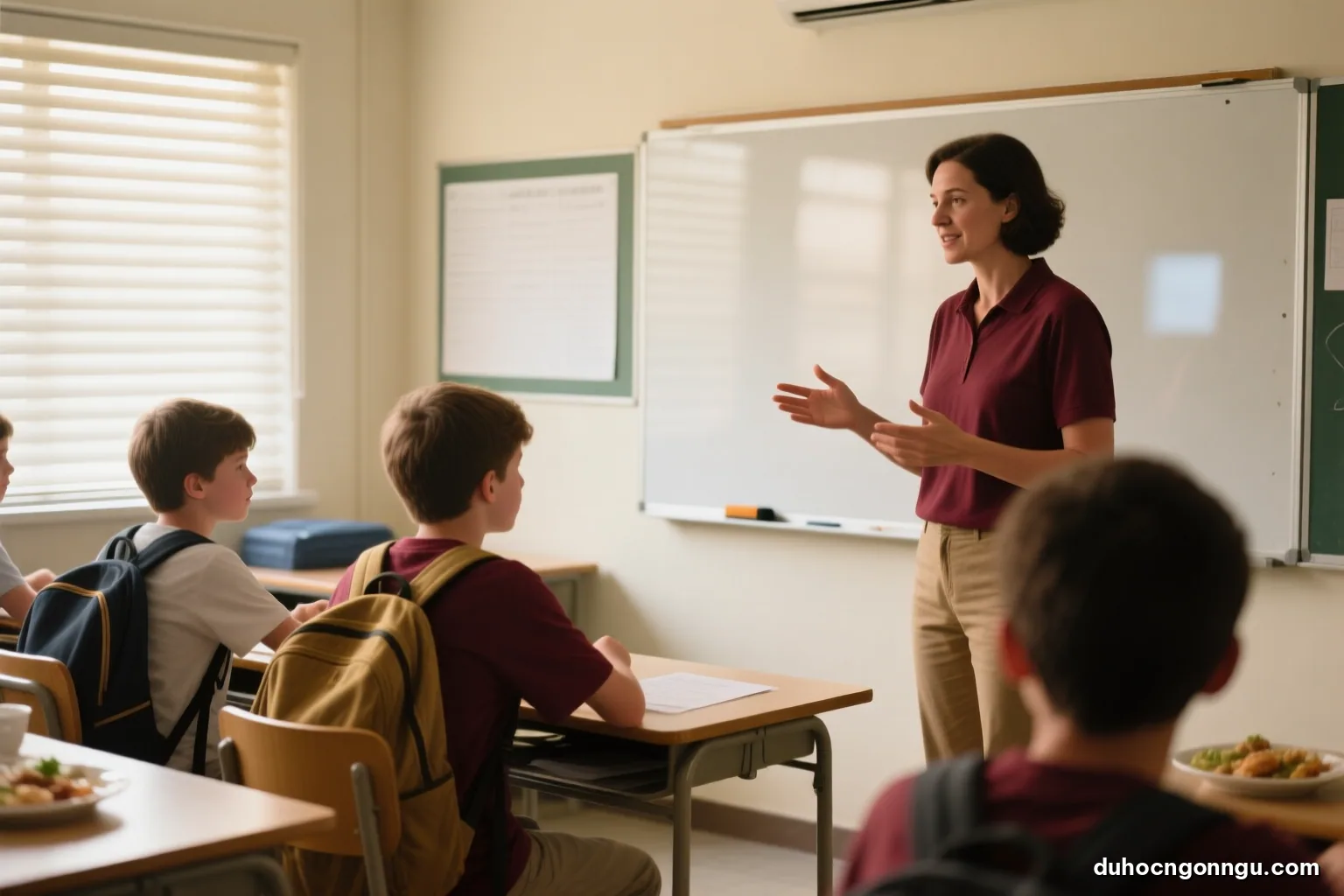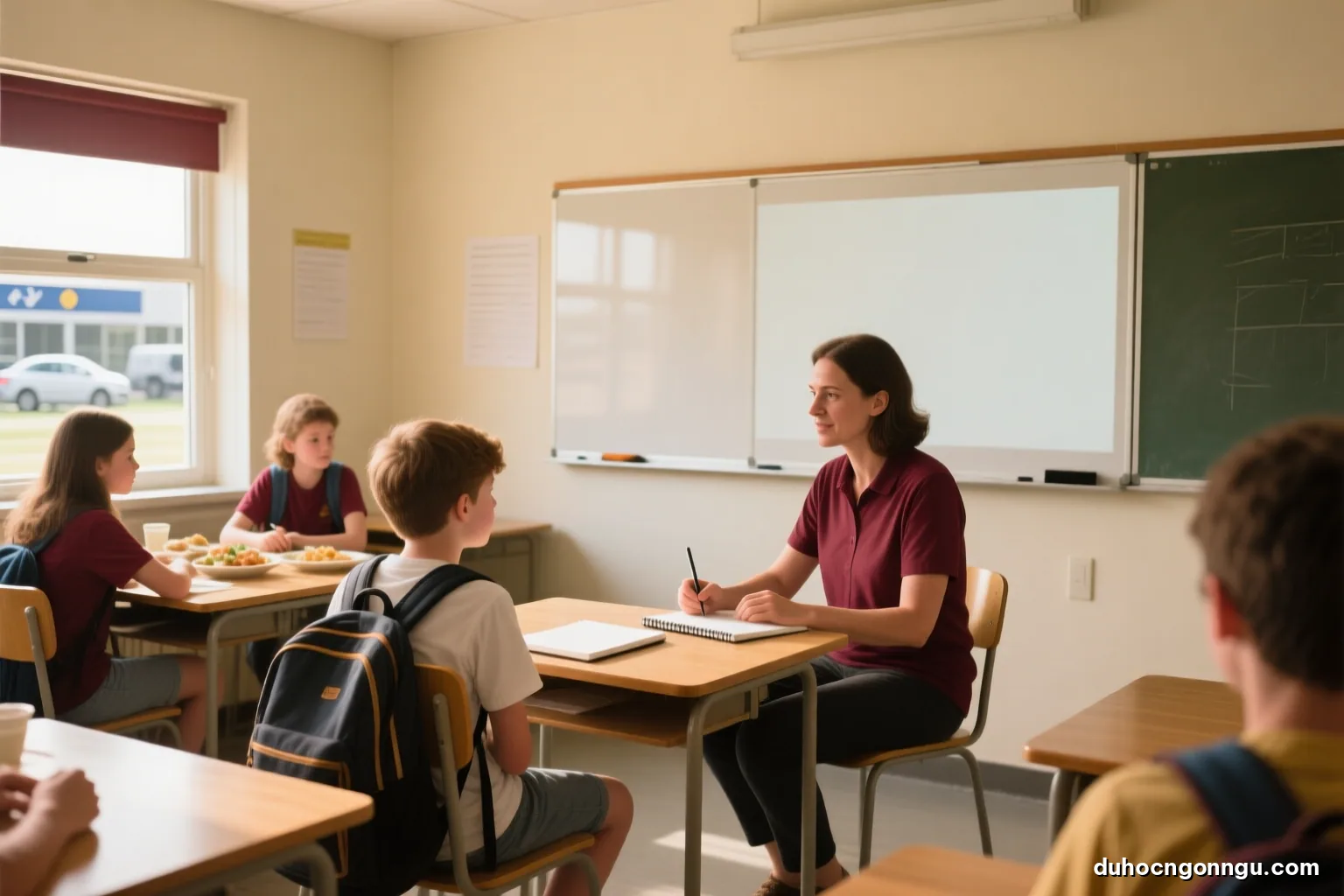
A day at an English school in the Philippines usually has four to six one-to-one lessons, one to four small-group lessons, plus evening self-study; each lesson lasts about forty-five to fifty minutes. The one-to-one class is where your child speaks the most and gets corrected the most, the group class is where they practise listening to others and discussing, and self-study time is for writing things up, reviewing and preparing for the next day.
The exact numbers vary by school and by package, so parents should ask for a sample timetable for the very course their child is enrolling in. This article describes the general structure, what happens inside a one-to-one lesson, and how to help your child not waste the most valuable hours of the trip.
A sample timetable from morning to evening
The timetable below is a hypothetical example for a lower-secondary pupil at a semi-sparta school, built from the way language schools are commonly organised. Actual times at each school may differ by a few dozen minutes.
| Time of day | Activity | Purpose |
|---|---|---|
| Early morning | Breakfast; some schools add an optional lesson such as pronunciation | Warming up, getting focused |
| Morning | Two to three one-to-one lessons in a row, with short breaks | Speaking, listening, individual error correction |
| Midday | Lunch, rest | Recovery |
| Early afternoon | One or two group lessons of four to eight students | Discussion, presentations, hearing many accents |
| Late afternoon | One or two more one-to-one lessons | Writing, reading or other weak skills |
| Evening | Dinner, then one or two hours of supervised self-study | Reviewing vocabulary, homework, preparing for the next day |
| Weekend | No classes; extracurricular activities organised by the school | Using English outside class, resting |
Looking at the total hours, a day like this is very full for a child who is not used to it. Parents of children under twelve should ask whether the school has a lighter timetable for young learners, as many junior camps cut the number of lessons and add activity time.
Inside fifty minutes of one-to-one teaching
A good one-to-one lesson is not fifty minutes of free chat. Teachers usually have course materials for each skill: a topic-based speaking lesson, a listening lesson, a reading lesson, a writing lesson, a pronunciation or grammar lesson. Each lesson follows a rhythm: a quick review of the previous lesson, new content, practice, then homework.
In a speaking lesson, the teacher asks open questions, lets your child give long answers, notes down recurring mistakes, then stops to correct them. Common ways of correcting are repeating your child's sentence in the correct form, or asking your child to correct it themselves when the teacher points to the mistake. In a writing lesson, your child writes a short paragraph on the spot, and the teacher reads it and corrects it right there on the page, explaining why. This is what a large class cannot do: each mistake is dealt with while your child still remembers what they meant to say.
And because they sit face to face for the whole lesson, your child has nowhere to "hide". For introverted children, the first few days are quite tiring. An experienced teacher will start with familiar topics such as family, hobbies and food, and only then raise the level. If after a week your child is still answering in one or two words, parents should ask the school how the teacher is encouraging them, rather than simply changing teacher.
What group lessons and self-study time are for
Group lessons let your child hear many accents. In one-to-one lessons, your child gets used to one person's voice. A group class has classmates from Korea, Japan, Taiwan or elsewhere, each with their own pronunciation. Learning to understand those accents is a real skill, because in real life your child will use English with non-native speakers more often than with native speakers.
Group lessons are where your child practises debating and presenting. Activities such as pair discussions, role-plays and presenting an opinion to a group are hard to do in a class of two. Your child learns how to cut in politely, disagree and summarise other people's ideas, all of which they will need for future study.
Self-study time is where knowledge stays. If your child only studies in class and then goes off to play, today's new words will drift away by tomorrow. Evening self-study, which at sparta schools is usually compulsory with a roll call, is when your child writes up the phrases they have learned, does writing tasks and prepares topics for the next day's speaking lesson.
Optional lessons fill the gaps. Many schools offer optional evening or early-morning lessons such as pronunciation, film discussion or topic-based vocabulary. If your child has the energy, they can join; if they are tired, getting enough sleep should come first.
The first day: placement test and timetable
Most schools devote the first day to orientation and testing. Knowing the sequence helps your child not feel lost:
- Checking into the room, receiving the rules, a tour of the campus and an introduction to the staff in charge of students.
- Taking the placement test, covering listening, reading, grammar and short writing, plus a speaking interview with a teacher.
- The school assigns a level, often converted to the CEFR or an in-house scale, and chooses the course materials.
- Your child receives a personal timetable with the teacher's name and classroom for each lesson.
- In the first few days, your child can ask for adjustments if the material is too easy or too hard.
Parents should tell their child to take the placement test honestly and not guess wildly to get placed higher. Placed too high, your child cannot keep up and loses confidence; placed too low, time is wasted. This test is also the benchmark to compare with the end-of-course result.
When your child does not get on with a teacher
Not getting on with a teacher is quite common: the teacher speaks too fast, corrects too little, or on the contrary corrects so much that your child becomes afraid to speak. Most schools have a procedure for changing teachers, usually done weekly through the academic office or the student manager. Some schools allow a certain number of free changes; others change whenever a teacher is available.
Before changing, help your child name the specific problem. "She's not good" helps nobody; "he talks fast and I don't understand the exercises" or "she doesn't let me speak much" is something the office can deal with, and sometimes a conversation with the teacher is enough. Older children can raise it themselves; for younger children, the guardian or group leader should do it for them.
On the other hand, parents should be careful about changing teachers repeatedly. Each time, the new teacher needs a few lessons to get to know your child. A strict teacher who corrects a lot may not be pleasant at first, but is often the one who helps your child progress most. The test should be whether your child gets to speak a lot and is corrected systematically, not whether the lessons are fun.
Tracking progress mid-course: what parents should receive
For courses of four weeks or more, schools usually hold regular tests, weekly or monthly, in the same format as the placement test. Results come with comments from each one-to-one teacher on strong and weak skills and what to work on next. Parents should ask at the start: how the report is sent, in which language, how often, and whether someone can explain it if it is unclear.
A useful report states your child's level on a clear scale, for example mapped to the CEFR, and gives concrete examples: your child now tells stories in the past tense more accurately, still drops final sounds, and still makes linking mistakes in compound sentences. A report with only general phrases such as "hard-working, making good progress" does not help the family know what to do next when their child comes home.
It is also worth understanding that progress over a few weeks usually shows most clearly in fluency and confidence, and more slowly in grammatical accuracy and vocabulary. A small rise in test scores does not mean the course was useless; equally, a quick rise in an internal test is not necessarily equivalent to an international exam. Read the report as information, then compare it with what you hear when you talk to your child.
How face-to-face one-to-one lessons differ from online one-to-one lessons
Density. Online lessons with Filipino teachers are usually one or two sessions a day, squeezed between school and chores. At the school, your child has four to six one-to-one lessons a day, continuously, for several weeks. High density means vocabulary and structures just learned are used again the very next day, instead of waiting until the next session.
Non-verbal signals. Sitting at the same table, the teacher sees your child frown, hesitate or glance at their notebook, and changes the explanation or slows down. Through a small screen, most of these signals are lost, especially with quiet children. Face-to-face lessons therefore usually get shy children talking sooner.
No way out. After an online session, your child goes back to the Vietnamese around them. At the school, breaks, meals and self-study still happen in English if the rules are kept. This is the biggest difference, and the reason a short on-site course can bring a real shift in confidence.
Online lessons still have their place. Before the trip, a few weeks of online lessons help your child get used to Filipino teachers' accents and the one-to-one format. After the trip, they are a cheap and convenient way to keep speaking regularly. The two formats do not exclude each other.
Helping your child make the most of one-to-one time, before and during the trip
One-to-one time is the most valuable part of the course. A few small things help your child use it where it counts:
- Before departure, list with your child three or four situations they want to be able to handle in speech, for example a two-minute self-introduction, telling the story of a trip, or presenting an opinion.
- Prepare a notebook just for recording frequent mistakes and the corrected sentences; reread it at the end of each week.
- Tell your child to ask again in English when they do not understand, rather than nodding along.
- At the end of each week, your child writes a few lines: what new things they could say this week and what they still struggle with, then shows it to the teacher.
- Call your child at a fixed time and ask about one thing they learned, not only about food and sleep.
None of this takes extra lesson time, but it turns the course from your child being taught into your child actively using the teacher. In a one-to-one class, the learner's initiative decides a great deal.
Frequently asked questions
Are one-to-one classes too intense for a ten-year-old?
They can be, if the timetable has five or six lessons a day as for adults. Junior camps usually cut the number of one-to-one lessons and mix in games, activities and a longer midday break. Parents should ask for the timetable for their child's age group and watch whether their child is getting enough sleep in the first week.
Do one-to-one teachers follow a syllabus or teach as they please?
A decent school has course materials for each skill and level, and teachers keep records of each student's progress. Parents can ask for the name of the materials or a sample page. If the school replies that teachers simply chat about whatever the student likes, that is a conversation class, not a course with a learning path.
Can my child choose which skills to focus on in one-to-one lessons?
Many schools let students choose a focus, for example more speaking and less grammar, after seeing the placement results. For young children, it is best to let the school propose a plan based on the test, while parents state the family's goal clearly: communication, reading, or preparing for an exam.
Does the number of lessons in the advert include self-study time?
Some schools count it, some do not. This is a common source of confusion when comparing two programmes. Ask separately for three numbers: one-to-one lessons, group lessons and hours of supervised self-study per day, and only then compare.
If my child falls ill, can missed lessons be made up?
Each school has its own policy. Some schools allow make-up lessons within certain limits if notified in advance; others do not make up lessons missed for personal reasons. Parents should ask before enrolling, especially for short courses of two or three weeks, because missing a few days means missing a large part of the course.
Do one-to-one teachers speak Vietnamese?
Almost never. Teachers at Philippine language schools are Filipinos who teach entirely in English. Some schools have Vietnamese staff in the office to support students and parents, but they do not teach. This is exactly what forces your child to use English.