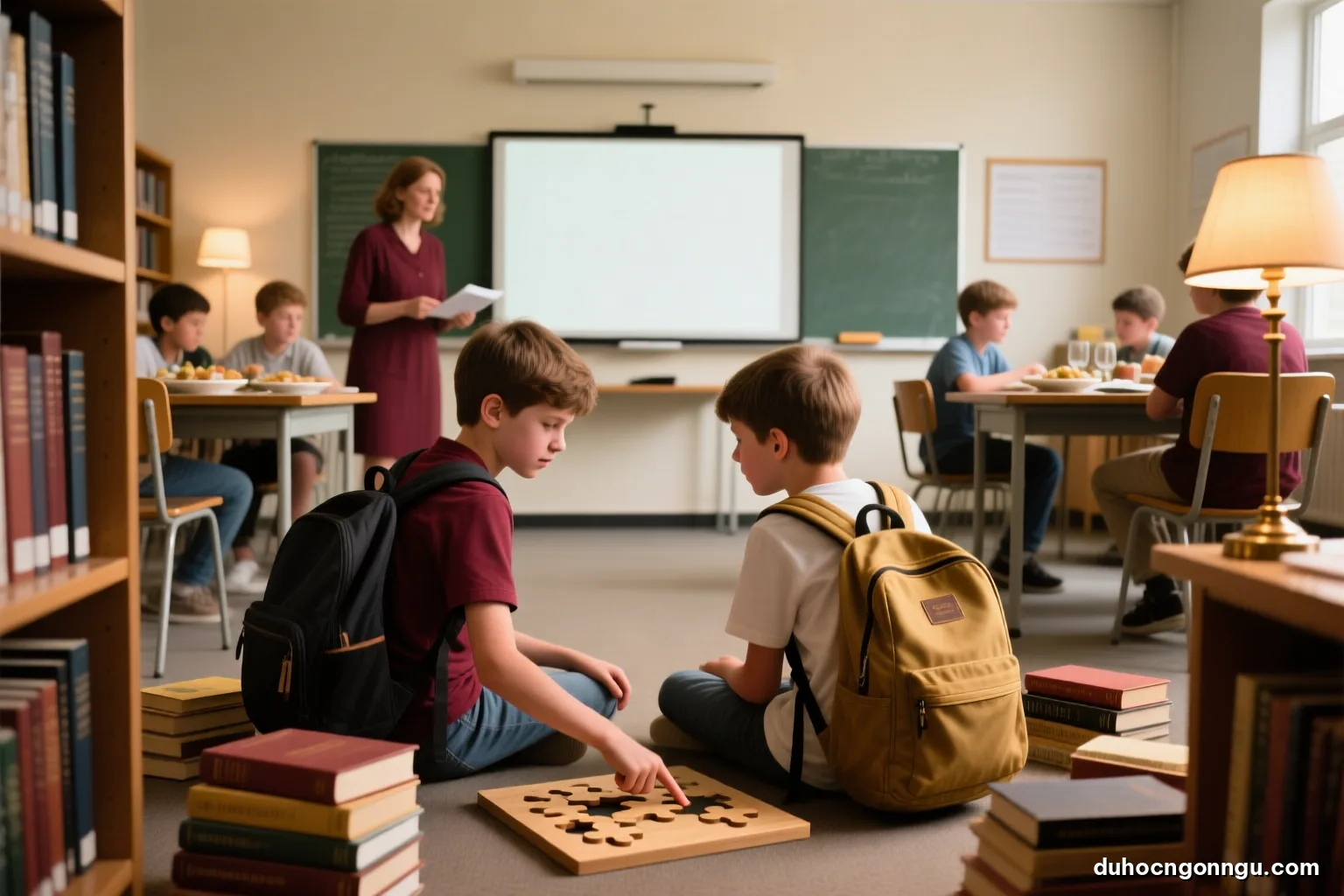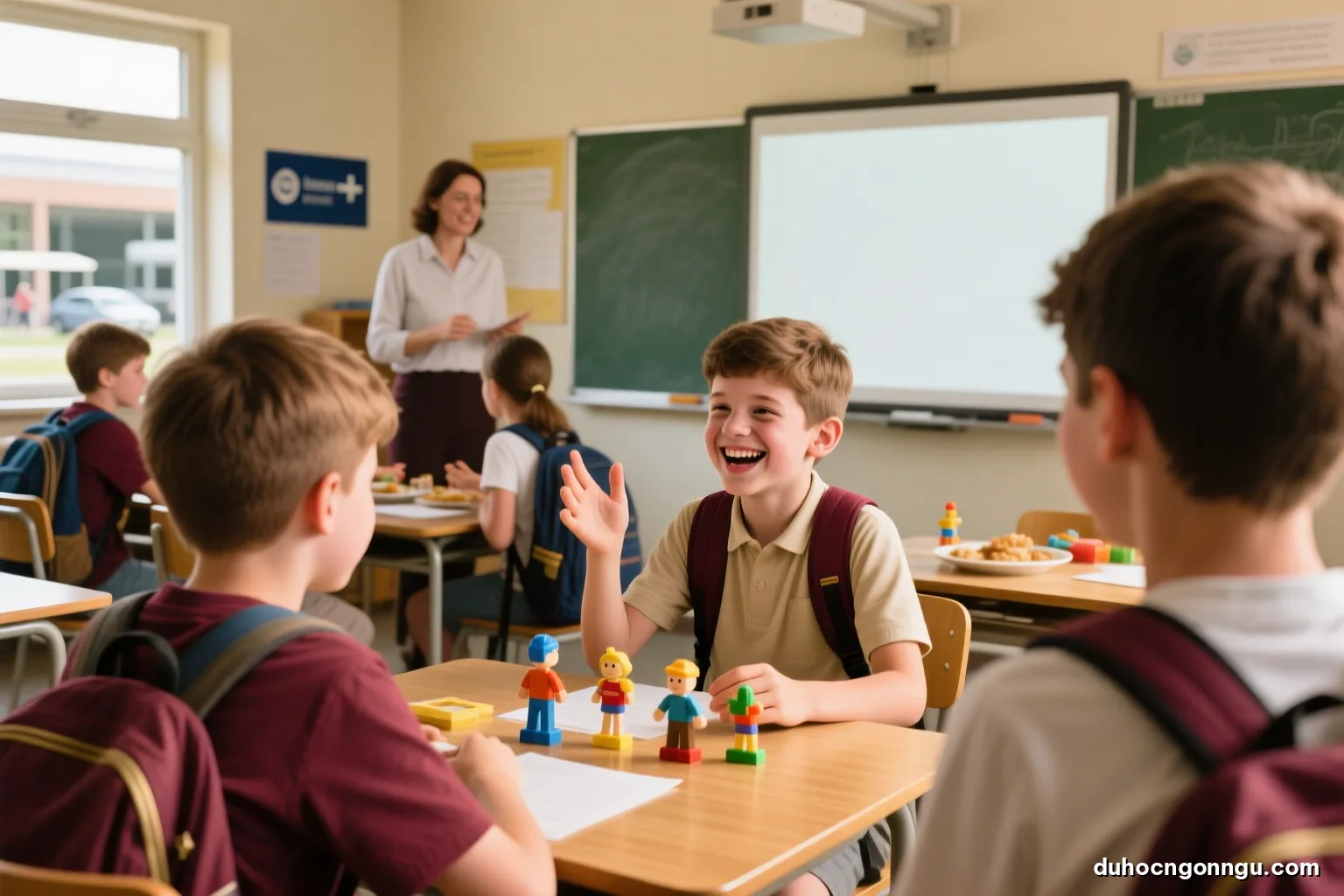
Language immersion is a way of learning in which the target language is used as the medium for studying and daily life, not just as a school subject. The most thoroughly studied model is the French immersion classes in Canada, running since 1965: English-speaking pupils study their subjects in French and, after several years, understand French almost like native speakers, without falling behind in English or in their other subjects.
But those same studies also revealed an important limit: immersion pupils' speaking and writing remain much less accurate than their comprehension. More than half a century of Canadian data helps answer a question parents often ask when considering a language course abroad: is simply being surrounded by the language enough, or is something more needed?
St. Lambert, 1965: a group of parents makes a start
In 1960s Quebec, French was the language of the majority, but many English-speaking families found that their children studied French at school for years and still could not use it. A group of parents in the town of St. Lambert, near Montreal, lobbied the school board to open a kindergarten class taught entirely in French for English-speaking children. The first class opened in 1965.
The psychologist Wallace Lambert of McGill University and his colleagues followed these classes for many years, comparing them with pupils from the same community in the regular programme. The results were presented in the 1972 book Bilingual Education of Children: The St. Lambert Experiment by Lambert and G. Richard Tucker. From a single experimental class, the model spread across Canada in many variants: early immersion from kindergarten, middle immersion from around grade four or five, late immersion from around grade seven, and total or partial immersion.
What gives the Canadian case its scientific value is its scale and duration: decades, many provinces, many generations of pupils, many independent research teams. For a question like "does immersion work?", few data sets are more complete.
What immersion pupils achieve
Very high comprehension of French. The listening and reading skills of early immersion pupils, after a few years, are usually described as close to those of native speakers of the same age. They can follow lessons in maths, science and history in French, which means using the language to learn new knowledge, not just to say hello.
No long-term loss in the mother tongue. Early immersion pupils usually fall behind for a short time in English reading and writing during the first few years, because they have not yet been taught to read in English, and then catch up once English is brought into the curriculum. This was the most important finding for parents at the time, who worried their children would lose their mother tongue.
No negative effect on other subjects. The maths and science results of immersion pupils are on a par with those of pupils in the regular programme. Learning content through a second language does not weaken knowledge, provided the programme is designed so that pupils can understand.
A more open attitude towards the community that speaks the other language. Some studies by Lambert's team recorded more positive attitudes towards French speakers, although this depends heavily on the social context and is not consistent across studies.
The gap: excellent comprehension, less accurate speech
From the early 1980s, Merrill Swain and her colleagues in Toronto pointed out something the early reports had not stressed: although they understood very well, immersion pupils spoke and wrote French with many persistent grammatical errors, such as using the wrong gender for nouns, conjugating verbs incorrectly and rarely using complex tenses. They could communicate and were understood, but their language was not as accurate as a native speaker's.
Swain looked for the reasons and found two. First, in immersion classes pupils listen a lot but speak little: most of the time the teacher talks and the pupils give short answers. Second, when pupils do speak, listeners understand the meaning even if the sentence is wrong, so the pupils have no reason to make their sentences more accurate. From this she put forward the output hypothesis in 1985: learners need to be "pushed" to express themselves accurately, and it is precisely while trying to express something that they notice the gap between what they want to say and what they are able to say.
Another factor is that immersion pupils mainly speak French with the teacher and have few French-speaking friends outside class. Their classmates are all learners, so the French they use with each other is the same, including the same errors. This lesson applies directly to language courses abroad: if your child is in the middle of a group of friends from home, the shared language outside class will be Vietnamese, and the "immersion" environment will exist only in the classroom.
Roy Lyster and error correction in immersion classes
A 1997 study by Roy Lyster and Leila Ranta, which observed many hours of lessons in French immersion classes, classified the ways teachers respond when pupils make mistakes and looked at how pupils react. The main types of feedback:
- Recast: the teacher repeats the pupil's idea in a correct sentence, without saying explicitly that there was an error. This is the most frequently used type, but pupils often do not notice they have just been corrected and rarely say the correct sentence themselves.
- Explicit correction: the teacher says outright "no, that's not right, you should say...". Clear, but it easily breaks the flow of communication.
- Prompts for self-correction: asking again ("Can you say that again?"), repeating the error with stress, hinting at the rule, or leaving a sentence unfinished for the pupil to complete. Lyster grouped these together as "prompts".
- What they observed: prompts led to the largest number of pupils correcting their own sentences, while recasts led to the fewest.
Later research, including syntheses of many studies on corrective feedback, shows that the debate is not fully settled: recasts still work in some contexts, especially when they are clear and focus on one error. But the solid general conclusion is that feedback needs to be clear enough for learners to notice, and learners need the chance to correct themselves.
From Canada to a few weeks' language course: what carries over and what does not
Canadian immersion classes last for years, while a language course abroad usually lasts a few weeks. The results cannot be transferred wholesale, but some principles can be used. The table below sets them side by side.
| Lesson from Canada | How it carries over to a short course | Question to ask the organiser |
|---|---|---|
| Language is a medium for learning content, not just a subject | Projects, experiments, excursions with a purpose, using the language to do real things | Outside language lessons, what activities will my child use the language for? |
| Comprehension progresses faster than speaking | Do not judge a course only by your child saying "I understood everything" | Does the school measure speaking and writing at the start and end of the course too? |
| Learners need to be pushed to speak accurately | Small classes, time to speak, presentations and retelling activities | Roughly how many minutes a day will my child speak in class? |
| Classmates are the main source of language outside class | Groups of many nationalities, a rule of using the target language in shared areas | Do the classes and the residence mix students from many countries? |
| Feedback needs to be clear enough to notice | Teachers with a consistent way of correcting errors, individual comments | At the end of each week, does my child get personal comments on their common errors? |
In practice the fourth row is usually the deciding one. A course with good lessons where your child spends the time outside class only with friends from home will give results closer to classes at home than to a genuine immersion environment.
Limits of the comparison and what is still unknown
There are several reasons not to transfer the Canadian results wholesale to Vietnamese pupils. Canadian immersion pupils were learning French, a language from the same Indo-European family with many words of common origin with English; Vietnamese learners of English or Chinese face a different linguistic distance. The Canadian programmes lasted many years within the state school system, with specially trained teachers; a short course is a much shorter intervention. Canadian pupils live in a society with both languages, while Vietnamese pupils return after the course to an environment with almost none of the target language.
There are also questions that Canadian researchers themselves still discuss: were the immersion groups self-selected, from families who were better off and more involved, so that the good results were partly due to that? Studies tried to compare them with control groups from similar backgrounds, but they were not randomised experiments. How late immersion compares with early immersion in the long run has also produced inconsistent results.
What holds up most firmly across all of this: using a language to do real things makes comprehension progress very fast; for accurate speaking and writing, learners also need opportunities to speak with demands placed on them, clear feedback and attention to form. This is the framework parents can use to assess any programme that describes itself as "immersion".
The kinds of immersion parents commonly come across
The word "immersion" is used for many formats that differ greatly in duration and intensity. Calling each by its proper name helps set the right expectations:
- Total immersion: almost every subject taught in the target language for several years, like early immersion classes in Canada. This is the form with the most evidence behind it.
- Partial immersion: about half the curriculum in the target language and the rest in the mother tongue. Language results are usually lower than with total immersion but still higher than learning the language as a subject.
- Two-way immersion: classes with both speakers of language A and speakers of language B, taught in both, common in some schools in the United States with English and Spanish. Each group is a language source for the other.
- Content and language integrated learning (CLIL): some subjects or topics taught in the target language, flexible in degree, widespread in Europe.
- Short-term immersion: language courses abroad, language camps, a few weeks in a homestay. The time is short but contact is continuous, both in and out of class; of the five types, this is the least researched.
When a programme calls itself "immersion", the first question should be: which type is it, how many hours a day will your child actually use the target language, and for how long. The results of the first type should not be used to promote the fifth.
Frequently asked questions
Are immersion and CLIL the same thing?
The two models share the same spirit of learning content through the target language. Canadian-style immersion usually teaches most or all of the curriculum in the target language for many years. CLIL, widespread in Europe, is usually applied to some subjects or part of the curriculum and is more flexible in degree.
Will a few weeks in an immersion environment make my child mix the language up with Vietnamese?
Slipping foreign words into Vietnamese for a short while after a trip is normal and usually stops by itself. Research in Canada shows that the mother tongue does not decline in the long run, even after many years of learning through a second language.
Is early or late immersion better?
Early immersion gives more years of exposure and usually a more natural accent. Some studies show that late immersion pupils catch up fairly quickly in reading and writing thanks to their more developed study skills. The final outcome depends more on the total number of hours and the quality of the programme than on the starting age.
Do Canadian immersion classes teach grammar?
Very little at first, because of the belief that pupils would acquire it on their own through input. After the research of Swain and Lyster, many programmes added activities focusing on form, linked to the content of the lessons, to improve accuracy in speaking and writing.
Is a homestay a form of immersion?
A homestay creates opportunities for immersion, but not automatically. The amount of real communication depends on the host family, the daily routine and your child's personality. Some students chat with their hosts every evening; others exchange a few words of greeting and go back to their room.
Can an immersion environment be created in Vietnam?
To some extent, yes, for example schools that teach subjects in English, clubs that use English only, and language camps. The difference from being abroad is that outside those hours everyone's shared language is still Vietnamese, so the immersion part is usually limited to the organised hours.