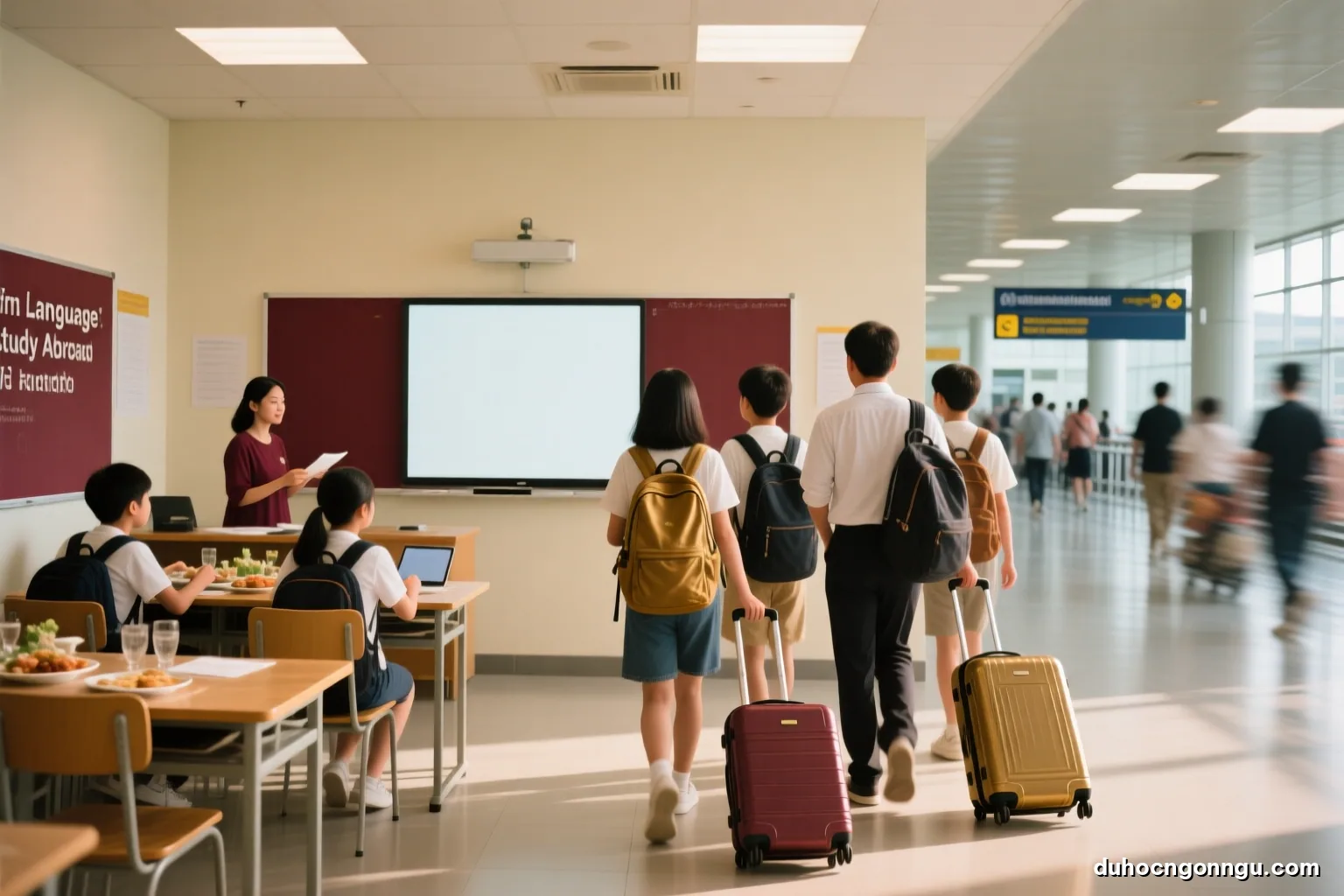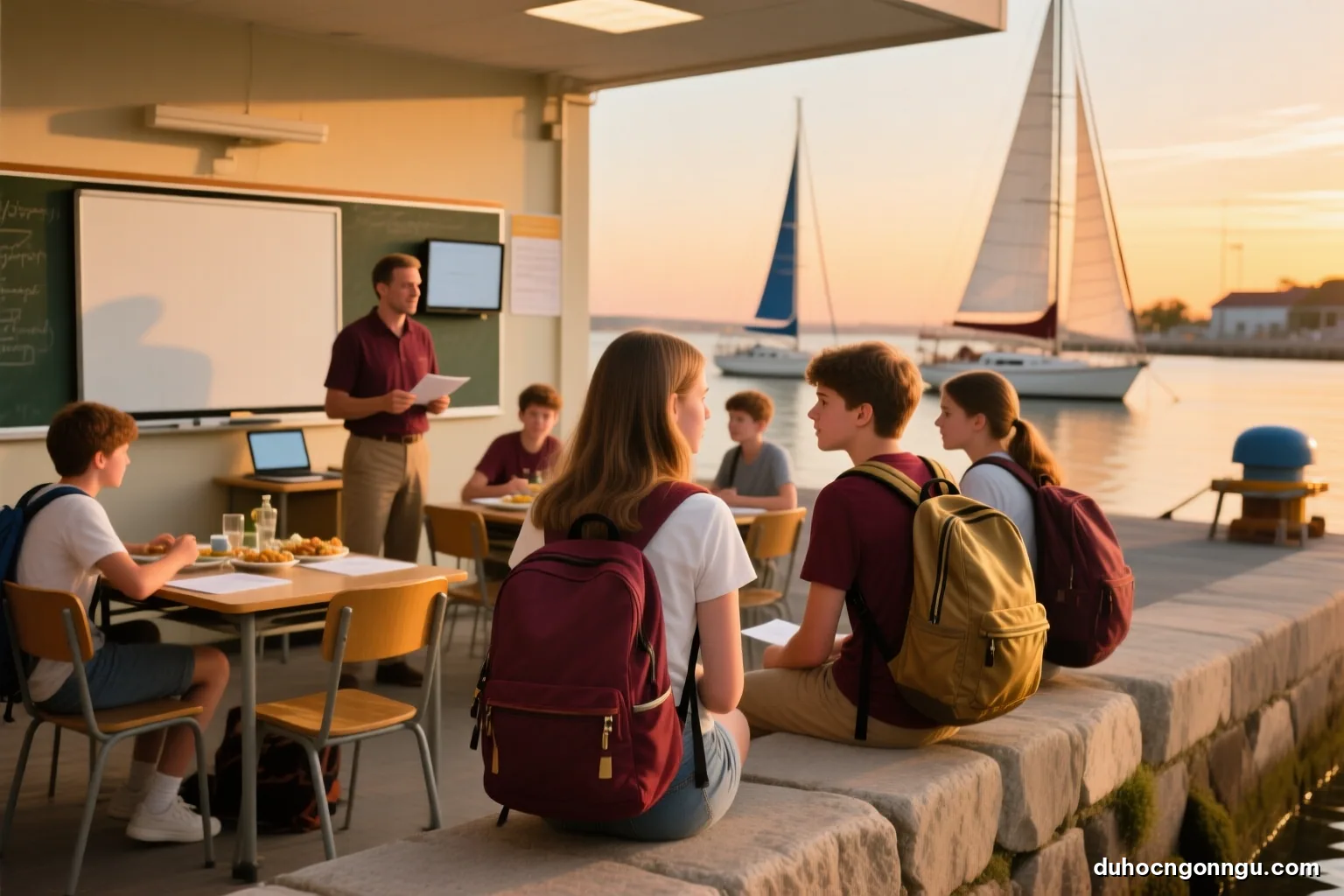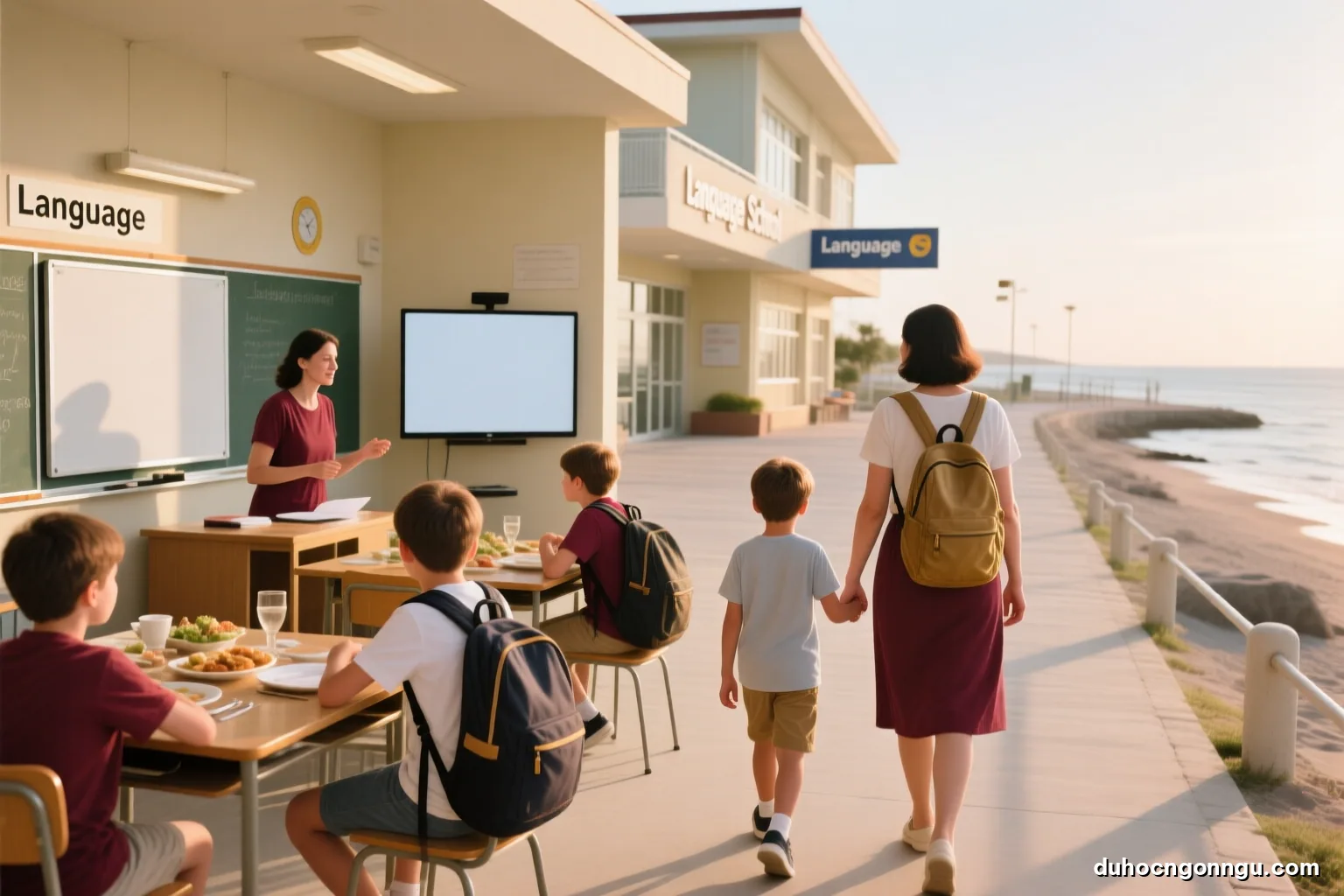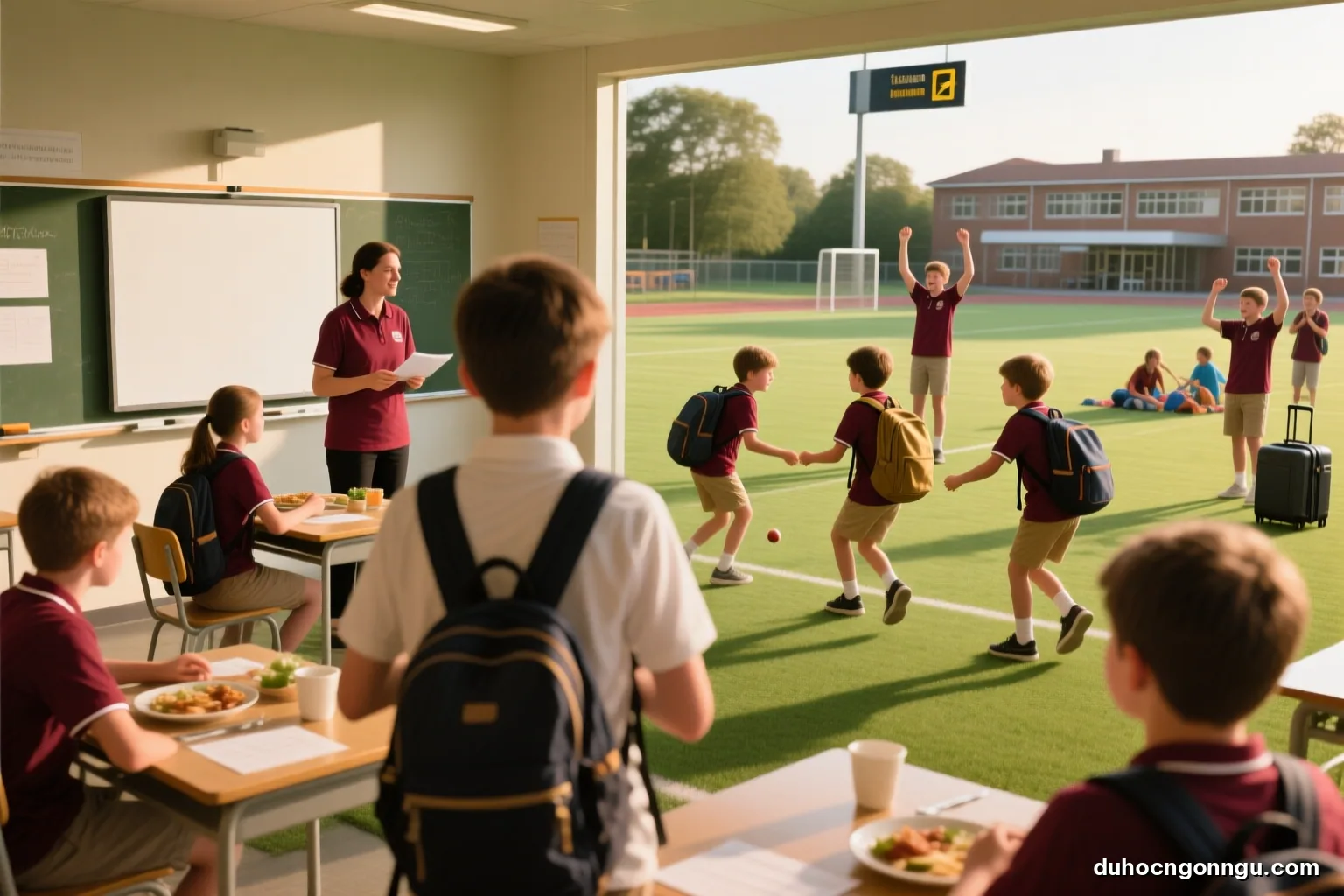
A typical day at a residential summer language camp has three parts: in the morning, around three to four hours of language lessons in class; in the afternoon, sport, art or a visit to the city; in the evening, group activities and then back to the rooms by the lights-out time for each age group. At weekends there is usually one full-day trip and one lighter day.
Daily timetables sound much the same from camp to camp, but the quality lies in the details: who leads the afternoon activities, whether students have to use English during play, and whether evenings are really organised or just "free time in the residence". This article goes through each part of the day using a hypothetical example, with the things parents should look for when reading the weekly timetable the school sends.
A sample day, from morning to night
The schedule below is a hypothetical example put together from the way residential camps usually arrange the day, not the timetable of a particular school. Times may shift slightly between camps and by age group.
- Around 7:30 – 8:30: get up, wash, have breakfast in the dining hall. Staff go round the rooms to make sure every student is up.
- Around 9:00 – 12:30: morning lessons, in two or three blocks with a break in between. Classes are grouped by level and age group.
- Around 12:30 – 13:30: lunch and a short rest. This is often when students call or message home, if the camp allows phones at this time.
- Around 14:00 – 17:00: afternoon activities, which may be sport, art, drama, science, or a visit to a place in the city in groups accompanied by staff.
- Around 17:00 – 19:00: rest, showers and dinner.
- Around 19:30 – 21:00: evening activities such as big group games, talent shows, quizzes, film nights or discos.
- Around 21:00 – 22:30: back to the rooms, with an earlier lights out for younger groups and a slightly later one for older groups.
Looking at this timetable, most of your child's waking hours are spent outside the classroom. That is why the quality of the afternoon and evening activities matters as much as the morning lessons.
Mornings: how lessons actually work
Lessons at a summer camp differ from extra classes in Vietnam in several ways. First, classes have students of many nationalities, so English is the only common language, even for borrowing a pen. Second, many camps teach by weekly theme, for example a week on cities, a week on the environment, a week on film, with a small project to complete and present at the end of the week. Third, teachers put more weight on speaking and listening than on written grammar exercises.
The usual unit is a "lesson" of 45 or 60 minutes. When a school says "15 lessons a week", that may mean 11 hours 15 minutes or 15 hours, which is quite a difference. Ask how long each lesson is and how many actually take place, because arrival days, departure days and public holidays can cut the first and last weeks short.
One point that is often overlooked: in the first week, morning lessons are when your child is most tired because of jet lag. Teachers used to international students usually schedule movement activities and language games in the first few days so students do not nod off. If the teacher's first-week comments say your child "participates little", that is not yet a sign to worry about.
Afternoons: which activities help language learning and which are just for fun
Afternoon activities are heavily advertised: football, swimming, horse riding, film-making, painting, cooking, castle visits, boat trips. For language learning, the question is not which activity it is but whether your child has to speak during it. A swimming session where the coach only blows a whistle gives very little English. A short film project in a group, where students have to agree on a script, cast the roles and revise the dialogue, gives a great deal.
Language-rich activities usually have something in common: students work in mixed-nationality groups, there is a product to finish, and the person leading the activity asks questions and sets tasks in English. City visits are more valuable when there is a task sheet: finding information, asking local people, reporting back to another group, rather than just following a guide and taking photos.
That does not mean "just for fun" activities are useless. Children need to move after three hours in class, need relaxed moments to make friends, and close friends are the biggest motivation for speaking English in the evening. A good weekly timetable has both kinds, alternating.
Evenings and lights out
Organised evening activities. A good camp has an evening programme every day led by staff: group games, talent contests, fancy-dress nights, film screenings with discussion. Younger students especially need this, because evenings are when homesickness is strongest.
Limited free time. Older students usually have a short period of free time on campus before going back to their rooms. This is when students of the same nationality tend to gather, so camps with a shared language rule have staff walking around giving gentle reminders.
Lights out by age. Younger groups usually go back to their rooms earlier than older groups. Staff check the rooms and count the students. Ask the camp what lights-out time applies to your child's age group and how the checks are carried out.
Phones in the evening. Many camps collect younger students' phones in the evening or only allow them at set times. This helps children get enough sleep and stops them staying up late messaging friends at home, who are in a different time zone.
Homestay students. For homestay students, the evening means dinner and time at the host family's home, with a return time set by the school. Some schools let homestay students join evening activities at school a few times a week.
Weekends at summer camp
Weekends are usually organised differently from weekdays. Common formats:
- Full-day trips: to a nearby city, a large park, a heritage site or a museum. Usually by camp coach, with staff accompanying small groups.
- Half-day trips: supervised shopping, a local market, a beach near the school.
- Days at camp: lighter activities, sports tournaments between groups, time for laundry and tidying rooms.
- Arrival and departure days: at many camps, new students arrive and departing students leave at weekends, so that day is given over to welcomes, goodbyes and getting to know each other.
Weekend trips are what students remember longest, but they are also when students get tired and things are most likely to go wrong. Ask the camp about the staff-to-student ratio on outings, how groups are divided, and the procedure if a student gets separated from the group. Detailed safety procedures are covered in a separate article in the safety and guardianship topic.
Reading the weekly timetable the school sends: good signs and signs to ask about
Most schools send a sample weekly timetable when a family enrols. The table below helps you read it through the eyes of someone who has seen many camps:
| Part of the timetable | Good sign | Sign to ask more about |
|---|---|---|
| Lessons | States the number of lessons, the length of each and the weekly themes | Just says "lessons" in general, with no number of hours |
| Afternoon activities | Names specific activities, with choices by age | Many sessions of "free time" or "activities" without saying what |
| Evenings | A programme every evening | Many empty evenings or just "evening in residence" |
| Weekends | States the destination, departure and return times | Says "optional excursion", which may cost extra |
| Common language | Has an English-speaking rule and someone who enforces it | Not mentioned |
| Arrival and departure days | States the airport pick-up times | Says nothing about the first and last days |
A weekly timetable is only a plan. The weather, the actual number of students and incidents can all change it. But a carefully prepared timetable shows that the camp has thought through every part of the day, and that is a good sign of how it is run.
Who is with your child all day
Teachers. They teach in the morning and usually hold a qualification in teaching English to speakers of other languages. Teachers see your child every day in class but are rarely there in the afternoon and evening, so their comments reflect your child in class, not the whole day at camp.
Activity staff. Usually young people, many of them students on summer jobs, who lead the afternoon activities and evening programme and go on the excursions. These are the people your child talks to most apart from friends, so how they are recruited and trained directly affects your child's experience.
Residential staff. They live in the same residence building, keep to the schedule, check the rooms, and are the people your child goes to when ill or having a problem with a roommate at night.
Group leader travelling from Vietnam. If your child travels with a group, the group leader is the link between the camp and the family, and can speak Vietnamese with your child when needed. The role and limits of a group leader are discussed in detail in the article on travelling with a group.
A question worth asking. Does each group of students have a fixed staff member in charge, and does your child know that person's name from the first day? Having one specific adult to go to reassures young children far more than a general team.
Helping your child prepare for the rhythm of camp life
Vietnamese students are used to lessons in the morning, extra classes in the evening and going to bed late. At camp, the day starts early, afternoons involve a lot of physical activity and lights out is on time. For a few weeks before leaving, you can get your child used to getting up at camp time, being active outdoors in the afternoon and spending less time on their phone in the evening. They will be less tired in the first week.
Read the school's weekly timetable together with your child, and ask which activities they like best and which they are unsure about. If the camp lets students choose activities in advance, let your child choose. Children who feel they have a say usually take part more enthusiastically and fit in more easily.
Finally, give your child one simple piece of advice: during free time, when you don't know what to say, ask a question. Ask about the rules of the game, ask a friend's name, ask where they are from. A simple question in English opens up more conversations than any prepared answer.
Frequently asked questions
Do students have lessons all day at summer camp?
No. Most camps put lessons in the morning, for about three to four hours, with afternoons and evenings given over to activities. Some intensive courses add afternoon lessons for older students who want to study more, but that is a separate option that usually has to be booked in advance.
Can my child leave the camp on their own?
For younger students, there is almost always a member of staff with them whenever they leave the campus. At some camps, older students may go out in small groups at set times and within set areas, after parents have signed their consent. Read this rule carefully in the enrolment documents.
Do afternoon activities cost extra?
It depends on the camp. Many programmes include everyday activities and the scheduled weekend trips, but special activities such as horse riding, big theme parks or long-distance trips are charged separately. Ask for a list of what is included and what may cost extra.
What if my child does not like the activity they are given?
Many camps offer a choice of several activities each afternoon. If there is no choice, your child should tell the staff member in charge of their group. A good camp will try to make arrangements, but will also encourage your child to try new things before refusing.
Can my child use their phone all day?
Most camps restrict phones during lessons, during activities and, for younger students, in the evening. The exact rules vary, so read the camp rules and agree with your child in advance on a schedule for calling home at permitted times.
Do homestay students join evening activities?
At some schools, homestay students can join a few evening activities a week, with someone taking them home or travelling as a group. At other schools, evenings are spent entirely at the host family's home. Ask in advance if your child would like both experiences.