Vietnamese passport holders need to apply for a visa before travelling to Ireland. For an English course of less than 3 months, the right category is the short stay C visa for study (short stay study visa); a course of more than 3 months moves to the long stay D visa, and the language course must then be on the state's list of eligible programmes. This information follows the website of Ireland's Immigration Service, part of the Department of Justice, at the time of writing (2026).
Ireland suits families who want a native English-speaking environment, a cool summer climate, a friendly pace of life and cities of a manageable size. One thing to remember: Ireland is not part of the Schengen area and has a separate visa from the UK, even though both countries are in the Common Travel Area. The sections below cover the visa, choosing a school, junior courses and everyday life.
The 3-month line and why it shapes the whole application
Ireland's visa system is divided by length of stay. Trips of under 3 months are short stays and use a C visa; longer trips are long stays, use a D visa and usually require registering residence after arrival. For an English course, this line is not just a formality: it decides which schools are allowed to accept your child.
A summer course of four, six or eight weeks fits comfortably within a C visa. The application revolves around the school's confirmation letter, evidence that fees have been or will be paid, accommodation, the sponsor's finances and, for under-18s, the parents' consent letter together with details of the person caring for the child in Ireland. A C visa for study does not allow work.
Courses longer than 3 months, such as a semester of English for a student who has just finished secondary school, belong to the group of programmes that must be on the list of eligible programmes for international students from outside the EU. The D visa application is more thorough, has higher financial requirements and its own conditions on study hours. That lies outside the scope of short courses and needs to be researched separately. Families should decide clearly from the start whether their child is going for less or more than 3 months, and not plan to extend after arriving.
How to recognise a serious English school in Ireland
The quality assurance body. In Ireland, the state body for quality assurance in education and training is QQI (Quality and Qualifications Ireland). In recent years the state has tightened oversight of language schools teaching international students, through a quality mechanism run by QQI together with the immigration service's list of eligible programmes. Ask the school which mechanism it is recognised under and ask for the programme name as it appears on the list.
Language school associations. MEI (Marketing English in Ireland) is a large association of English language schools in Ireland, with its own membership criteria. Membership of an association does not replace state recognition, but it shows the school follows a shared professional code and gives parents somewhere to raise concerns.
Programmes for minors. Ask whether the school has a written child protection policy, who its designated child protection officer is, and whether staff working with children are vetted as required in Ireland. Schools that run junior courses seriously answer these questions straight away, with documents.
Real class hours. A "week of study" may be 15, 20 or 25 lessons, each 45 or 60 minutes long. Junior summer courses usually have lessons in the morning and activities in the afternoon. Get the number of classroom hours in writing, separately from activity time led by English teachers and from excursion time.
How junior courses in Ireland work
Irish schools break up for the summer from around early June, so many junior courses use school or university campuses in June–August. The description below is the common pattern; each school differs in the details:
| Element | Homestay course | Residential course |
|---|---|---|
| Ages accepted | Usually from about 12 | Some places accept children from 8–10 |
| Morning | English lessons in classes grouped by level | English lessons in classes grouped by level |
| Afternoon | Sports, cultural activities, guided excursions | Activities on campus or group excursions |
| Evening | Dinner and time with the host family, fixed time to be home | Supervised group activities, lights-out time |
| Weekend | Usually one full-day trip, the other day with the family | Full-day trips and activities at the school |
| Getting around | Public buses or school transport, with guidance in the first week | Almost no independent travel |
A question worth asking: on a homestay course, from which day does your child take the bus alone, who shows them how, and whom do they call if they get lost? For 12–13-year-olds going abroad for the first time, many families choose a residential course the first year and a homestay the next time.
Life in Ireland: the small things that often take students by surprise
Irish summers are cool, with daytime temperatures usually only in the teens to low twenties Celsius, and the weather can change several times a day, with short showers followed by sunshine. Students from Vietnam often pack too few warm clothes and waterproof jackets. Summer days are very long, with daylight until nearly ten in the evening, which makes it hard for children to get to sleep on time in the first week.
Traffic drives on the left as in the UK. Sockets have three flat pins, like the UK and quite different from Vietnam. Ireland uses the euro. Irish (Gaelic) is the first official language under the constitution, but in everyday city life English is the common language; your child will see bilingual place names and hear a few greetings in Irish.
English in Ireland has its own rhythm, and in many areas the r at the end of words is clearly pronounced, closer to American English than to London English on this point. Irish people are known for chatting with strangers, which helps learners if your child dares to start a conversation. The cities with language schools, such as Dublin, Cork, Galway and Limerick, differ in size: Dublin is a busy capital, while the others are smaller and easier to walk around.
A day for a student in an Irish homestay
To picture it, follow a 14-year-old student (a hypothetical example) in the second week of a summer course in a medium-sized Irish city. In the morning she has breakfast with her host family, usually cereal, toast, tea or milk, then takes a bus for about twenty minutes to school with a classmate who lives nearby. In the first week someone from the school showed them the way; by the second week the students travel on their own in a group.
Lessons go on until about midday, with a break in the middle. Lunch is usually a packed lunch prepared by the host family or a meal in the canteen. The afternoon is for activities: a football match, an Irish folk dance class, or a museum visit with a teacher. In the late afternoon she goes home and has a little time to herself before dinner.
Dinner is the most valuable part for language. The whole family sits at the same table, asks her what she did today, talks about their own children, sometimes discusses a sports match. She does not understand everything, but she has to answer in English and ask again when she does not catch something. In the evening there may be a school activity or time at home; the curfew is set by the school and the host family knows it.
Not every homestay is like this. Some families are busy and have little time to talk; some host two or three international students at once. So the questions to ask the school are how many people are in the family, whether there are children, how many students they host at once, whether any other student shares your child's nationality, and how long it takes to change family if it does not work out.
A C visa application for students under 18: the parts it needs
The exact list should always be taken from the Irish Immigration Service website at the time of applying. For minors on short courses, the application usually revolves around the following:
- The school's confirmation letter, stating the course name, start and end dates, class hours, fees and payment status.
- Accommodation details: a homestay arranged by the school, the residence of a residential course, or a relative's home with an invitation letter.
- Your child's birth certificate and a consent letter for the trip from both parents, or from whoever holds legal guardianship.
- Evidence of the finances of the person paying, usually the parents, and documents showing the relationship between that person and your child.
- Details of the adult responsible for your child while in Ireland, which may be a group leader or a member of the school's staff.
- Travel and medical insurance for the whole stay.
- Documents showing your child is at school in Vietnam and will return, such as a letter from their secondary school.
Documents not in English need translations. Families who have ever been refused a visa by any country must declare it truthfully, because a false declaration is usually a more serious reason for refusal than the earlier refusal itself.
Who Ireland suits, and who it suits less
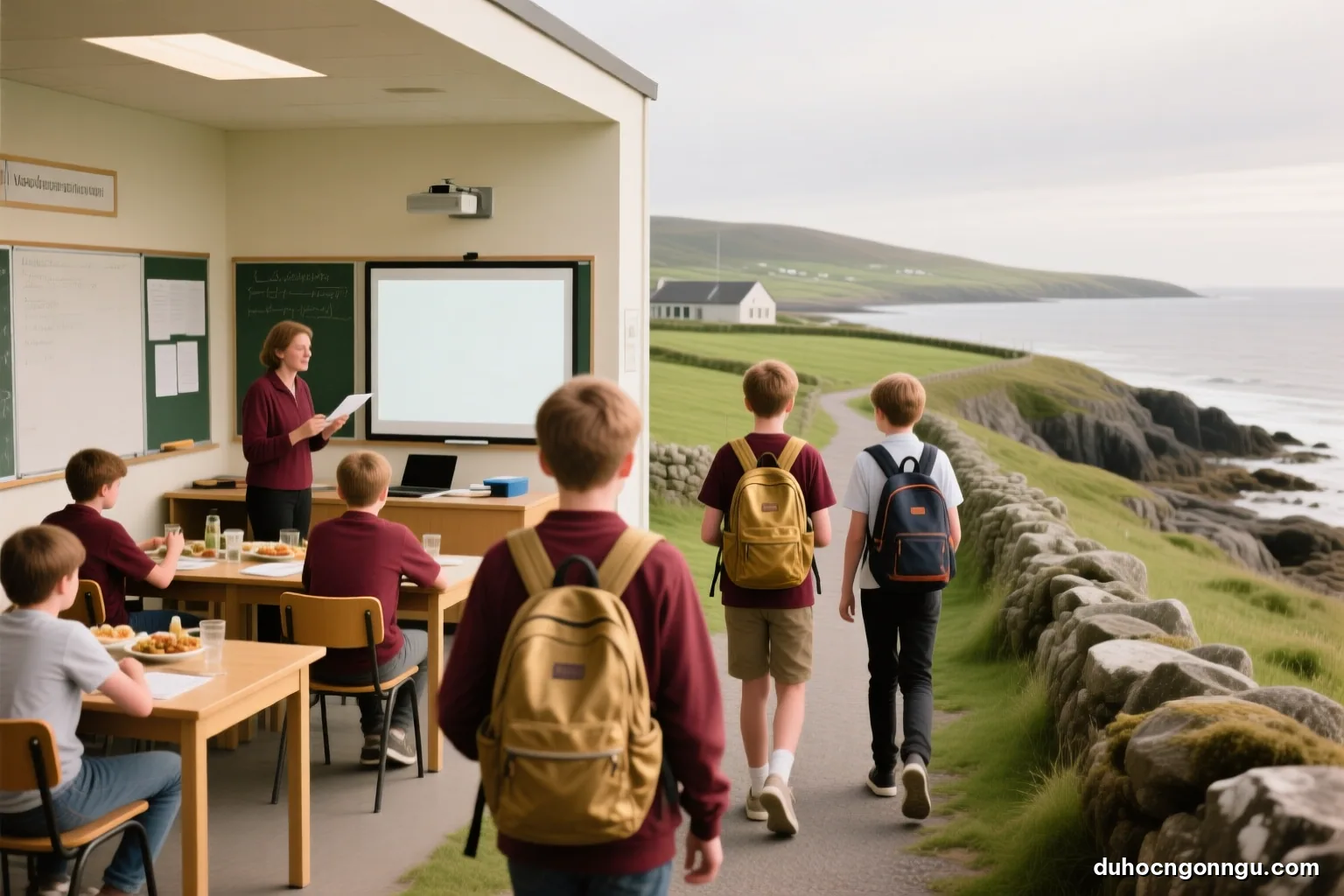
Ireland suits students who want to live with an English-speaking family, can cope with cool, rainy weather and enjoy outdoor activities such as coastal walks or sport. Older students aged 15–17 who are already independent usually make good use of homestays in medium-sized and small cities, where talking with local people happens naturally.
Ireland suits families less if they can only manage a two-week course, because the long flight with connections plus the time difference take up a significant share of it. It is also worth thinking twice if your child is easily affected by long spells of grey weather, or if the family expects plenty of sunshine and warm sea for the holiday.
For students who plan to study long term in Europe later, a short course in Ireland gives them a real experience of the climate, the pace of study and how to manage daily life before the family makes a big decision. That is the information value of the trip, separate from how much their English improves in a few weeks.
Frequently asked questions
If my child already has a UK visa, can they enter Ireland?
For Vietnamese passport holders, a UK visa does not replace an Irish visa. The arrangement for sharing visas between the two countries only applies to certain nationalities. Families should apply for a separate Irish visa for the study trip and, if they plan to visit the UK on the same trip, also apply for a UK visa.
Do language courses in Ireland follow the CEFR?
Most schools place classes and describe levels according to the Common European Framework of Reference (CEFR), from A1 to C2. On the first day your child usually takes a short written and spoken test for placement. The certificate of completion at the end of the course often states an estimated level on this framework, based on the school's assessment.
Can students work part time while on a short course in Ireland?
No. A short stay C visa for study does not allow work. The right to work part time is only linked to certain types of long stay with their own conditions. For minors on summer courses this question hardly arises, but older students need to be clear about it.
Is Ireland safe for students travelling alone?
Ireland is generally regarded as safe, but the safety of a student on a short course depends mainly on the programme: an airport pick-up, supervision, rules on curfew and an emergency contact number that actually works. Ask the school for its written child protection policy.
Should my child study in Dublin or a smaller Irish city?
Dublin has many schools and convenient flights, but accommodation is expensive and summer is crowded with international students. Smaller cities are quieter and easy to walk around, and host families usually live closer to the school. Choose according to your child's age, independence and type of accommodation, not just the name of the city.
How long does an Irish visa take to process?
Processing times vary by season and by where you apply. The Irish Immigration Service publishes indicative processing times and advises applying well before the travel date. For a summer course, applying about three months ahead is a safe margin, and do not book non-refundable flights before the visa is issued.