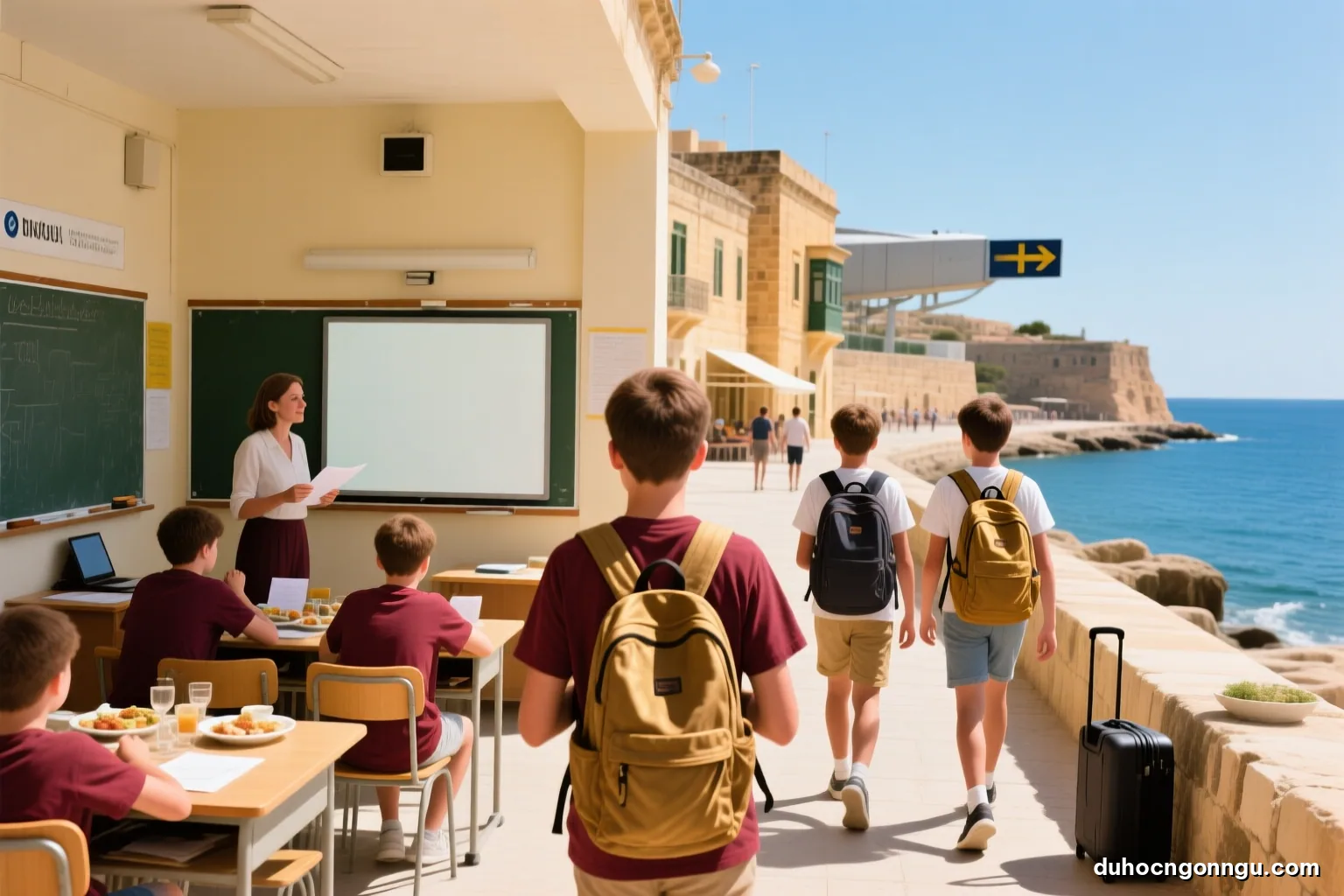
Malta is a small island nation in the Mediterranean, a member of the European Union and of the Schengen area, where English is an official language alongside Maltese. Vietnamese passport holders taking a short English course in Malta need a short-stay Schengen C visa, which allows a stay of up to 90 days in any 180-day period; longer courses need a national D visa.
English language schools in Malta must be licensed by the ELT Council, a state body within the education sector. Malta appeals for its sunshine, sea, short travel distances and diverse international student community; in return, summer is very hot and crowded. The sections below explain the visa rules, how to check a school, and the things particular to Malta that Vietnamese families often overlook.
Why a country that speaks two languages is a place to learn English
Malta was a British colony until 1964. Malta's constitution recognises Maltese as the national language, with Maltese and English both official languages. In practice, English is used in administration, the courts, education, the press and business; many school subjects are taught in English. Most people can use both languages and switch between them in the same conversation.
For learners, this means that outside class your child can still communicate in English in shops, on buses and in restaurants, but will also hear Maltese spoken between local people. English in Malta has its own accent, influenced by British English as well as by the intonation of Maltese and Italian. That is not a bad thing: English today is mostly used between people with different accents.
Families choosing Malta usually do so not because they want their child to "hear a standard accent" but because it combines language study with a sunny, warm climate, short distances between accommodation and school, and an international environment. If the family's top priority is for their child to live with a local family that speaks only English, it is worth considering other countries as well.
The Schengen visa for a language course in Malta: the points to understand
The 90/180 rule. A C visa allows a stay of up to 90 days in any 180-day period, counting every day spent in the Schengen area. An eight-week course plus a week of travel in Italy or France still fits within the limit, but the days must be counted correctly.
Which country issues it. Under Schengen rules, the application is made to the country that is the main destination of the trip. If your child is studying in Malta and then making a short visit to another country, the application goes to Malta through the representative Malta has designated for residents of Vietnam. Find the application point on the website of Malta's foreign affairs or immigration authority, not by word of mouth.
The study purpose must be consistent. The school's confirmation letter, the accommodation, the itinerary and the finances need to match. An application stating language study as the purpose but with an itinerary full of travel to other countries is likely to be questioned.
Travel insurance. Schengen visa applications require travel medical insurance valid throughout the Schengen area for the whole stay, with the minimum cover set by the area's common rules. Read the exclusions carefully, especially for water activities your child may take part in.
Children under 18. A consent letter from the parents or legal guardian, a birth certificate and details of the adult responsible in Malta are needed. Some application points require the parents to be present when applying or to sign a certified letter.
The ELT Council and FELTOM: how to check a school in Malta
Malta regulates the teaching of English to foreigners quite strictly for a country of its size. The ELT Council is the state body that licenses English language schools and licenses teachers to practise. A school that wants to run courses for international students must hold a valid licence, undergo inspections and comply with rules on teachers, classes, premises and the care of minors.
FELTOM is the federation of English language teaching organisations in Malta, bringing together many large schools. Members of the federation commit to an additional shared code of professional practice and quality. Some schools also hold other international accreditations. Not every good school is a FELTOM member, but a school without an ELT Council licence is not eligible to teach international students.
A simple way to check: ask the school for its ELT Council licence number and compare it with the authority's public list; ask whether the school belongs to any federation; ask whether the teachers on the junior course are licensed to teach in Malta and have experience with children. For under-18s, also ask about the ratio of supervisors to students during activities and at night, and the policy on going to the beach and swimming.
Summer in Malta: what you gain and what to prepare
Most Vietnamese students will go to Malta in June–August. This is the best season for the sea, but also a season with things that need careful preparation:
| Feature | The advantage | What to prepare |
|---|---|---|
| Hot sunshine, little rain | Outdoor activities are almost never cancelled because of the weather | Sunscreen, a hat, water; ask the school about scheduling activities to avoid the hottest hours |
| Many international students | Classes with many nationalities, lots of group activities | Ask about the nationality mix and how the school divides classes and rooms |
| The sea is close to everywhere | Swimming, boat trips and snorkelling are common activities | Ask who supervises in the water and whether your child must be able to swim |
| Short distances | A bus ride of a few tens of minutes takes you to another town | The junior course's curfew and rules on going out alone |
| Lively nightlife in a few areas | No benefit at all for young students | Ask where the accommodation is in relation to the nightlife areas |
If your child does not cope well with heat or the family wants quieter classes, spring and autumn in Malta are much more pleasant, but Vietnamese secondary school students can rarely go in those months.
A typical week on a residential junior course in Malta
The schedule below describes the common pattern, not the timetable of any particular school. Use it as a framework to compare with the real schedule the school sends:
- Arrival day: staff meet students at the airport, take them to their accommodation and explain the rules, times and emergency contact numbers. Many courses keep passports and large amounts of cash in safekeeping.
- First day of lessons: a short written and spoken placement test, class allocation and meeting the teacher. The afternoon is usually a walk to get to know the surrounding area.
- Weekdays: lessons in the morning or afternoon depending on the shift, with the rest of the day for activities such as supervised swimming at the beach, visits to the old fortified cities, sport and group projects in English.
- Evenings: supervised group activities such as discos, games and film nights, then back to rooms by the set time.
- Weekend: a full-day trip, for example to the island of Gozo, and a lighter day for students to rest, call home and do their laundry.
When you receive the real schedule, count the classroom hours per week and the number of sea sessions. A schedule packed with sea activities in the middle of the day, or one that does not say who supervises swimming, is something to ask about before agreeing.
Things particular to Malta to tell your child
Malta is small and friendly, but a few things differ from habits in Vietnam:
- Traffic drives on the left, a legacy of British rule. Sockets are also the three-flat-pin type, as in the UK.
- Malta uses the euro. Cards are accepted in many places, but it is good to have a little cash for small stalls.
- Tap water in many places is desalinated from seawater, safe but with a different taste; many people choose to drink bottled water.
- Much of the coastline is rocky rather than sandy; water shoes help avoid scraped feet.
- There are three inhabited islands, Malta, Gozo and Comino; trips to Gozo or Comino usually go by ferry or boat, and meeting times must be kept.
- In summer there are many village festivals with fireworks and music in the evening; junior courses usually only let students attend with a guide.
These points help your child feel more confident getting around, and give parents a few specific questions to ask the school about safety outside class.
Who Malta suits
Malta suits students from about 12 upwards who enjoy outdoor activities and the sea, can cope with heat and want to make friends with students from many European countries. For families planning to travel in Europe on the same trip, Malta is convenient because the Schengen visa allows a course to be combined with a few days in another country in the area, as long as the 90/180 rule is respected and the main purpose is still study.
Malta suits less well if your child is under 10 and travelling alone, because the flight from Vietnam requires a connection and the hot summer tires young children. It also suits less well if the goal is a homestay with a family that uses only English, because many Maltese families speak Maltese to each other at home.
A practical suggestion is to put Malta side by side with another summer destination, such as Ireland, and compare three things: the nationality mix on your child's course, the level of supervision outside class and the real number of class hours per week. These three usually give a clearer answer than any comparison of scenery.
For university students and working people, Malta has another strength: many schools run adult classes all year round and take students week by week, so someone with two or three weeks of leave can still join a class that is already running. Adult classes in autumn and winter are usually quieter than in summer, accommodation is cheaper and the weather is cooler. Working people who need English for work can ask schools about business English classes or a few private lessons a week.
Frequently asked questions
Do Maltese people speak good English?
English is an official language and is widely used in education, administration and business, so most people communicate well in English. Within families and between local people, Maltese is still common. Learners therefore hear both languages in everyday life.
Can my child visit other Schengen countries while studying in Malta?
A Schengen C visa issued by Malta allows travel within the Schengen area during the visa's validity, provided the total time does not exceed 90 days in 180 and Malta is the main destination. The itinerary submitted with the application must reflect the real plan; do not declare one thing and do another.
Are there English courses for the whole family in Malta?
Some schools in Malta offer family courses, where children attend junior classes while parents attend adult classes at the same time, or only the child studies while the parents holiday. This format solves the supervision question for young children, but ask carefully whether the timetables of the different classes fit together.
Do language courses in Malta prepare for Cambridge or IELTS exams?
Many schools have exam preparation classes for international exams such as Cambridge English or IELTS, usually for students aged 16 and over. On junior summer courses, the focus is usually general English and communication. If your child needs exam preparation, ask whether the class has specialist exam teachers and mock tests.
Does my child need to be able to swim for a summer course in Malta?
It is not required for enrolment, but many activities in Malta involve the sea. Ask the school how they handle students who cannot swim: are there alternative activities, are there lifeguards on beach trips, do they check swimming ability before letting students into the water? Declare your child's swimming ability honestly when registering.
Does Malta issue Schengen visas to under-18s travelling alone?
It can, if the application shows adequate care arrangements: a school confirmation letter with transfer and supervision services, specific accommodation, the parents' consent letter and finances. The decision rests with the visa authority. Ask the school whether it has experience supporting applications for Vietnamese students.