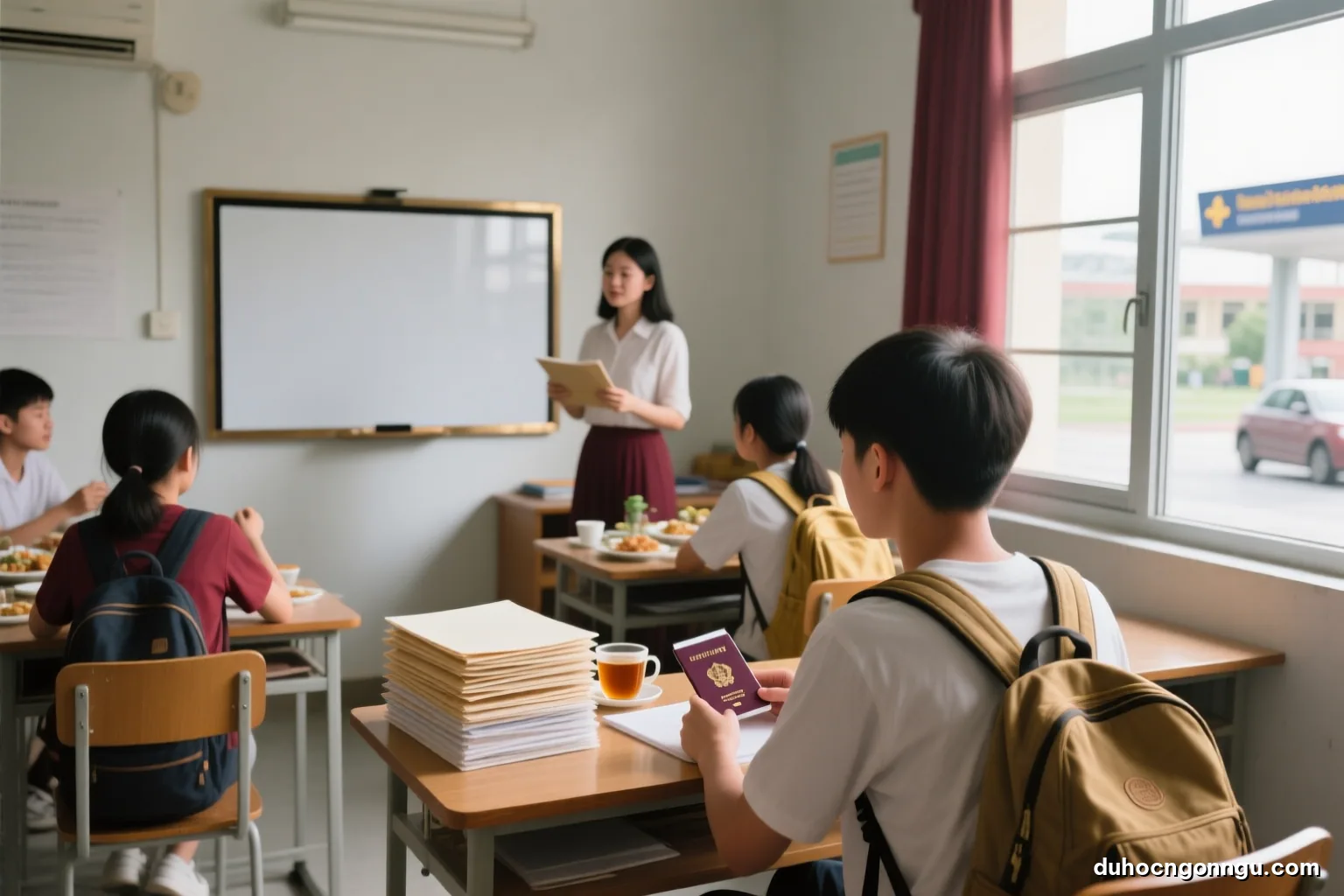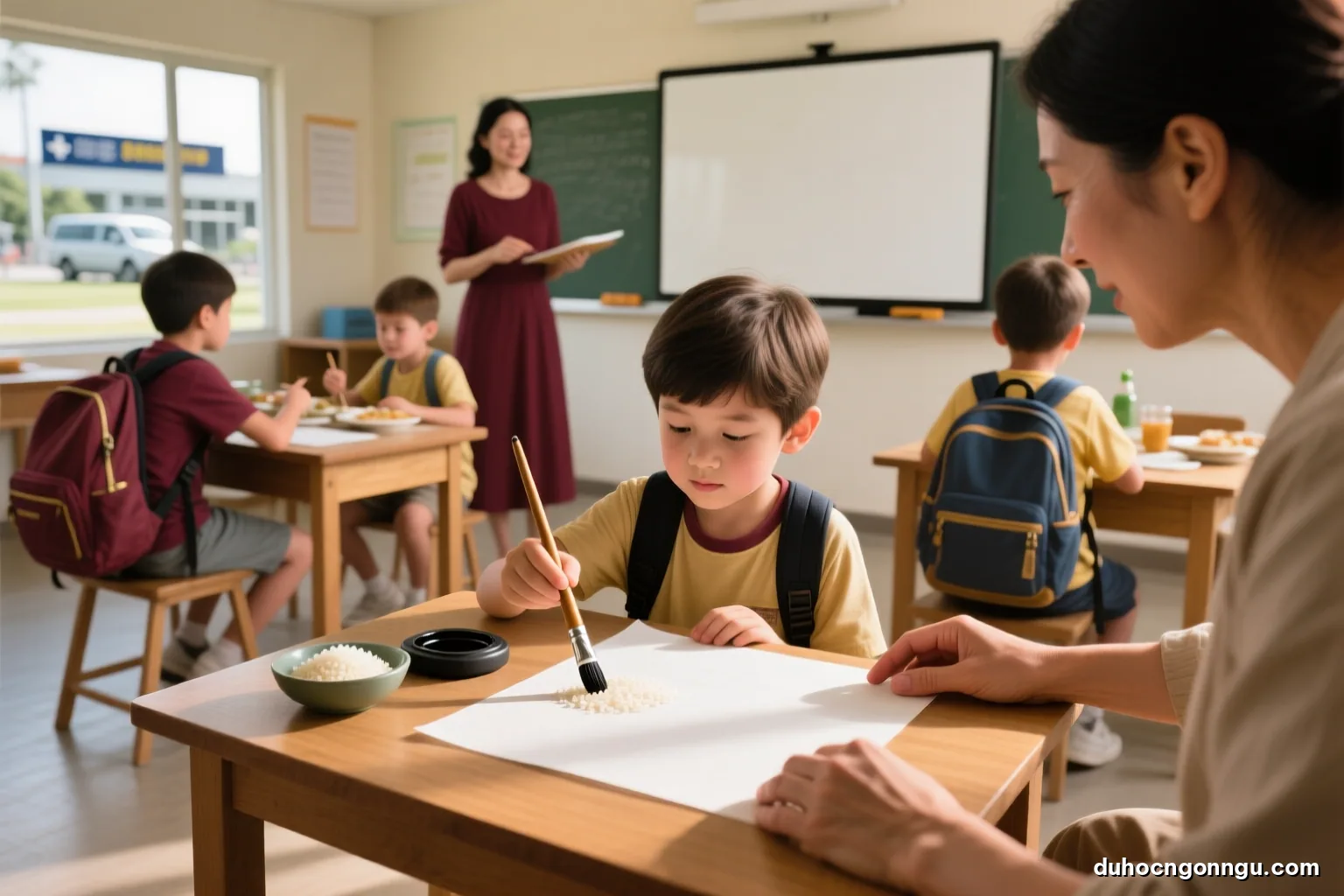
A short Chinese course abroad means studying Mandarin somewhere Chinese is used every day, for a few weeks to a few months, without earning a degree. There are four main types: language summer camps for teenagers (usually 2–4 weeks, with guardians), term courses at university Mandarin centres (usually about three months per term), intensive summer classes for adults, and private tutoring combined with a homestay. The destinations most popular with Vietnamese learners are Taiwan, mainland China and Singapore.
Which format to choose depends on three questions that come even before choosing a destination: how old the learner is and whether they can already look after themselves; what their current level is (no characters at all, pinyin, or already able to hold a conversation); and whether the trip is meant to keep up interest, to get them speaking, or to prepare for a longer plan. The sections below go through each format, how to read course length and teaching hours, how to match a format to the learner, and the questions to ask the organiser before paying a deposit.
Four formats of short Chinese study abroad
The table brings together the types of programme you are likely to come across. Length and organisation vary from place to place; the last column lists what to check, not criticisms.
| Format | Usually for | How it is organised | What to check |
|---|---|---|---|
| Language summer camp | Pupils aged about 8–17 | Travelling in a group or joining a local camp; lessons in the morning, activities in the afternoon, staying in the camp's dormitory or hotel | Adult-to-child ratio, real teaching hours per day, who meets the children at the airport |
| Term course at a university Mandarin centre | From the last years of high school upwards, university students, working adults | Placement by test, small-group classes for a few hours a day, own accommodation or a dormitory | Age requirements, intake dates, type of visa, whether under-18s are accepted |
| Intensive summer class | Adults who want to study intensively for a few weeks | More hours than a regular course, sometimes with private lessons in the afternoon | Whether there is a placement test, maximum class size, homework |
| Private tutoring with a homestay | Busy people who need a flexible schedule or have very specific goals | One-to-one lessons by the hour, accommodation arranged separately | Whether the teacher is trained to teach Chinese to foreigners, who is responsible if something goes wrong |
For younger pupils, the first two formats are the most common, but they are not interchangeable: a summer camp takes care of daily life and supervision, while a university centre only takes care of class time. Sending a thirteen-year-old to an adult term course and leaving them to rent a room on their own puts far too much on their shoulders that has nothing to do with the language.
Course length and teaching hours: reading the numbers correctly
Parents often ask "how long does my child need to go for". The real answer lies in the number of hours taught by a teacher, not the number of weeks. Two four-week programmes can differ by a factor of two: one teaches three hours every morning, five days a week; the other teaches two hours and has a sightseeing trip every afternoon. When reading a brochure, reduce everything to one figure: total classroom hours, excluding cultural activities and self-study time.
A hypothetical example to calculate: course A runs four weeks, three hours a day, five days a week, minus one public holiday, which comes to about 57 hours. Course B runs three weeks but four hours a day including group and private lessons, which comes to about 60 hours. Course B is shorter but has more hours, and means fewer days away from home. On the other hand, if the learner is a ten-year-old, four hours a day may be too much, and course A with more outdoor activities may suit them better.
There is one more dimension: time spent using the language outside class. At a summer camp, this happens in sessions such as baking, calligraphy or going to the market with a counsellor. On an adult course, it depends on whether the learner is willing to go out and talk. Time outside class cannot be written into a contract, but you can ask about it: what does the programme do to make learners use Chinese during the day, do they share a room with someone who speaks another language, is there a Chinese-only rule in common areas?
Matching the format to the learner
Primary school pupils who have never studied Chinese. A reasonable goal for a summer trip is enjoyment, getting used to the sounds and the characters, and being able to say a few everyday sentences. A camp with guardians and plenty of hands-on and physical activities suits them better than any grammar class. Travelling with parents nearby is also an option at this age.
Lower-secondary pupils who have studied for a year or two in Vietnam. They can choose a camp with more class hours, or a camp that groups classes by level rather than by age. This is the age when the gap between classroom learning and real speaking starts to show clearly; they need a programme that makes them ask for directions, order food and explain small things in Chinese.
Students in the last years of high school and university students. They can start joining term courses at university centres, depending on each centre's age requirements. A three-month course for someone with a foundation is long enough to see clear progress in listening and speaking. Those planning to go on to university in Chinese later should treat a short course as a test: can they cope with the pace of life, the climate and the way of studying there?
Working adults. They can usually only go for two to four weeks. An intensive class plus private lessons tailored to their work is an efficient use of time; bring a list of real situations from your job so the teacher can teach exactly what you need.
Choosing a destination: how the three places differ
Detailed comparisons of each destination are in separate articles in this topic. The table below only brings together the differences that matter for a short course.
| Criterion | Taiwan | Mainland China | Singapore |
|---|---|---|---|
| Characters used in daily life | Traditional | Simplified | Simplified |
| Common phonetic system | Zhuyin in local schools; pinyin is common in classes for foreigners | Pinyin | Pinyin |
| Common language on the street | Mainly Chinese | Mainly Chinese | English is the working language, with Chinese alongside |
| Suits whom | Those who want a strongly Chinese-speaking environment and are comfortable with traditional characters | Those who need simplified characters and the standard Mandarin used in mainland exams | Pupils who want to keep up their English at the same time, families who prefer a familiar environment |
No place is "the best". A pupil learning simplified characters at school in Vietnam can still study in Taiwan; they just need to know in advance that they will see different characters on the street. A university student who wants intensive Chinese but chooses Singapore may find themselves speaking more English than expected.
Questions to ask the organiser before paying a deposit
The list below does not replace reading the contract, but it helps quickly filter out programmes that are unclear. Answers should be in writing.
- How many hours are taught by a teacher in total, and how they are split between group lessons, private lessons and activities that use the language.
- Whether classes are grouped by age or by level; whether there is a placement test on the first day; the maximum class size.
- Whether the teachers are trained to teach Chinese to foreigners, or are student volunteers.
- For under-18s: who the guardians are, the ratio of adults to children, who meets them at the airport, and who is on duty at night.
- Whether accommodation is a dormitory, hotel or homestay; who they share with; how meals are handled if your child has allergies.
- Whether there is a written report on the four skills at the end of the course, or only a certificate of attendance.
- How refunds work for cancellation, postponement, or coming home early because of illness or homesickness.
A proper programme can answer these questions without beating around the bush. Any question that gets sidestepped is one to ask a second time, and then write down the answer.
Reasonable expectations after a short course
Chinese is a tonal language whose characters do not directly show pronunciation, so beginners usually spend time on two things: hearing and producing the right tones, and recognising characters. A course of a few weeks rarely takes a complete beginner to comfortable conversation. What it does well is break down barriers: the ears get used to real speaking speed, the mouth dares to open, and the mind sees Chinese characters as a system with rules rather than random drawings.
Vietnamese learners have a significant advantage: most Sino-Vietnamese words in Vietnamese share their roots with Chinese words, so once they grasp the sound correspondences, they learn abstract vocabulary (education, economics, culture) faster than learners who speak European languages. That advantage shows clearly from intermediate level upwards, and is rarely noticeable in the first week.
So set goals in terms of what the learner can do, not certificate levels. For example: ordering food and asking prices on their own, introducing themselves and their family for two minutes, reading their own class timetable. Testing again after coming home, and having a plan to keep studying, is what decides whether the trip leaves anything lasting.
Common misconceptions when choosing a course
"The further and more expensive, the better the learning." The quality of a language course lies in real teaching hours, class size, who teaches and how much Chinese learners are forced to use each day. Distance and price say nothing about those things. Two programmes in the same city can be very far apart.
"Living among native speakers will make them speak automatically." Immersion only works when learners understand most of what they hear. A child who knows nothing dropped into a busy street will hear noise rather than language. A class is needed to build the foundation; only then does the environment pay off.
"Summer camps are all play and no learning." Some camps are like that, but others design afternoon activities to make children use exactly the sentence patterns they learned in the morning. Ask for a concrete daily timetable and how each activity uses the language, and you will know which kind of camp it is.
"Learning Chinese is the same everywhere, only the scenery changes." Characters, phonetic systems, local accents and the amount of English around differ clearly between places. A pupil learning simplified characters at school should know in advance what to expect in a place that uses traditional characters, so as to prepare rather than avoid it.
Frequently asked questions
Should my child go on a short Chinese course abroad without knowing a single character?
Yes, they can, especially on a summer camp for teenagers, which usually has a class for beginners. But the time will be used much more effectively if they spend a few weeks at home learning pinyin and tones, plus about a hundred common characters, so the course abroad does not have to start from the alphabet.
How is a two-week course different from a four-week course?
The first week in a new place is mostly spent getting used to things: different eating and sleeping times, the climate, new friends, the way of studying. Clear progress usually starts from the second week. So a four-week course usually has a higher share of effective learning time than a two-week course, not just twice the number of days.
Does my child need to take a certificate exam after a short course?
It is not required. Certificates such as HSK, YCT or TOCFL are useful when you need a measurable milestone or when a future application requires one. For a course of a few weeks, detailed teacher comments on each skill usually give parents more information than a low-level certificate.
Is it better to go in summer or another season?
Camps for teenagers mostly run in summer because it coincides with school holidays. Adults can go in other seasons to avoid crowded classes and peak-season fares. Summer in Taiwan, southern China and Singapore is hot and humid, with rain and storms; take this into account when choosing dates for young children.
Can online lessons with native-speaking teachers replace the trip?
Online lessons are good for regular study and cost less time. What they cannot replace is the hours spent getting by in Chinese outside class: asking for directions, shopping, hearing strangers speak fast. The sensible approach is online lessons before and after, with the trip as the acceleration phase in the middle.
My child is learning English at school; should we add a Chinese study trip?
Children can learn two foreign languages in parallel if the schedule is not too packed and each language gets enough exposure. The more practical question is what your child's goal is this year; if English is at a stage that needs full effort, the Chinese trip can wait until next year.