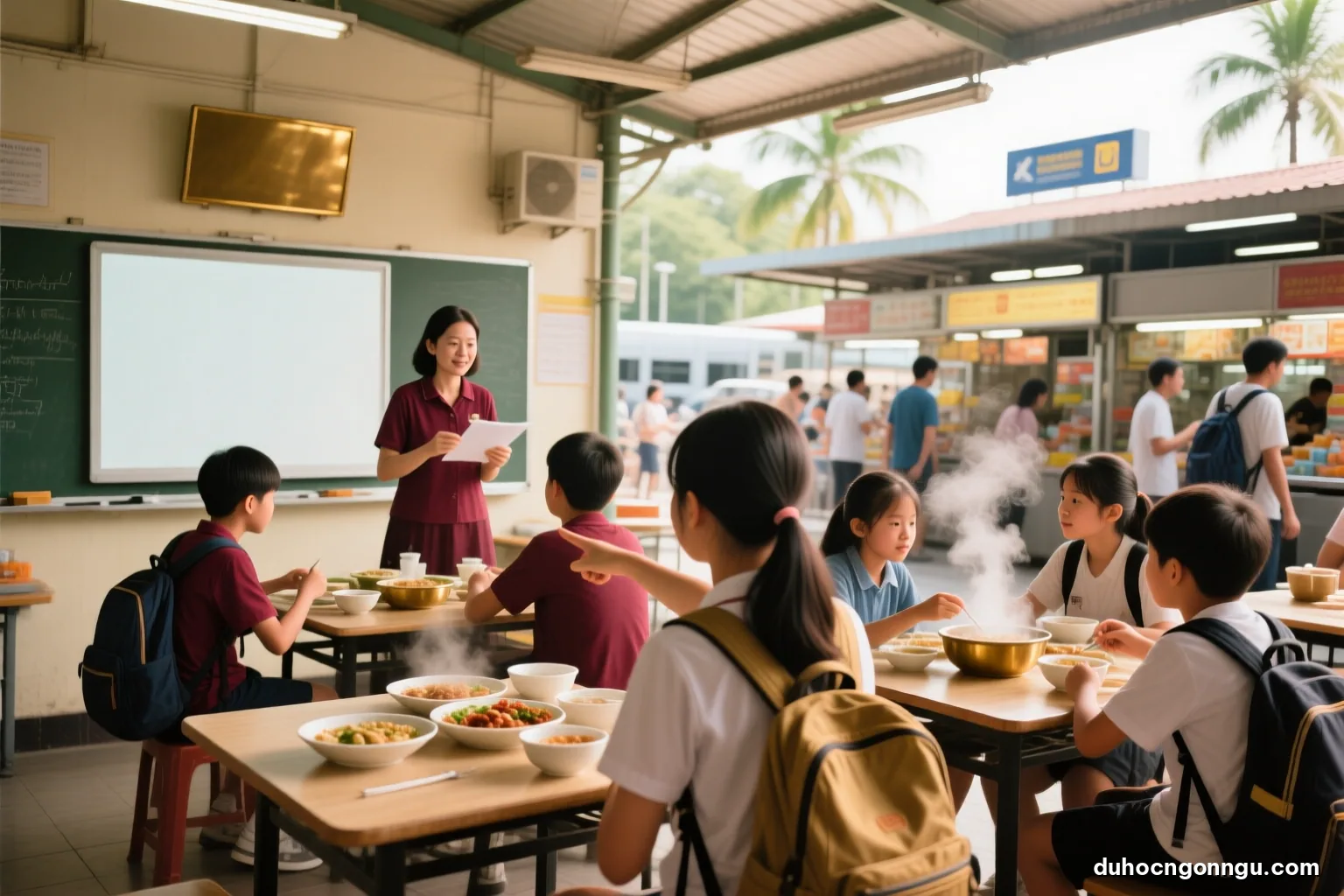
Learning Chinese in Singapore suits families who want their child to use both English and Chinese on the same trip, in an environment that is safe, familiar and close to Vietnam. Singapore teaches Chinese in schools as the mother tongue of ethnic Chinese pupils, using simplified characters and pinyin as on the mainland. But English is the working language and the common language on the street, so the amount of Chinese learners have to use each day is usually smaller than when studying in Taiwan or mainland China.
In other words, Singapore is not the place for the most concentrated "soak" in Chinese, but a place where two languages live side by side. For some children, that is exactly what the family needs; for anyone who wants to speed up their Chinese as fast as possible, it can be a drawback. Below we explain the language background in Singapore, the types of Chinese course foreigners usually come across, how to check a private school, the features of the Chinese spoken there, and how to keep the trip Chinese enough.
The language background: why Chinese in Singapore is different
Singapore has four official languages: English, Malay, Chinese and Tamil. English is the main language of instruction in schools and the common language between communities. Under the bilingual policy, pupils learn English together with a mother tongue; for ethnic Chinese pupils, that is Mandarin. Chinese is therefore present in schools, newspapers and television, but it is not the default language of every conversation.
History has also left its mark. The Chinese community in Singapore used to speak many dialects such as Hokkien, Teochew, Cantonese and Hainanese. In 1979 the government launched the Speak Mandarin Campaign to replace the dialects with Mandarin in daily life. Since the 1970s, schools have used simplified characters and pinyin, as on the mainland.
The result is that learners will hear a Chinese with its own flavour: standard pronunciation on television and in class, but in everyday life plenty of words borrowed from English, Malay and the dialects, and sometimes switching between Chinese and English within a single sentence. For learners this is not an obstacle, but it is worth knowing so as not to be surprised when a stallholder at a food centre speaks differently from the textbook.
The types of Chinese course foreigners usually come across
The table describes general trends. Visa rules and conditions for accepting foreign students depend on the type of course and the length of study.
| Type of course | Usually for | Features | What to check |
|---|---|---|---|
| Language summer camp for children | Primary and secondary school pupils | Usually run during the holidays, combining Chinese with activities, sometimes with English as well | Who supervises, where they stay, the ratio of Chinese to English class hours |
| Chinese classes at a private language school | Adults; some places accept teenagers | Group classes or private lessons by the hour, flexible schedule | Whether the school is registered with the private education regulator |
| Short courses at centres attached to universities | Adults | Evening or weekend classes for working people, rarely designed for foreigners coming for a short course | Whether they accept people not resident in Singapore |
| Private tutoring at home or online | Families living in Singapore for a period | As needed | Whether the tutor has proper training |
The difference from Taiwan and the mainland: Singapore does not have a dense network of university Chinese language centres set up to take foreigners for a term. Short-term Chinese learners in Singapore usually go through a summer camp or a private language school, which makes checking the school all the more important.
Checking a private school before you pay
Singapore regulates private education institutions quite strictly, and most of the information can be looked up publicly. The steps below let the family check in advance, without needing anyone's help.
- Look up the school's name in the list of private education institutions registered with the Committee for Private Education (CPE), part of SkillsFuture Singapore.
- If the course requires the foreign learner to apply for a student pass, check whether the school holds a valid EduTrust certification; schools without it usually cannot take foreign students on this basis.
- Ask whether the specific course is on the school's list of registered courses, because a registered school does not mean every course is permitted.
- Read the student contract: the clauses on refunds, fee protection, changing class and withdrawing.
- Look up the current entry rules of Singapore's Immigration and Checkpoints Authority (ICA) for the specific type and length of course; do not assume that the short-stay visa exemption for ASEAN citizens is enough for studying.
These steps also apply to summer camps run by private schools. For camps where an organiser in Vietnam takes a group over, also ask who the partner organisation in Singapore is and look up that partner in the same way.
Who Singapore suits, and who it does not
Suits: children who need to keep up their English at the same time. A trip where your child uses English for daily life while learning Chinese in class is a way of practising both foreign languages without having to choose one. For children on an enhanced English programme in Vietnam, this is the option with the fewest trade-offs.
Suits: families sending their child away for the first time. Singapore is close, the flight is short, the city's infrastructure and healthcare are good, and English is spoken everywhere. For parents who still worry about safety and staying in touch, it is a comfortable destination for a first trip.
Suits: students learning simplified characters. The script and pinyin are the same as in the materials they are using in Vietnam, so there is no need to switch systems.
Less suitable: learners who want their Chinese to accelerate very quickly. Because it is possible to live entirely in English on the street, learners easily slip into English whenever they get stuck. Anyone who needs many hours of having to use Chinese to get by should consider Taiwan or the mainland.
Less suitable: learners who need to hear a lot of standard Mandarin outside class. Everyday Chinese in Singapore has a clear local flavour. It is not wrong, but it differs from the accent usually heard in exams and in mainland or Taiwanese films.
Keeping the trip Chinese enough
If you have chosen Singapore, the ideas below help increase the amount of real Chinese in the day without losing the bilingual advantage.
- Ask the programme about the ratio of Chinese teaching hours to English teaching hours, and which language the instructors use in afternoon activities.
- Choose accommodation or an area of daily life with many Chinese speakers; many residential areas and markets have older people who are more used to speaking Chinese than English.
- Agree a rule with your child: buy food at the food centre in Chinese, even if the stallholder answers in English.
- Have your child listen to Singapore's Chinese-language radio or watch its Chinese television programmes for a few minutes every day, then retell what they heard in a few sentences.
- Look for activities with local children of the same age, such as sports or art classes taught in Chinese.
- Note down the local words your child hears, then ask the teacher for the standard Mandarin equivalent: learning the words and understanding why there are differences at the same time.
These small steps turn Singapore from a place that "has Chinese" into a place where your child "has to use Chinese" for part of the day. For the rest of the day, English is still practised naturally.
When to go, and the rhythm of Singapore's school year
Singapore's school year has a mid-year break around June and a year-end break from around mid-November to the end of December. Many summer camps and short courses for children run during these two periods. The summer holiday for Vietnamese pupils lasts from late May to August, so it only partly overlaps with Singapore's mid-year break. If your child goes outside Singapore's holidays, they may not meet many local children in activities; if they go during the holidays, camps are busy and places have to be booked early.
The climate is hot and humid all year, with frequent showers; Vietnamese children adapt to this easily. What needs more preparation is the very cold air conditioning indoors, on buses and in classrooms: packing a light jacket for your child is a small thing that is often forgotten.
One more point: Singapore strictly enforces discipline in public places, with rules on littering, eating and drinking on public transport, and smoking. Children travelling alone or in a group should be told about these rules beforehand, both to avoid trouble and as an interesting lesson about life in another society.
Reasonable expectations after a Chinese course in Singapore
Because of the bilingual environment, the clearest result after a short trip to Singapore is usually confidence in using foreign languages in general: your child gets used to switching between two languages, talking to strangers and looking after themselves in a foreign city. English often benefits almost as much as Chinese, sometimes more, because it is the language of daily life. Families who choose Singapore should see this as an advantage, and not be disappointed if their child comes back speaking English more fluently than Chinese.
For Chinese specifically, progress usually shows in listening and speaking everyday sentences and recognising more characters in context. Reading and writing change little in a few weeks, as anywhere. If the camp has classes divided by level with tests at the start and end of the course, ask for both results to see the difference, together with the teacher's comments on each skill.
A useful way of looking at it is to place the Singapore trip within a roadmap of several years: a first trip to a safe, bilingual place so your child gets used to being away from home and sees that Chinese is real in daily life; later trips, when your child is older and has a foundation, to a place where Chinese is more concentrated to speed things up. That way each trip does one job, instead of expecting one trip to do everything.
Frequently asked questions
Can my child take the HSK after studying Chinese in Singapore?
Yes. Materials and writing in Singapore are in simplified characters, which match the HSK. The exam is held in Singapore according to the test centre's schedule. Even so, learners on short courses usually find it more convenient to take the exam in Vietnam after they come back, unless an exam date falls at the end of the course.
Is the Chinese spoken in Singapore "non-standard" Chinese?
The Chinese taught in Singapore's schools and used on its television is Mandarin with simplified characters and pinyin. Everyday speech has many local words and loanwords, just as every Chinese-speaking community has its own flavour. What is learned in class is still standard.
Should my child go to a Chinese camp in Singapore if their English is limited?
They can, but outside Chinese class, most daily life and communication with adults at the camp may be in English. Children who are weak in both languages will find it harder. Ask whether the camp has Vietnamese-speaking support staff or instructors who use Chinese.
Vietnamese citizens are exempt from a Singapore visa, so can my child go there to study?
The short-stay visa exemption is for visiting and tourism. Attending a course may require a separate pass depending on the type and length of the course. Check the ICA's current rules and ask the school in writing before going.
Should we choose Singapore or Taiwan for our child's first Chinese trip?
If your priorities are safety, proximity, keeping up English and continuing with simplified characters, Singapore is more convenient. If your priority is a concentrated Chinese environment and you accept traditional characters, Taiwan gives more hours of real Chinese. Many families go to Singapore first, then choose somewhere else for the next trip.