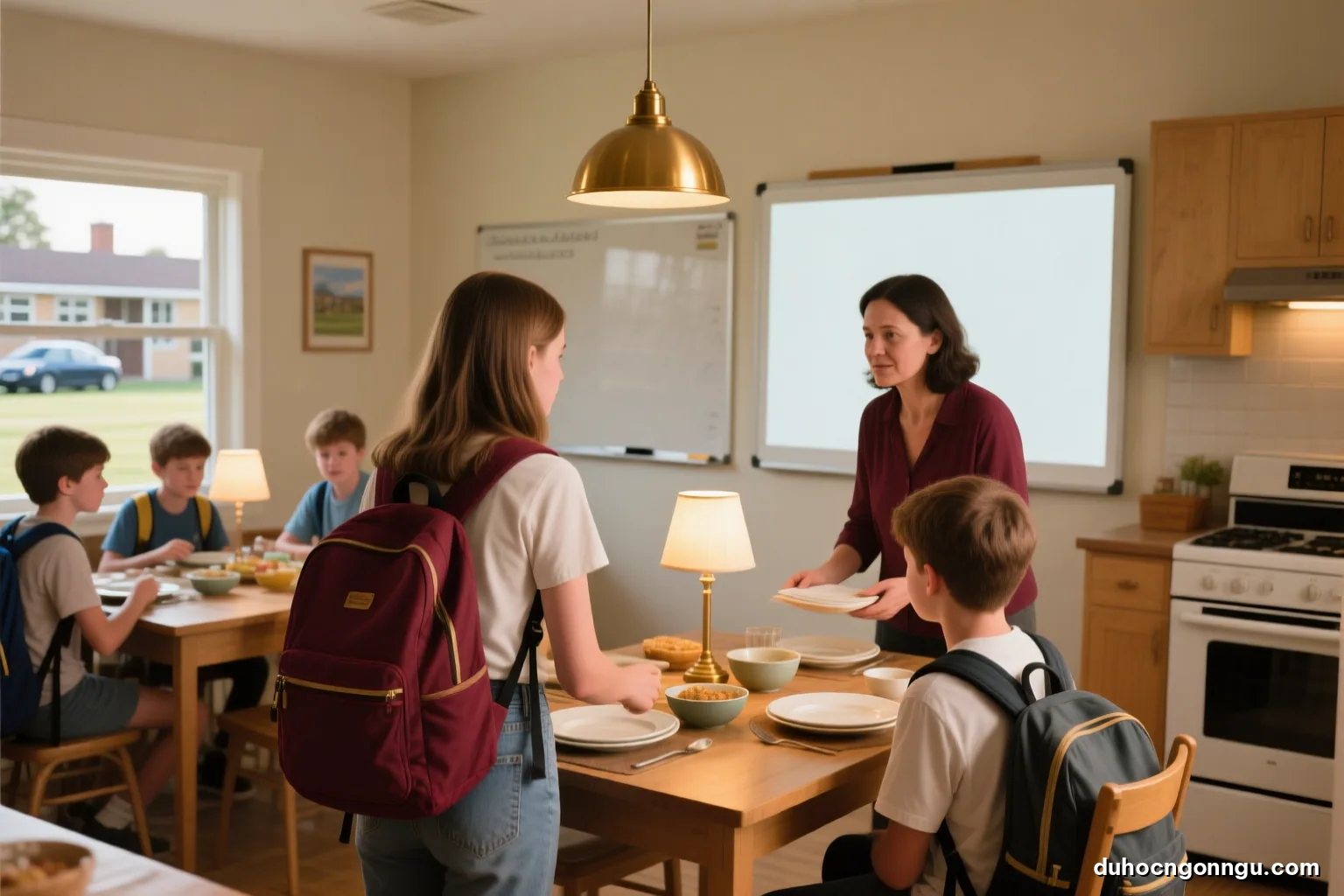
A homestay is an arrangement in which a student lives with a local family while studying, usually with meals included, with the family chosen and checked by the school or a specialist homestay organisation. On a short English course in an English-speaking country, this is usually where your child hears and speaks the most English outside class: dinner, household chores, the small everyday conversations that a classroom does not have.
A good homestay is not a beautiful house or one close to the centre, but a home that has been checked, with adults who genuinely talk to your child, clear rules and a way out if it does not work. This article explains how different countries check host families, the room and meal options, common culture clashes, and what parents should do from a distance.
What a homestay is, and what it is not
A host family takes in a student and receives a fee for accommodation, meals and the care agreed. They are not a hotel, so there is no daily room cleaning or service on request. Nor are they a private nanny: for students under 18, the host has supervisory responsibilities under the school's rules, but does not follow your child around all day.
What a homestay offers is a family routine. Your child sees what a family in another country eats, how they talk to each other and how they divide up the chores. The language your child learns there is everyday language: how to invite, how to decline, how to apologise, how to ask for a favour. These are things that are hard to learn in class, and they are why many families choose a homestay even though a residence is more convenient.
The downside is that the experience depends heavily on one particular family. Two students on the same course at the same school, staying with two different families, can tell completely opposite stories. So the question worth asking is not "is a homestay good?" but "how does the school choose and monitor its host families?".
It is also important to distinguish a school-managed homestay from accommodation found independently through room rental websites. The latter can be cheap and flexible for adults, but there are no background checks, no one in charge to step in when something goes wrong, and it does not meet the care requirements for students under 18. Visa applications for minors also usually require accommodation confirmed by the school.
How different countries check host families
For students under 18, reputable schools in English-speaking countries usually require background checks on the adults in the household through that country's system. The systems listed below are real systems in each country; the specific requirements depend on the school and the rules in force at the time:
| Country | Background check system usually used | Question to ask the school |
|---|---|---|
| UK | Checks by the DBS (Disclosure and Barring Service) | Have all the adults in the household had the appropriate DBS check? |
| Ireland | Garda Vetting, carried out by the National Vetting Bureau of the Irish police | Has the family been through Garda Vetting for hosting students under 18? |
| Malta | A Malta police conduct certificate, as required by the school | Have the adults in the household submitted a conduct certificate to the school, and when was the home inspected? |
| Canada | A police criminal record check, including a type for people working with vulnerable persons | Do the adults in the household have a valid background check? |
| Australia | A Working with Children Check under each state's law | Do the adults in the household hold a valid check of this kind? |
| New Zealand | Police vetting as required by the code of pastoral care for international learners | Has the home been vetted and inspected under the code? |
Besides background checks, serious schools also visit the home before approving it, photograph the room, interview the family and revisit regularly. Ask the school when the home your child will stay in was last visited.
Room and meal options
Before booking, families are usually offered a choice of several options. Understanding each one avoids surprises on arrival:
- Single or twin room: a single room gives more privacy; a twin room is usually shared with another student, sometimes of a different nationality. For young children, some schools only offer single rooms.
- Half board or full board: half board usually includes breakfast and dinner, with lunch bought separately or eaten at school; full board adds a packed lunch on school days.
- Private or shared bathroom: most homestays share a bathroom with the family; private bathrooms are less common and usually have to be requested from the start.
- Distance to school: schools usually state a maximum travel time; in big cities, thirty to forty-five minutes by public transport is normal.
- Special diets: vegetarian diets, allergies and foods avoided for health reasons must be stated clearly when enrolling; some schools charge extra for special diets.
- Whether the family has young children or pets: if your child is allergic to dogs or cats or is afraid of pets, say so beforehand, because many families in these countries keep pets indoors.
The more clearly you state your child's wishes and limits, the better the school can match them with a suitable family. Do not hesitate to mention things that seem small, such as your child being used to going to bed early, or liking spicy food.
Common culture clashes in the first week
Showers and hot water. In many homes hot water is limited and shared by the whole household. A long evening shower can leave the next person without hot water. Ask the host about suitable shower times and a reasonable length.
The kitchen and food. Not every home lets students cook for themselves; strong-smelling food such as spicy instant noodles may make hosts uncomfortable. Ask in advance when you can use the kitchen and whether there is a shelf in the fridge for you.
Laundry. Many homes do laundry on a schedule, once or twice a week, or only let students use the washing machine on certain days. Your child should ask on the very first day.
Times and letting people know. Coming home late without a message is what worries hosts most, especially with minors. A simple rule: if your time of return changes, send a message beforehand.
Silence is not politeness. In many Western cultures, very short answers or going straight to your room after eating are taken as a sign of being unhappy or not liking the family. Staying at the table for a few minutes after dinner and sharing something from the day is a simple way to bond and practise speaking.
Saying thank you and asking permission. Ask before taking food, using the family's things or inviting friends over. Hosts are usually happy to agree, but they expect to be asked.
The first 48 hours in a homestay: what your child should do
The first two days have a big influence on whether your child feels comfortable or awkward for the rest of the stay. A short list for your child to keep in mind:
- Greet the whole family and remember everyone's name, including young children and pets; ask again if they did not catch it, nobody minds.
- Ask about the main rules on the first evening: mealtimes, shower times, laundry, curfew, how to lock the door, wifi.
- Send parents a short message to say they have arrived, then put the phone away during dinner.
- Ask the host or someone from the school to show them the way to school, ideally doing the journey once before the first day of class.
- Give the small gift they brought, and tell the family a little about their own family and city using photos.
- If something feels uncomfortable, note it down and wait until the third day before deciding whether to tell anyone; many strange feelings go away once they have had enough sleep.
This list sounds simple, but it gives your child concrete things to do while they are tired from the flight and everything feels unfamiliar. Parents can read it with their child before departure, so they know that feeling awkward on the first day is something everyone goes through.
When to ask for a different family, and how
There are two different groups of problems. The first is not getting on: unfamiliar food, a home far from school, a family that talks little, your child feeling lonely. With this group, give your child at least a few days to adjust, try talking politely and directly with the host, and only then tell the school's homestay coordinator if things do not improve. Many issues are resolved with a single conversation.
The second group is about safety and rights: your child is not given enough to eat, the room is not as agreed, an adult in the household behaves inappropriately, your child is asked to do unreasonable work, or anything at all makes your child afraid. With this group, do not wait: your child should tell the school's coordinator or the school's emergency number immediately, and parents should contact the school at the same time.
Schools with a procedure for changing families will state how long it usually takes and what it costs, if anything. Ask about this before booking. Tell your child that asking to move is not a failure or a sign of ingratitude; it is a student's right when an arrangement does not work, and schools are used to handling it.
What parents can do from a distance
Parents in Vietnam can help their child a lot without taking away the chance to become independent:
- Agree on fixed call times, for example two or three times a week, instead of calling several times a day; calling too often can make your child more homesick and leave less time for the host family.
- Save the school's emergency contact number, the name and number of the homestay coordinator, and the host family's address.
- When your child complains, ask for specific details before drawing conclusions; distinguish ordinary discomfort from a safety issue.
- Send a small gift with a Vietnamese touch for the host family, along with a few family photos so your child has things to talk about.
- Do not contact the host directly to complain without going through the school; the school holds the agreement and has a procedure for dealing with problems.
Whether your child is ready for a homestay usually shows at home: do they get up by themselves, pack their own things, ask strangers for help when needed? If not, you could choose a supervised residence for the first trip and a homestay for the next.
Frequently asked questions
Is a homestay or a residence better for a 12-year-old?
There is no single answer. A supervised boarding residence offers close supervision and suits children travelling far for the first time. A homestay gives more hours of English conversation but demands more independence. Many schools only accept homestay students from around 12–14; ask the specific school for its minimum age.
Can we see information about the host family in advance?
Most schools send a host family profile about one to two weeks before departure, including the household members, their jobs, pets, the distance to school and sometimes photos. The timing differs from school to school. If you have not received it, ask the school directly.
Can two siblings stay in the same homestay?
Usually yes, if booked from the start and both are within the accepted age range. Staying together is reassuring, but siblings easily speak Vietnamese to each other at home. Many families have their two children stay in two homes close to each other, at the same school, to get both reassurance and an English-speaking environment.
What should my child do if they feel homesick in the homestay?
Homesickness in the first few days is normal. Keep to a regular call schedule, encourage your child to take part in school activities, and let them tell the host that they are missing home. If it goes on and affects eating and sleeping, tell the school's student welfare staff so they can provide support.
Can my child use the internet freely in a homestay?
Most homes have wifi, but each family has its own rules on when it can be used, especially for young students. Agree with your child beforehand to limit phone use at mealtimes and in the evening, because that is when there are the most chances to communicate in English.
Do we need to bring a gift for the host family?
It is not required, but a small, light gift with a Vietnamese touch often helps start a conversation. Avoid fresh food or items that may be restricted by customs in the destination country. More important than any gift is saying thank you and behaving well throughout the stay.